Quick answer
Often yes, but usually from zoning, not the building department. The model building code skips the building permit for fences 7 feet or lower. Many cities still require a fence or zoning permit and cap heights by yard, with lower limits in front. Jacksonville, Florida, for example, allows 4 feet in a front yard. Pool fences have extra rules.
Key facts
- Section R105.2 of the 2024 International Residential Code exempts fences up to 7 feet tall from a building permit, but it doesn't exempt them from zoning.
- Front yard fence limits are usually lower than side and rear limits. Jacksonville, Florida allows 4 feet in a required front yard, and Louisville, Kentucky allows 6 feet in a required side yard. A taller fence needs a variance or similar approval.
- Federal pool safety guidelines call for a barrier at least 48 inches high with gates that close and latch on their own.
- In 2026 meeting records, boards granted some taller fences and denied others: an 8-foot security fence passed 4-0, while a fence-and-wall combination neighbors put at about 14 feet was denied.
Do I need a permit for a fence? Usually yes, but the permit most people need comes from zoning, not the building department. The model building code that most U.S. cities adopt skips the building permit for fences 7 feet tall or lower. Many cities still require a separate fence or zoning permit, and they set height limits by yard, usually lower in the front yard than in the side and back. Pool fences and corner lots can come with extra rules, and your homeowners association may add its own.
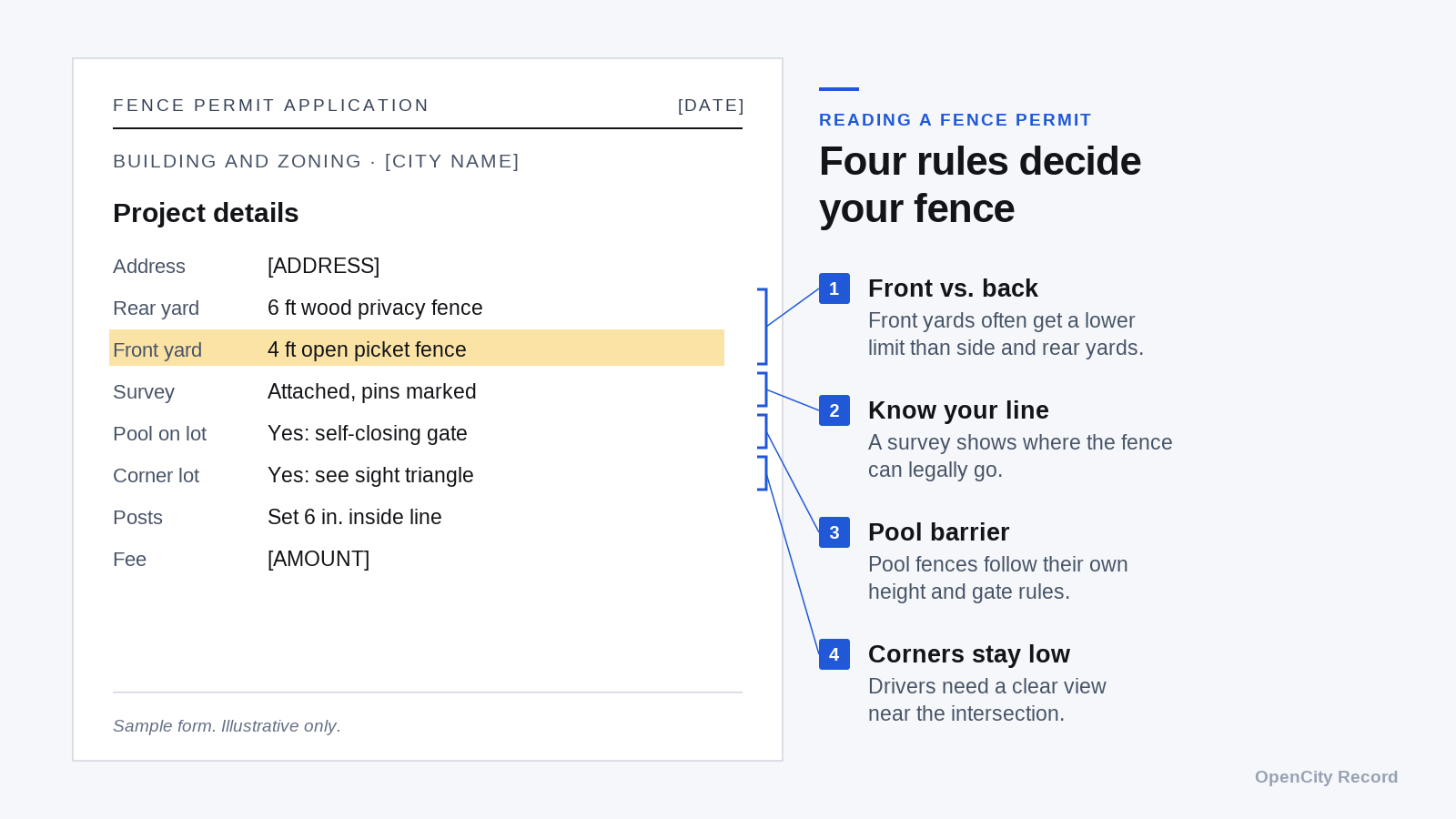 A fence can skip the building permit and still need zoning approval.
Do you need a building permit for a fence?
Usually not, if the fence is 7 feet or lower. Section R105.2 of the 2024 International Residential Code (IRC) lists "fences not over 7 feet" as work that doesn't need a building permit. Most U.S. cities use the IRC as their building code, sometimes with local changes, so check which edition and changes your city uses.
The same section says an exemption doesn't allow work that breaks any other local law. That's where zoning comes in. A 6-foot fence can skip the building permit and still break the zoning rule for front yards, which is why some cities run a separate fence permit through their zoning office.
What height can a fence be in a front yard vs. a back yard?
Zoning codes treat the front yard differently because it faces the street. A short or open fence there keeps sight lines clear for drivers and keeps the street looking open. Side and rear yards get more room for privacy.
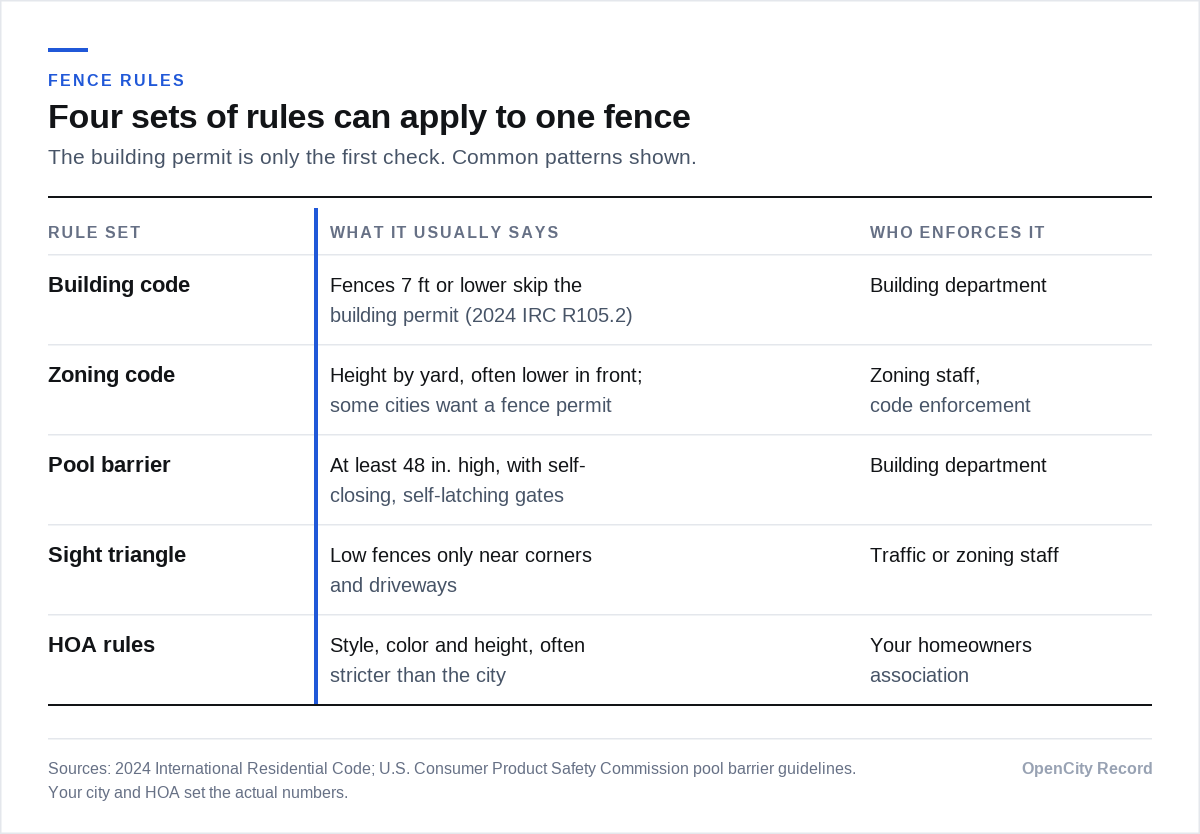 The building code is only the first check. Zoning, pool rules and your HOA can each say no.
Real codes show the pattern. Jacksonville, Florida's zoning code limits fences in a required front yard to 4 feet, according to city staff at a June 16, 2026 meeting of the Land Use and Zoning Committee. Louisville, Kentucky allows 6 feet in a required side yard, according to staff at the Board of Zoning Adjustment's Aug. 3, 2026 hearing. Your city's numbers may differ, so read your own code.
Corner lots may have a sight triangle, a zone near the intersection where fences, walls and hedges must stay low so drivers can see each other. Check your city's code for its size and height limit.
What are the rules for a pool fence?
Pool barriers are a safety rule, not a looks rule, so they're stricter. The U.S. Consumer Product Safety Commission's guidelines call for a barrier at least 48 inches high, gates that open away from the pool, and gates that close and latch on their own. Many cities write similar rules into their codes, often through the model swimming pool code, which the IRC points to for pools. If your fence doubles as the pool barrier, it has to meet both sets of rules.
What happens when you want a taller fence?
You ask for a variance or a special exception, and a board decides at a public hearing. Boards say yes and no, and the reason for the fence matters. Four 2026 cases show the range:
- In Louisville, Kentucky, a credit union asked to put up an 8-foot chain-link fence where 6 feet is the limit, after gas was siphoned and catalytic converters were stolen from its lot. The Board of Zoning Adjustment approved it 4-0 on Aug. 3, 2026.
- Clark County, Nevada's Planning Commission denied a fence height waiver on April 7, 2026 after neighbors objected. A neighbor testified the 6-foot block wall and the fence on top of it stood about 14 feet. The meeting record lists the vote as 7-0.
- In Jacksonville, Florida, the Land Use and Zoning Committee voted 6-0 on June 16, 2026 to recommend letting an existing 8-foot fence stand in a required front yard, according to the meeting recording. The fence sat about 80 feet back from the street, and the full City Council makes the final call.
- Fort Worth, Texas's Board of Adjustment approved a 6-foot fence in a projected front yard 12-0 on Oct. 21, 2026, according to the meeting recording. At the same meeting, it denied a 20-foot fence and net structure 12-0.
The approvals had a clear reason, like theft or a fence set far from the street. The denials drew neighbor objections or asked for far more height. To read cases like these from your own board, search recent meetings for fence variances.
How do you check your city's fence rules?
- Find the zoning code section on fences and walls. It's usually under accessory structures or general development standards.
- Note the limits for each yard, any sight triangle rule and any limits on materials.
- Ask the zoning office whether you need a fence permit, and what drawing to bring. Some offices ask for a simple site plan with the fence line and heights.
- Confirm your property line. A survey is the best proof if a neighbor disputes the line later.
- Read your HOA rules, which can be stricter than the city's.
- Call 811 before you dig post holes so buried utility lines get marked for free.
To see when your council last changed fence or setback rules, find your city and open its recent meetings.
This is general information, not legal advice. Check your city's code and your state's law before you build.
New in your city
See what’s being built in your city
Rezonings, site plans, subdivisions and variances show up on city agendas weeks before the bulldozers do. Pick your city to see the development applications on its agendas, such as rezonings, site plans, subdivisions and variances, with the status of each. It lists the whole city; it does not search by address.
Find your cityCommon questions
How tall can a fence be without a permit?
Under the model building code, a fence 7 feet or lower needs no building permit. Your zoning code still sets the height you can build, usually with a lower limit in the front yard, and some cities require a fence permit at any height.
Do I need a permit to replace an existing fence?
It depends on your city. Ask the zoning office whether a same-size replacement needs a permit, and expect one if you change the height or location.
Can I build a fence right on the property line?
It depends on your city's code and your HOA rules, and either way you need to know exactly where the line is. A survey with marked pins is the safest proof.
What are the rules for a pool fence?
Federal guidelines call for a barrier at least 48 inches high with self-closing, self-latching gates that open away from the pool. Many cities write similar rules into their codes, often through the model swimming pool code.
What happens if I build a fence without a permit?
The city can order you to get an after-the-fact permit, pay extra fees, or lower or move the fence. It can come up through a neighbor complaint or when you sell the house.
Sources
- 2024 International Residential Code, Chapter 1: Scope and Administration · International Code Council
- Safety Barrier Guidelines for Residential Pools (Publication 362) · U.S. Consumer Product Safety Commission
- Louisville Board of Zoning Adjustment, Aug. 3, 2026 · OpenCity Record
- Clark County Planning Commission, April 7, 2026 · OpenCity Record
- Jacksonville Land Use and Zoning Committee, June 16, 2026 · OpenCity Record
Keep reading
- GuideDo I Need a Building Permit? A Project-by-Project GuideDo I need a permit for a fence, shed, deck, roof or water heater? See the usual rule for 13 home projects, the 2024 IRC limits and how to check your city.
- GuideSetback Requirements Explained (with Diagram)Setback requirements set how close a building can sit to your property lines. See how front, side and rear setbacks are measured and what can go in them.
- GuideHow to Get a Zoning Variance: Steps, Hardship Test and VotesHow to get a zoning variance: the hardship test boards use, use vs. area variances, the application steps, vote rules and real board decisions.
- GuideHow to Read a Site Plan (Annotated Example)Learn how to read a site plan with an annotated example: north arrow, scale, property lines, setbacks, easements, utilities, drainage and parking.
- GuideDo I Need a Permit for a Shed or Garage?Small one-story sheds often skip the building permit, but garages, big sheds and any wiring need one. See the size limits, setbacks and how to check.
- GuideHow to Look Up Permits on a PropertyHow to look up permits on a property: search the right city or county portal by address, read each status and request older records that aren't online.