Quick answer
Planning and development is how your city decides what gets built and where. The comprehensive plan sets long-range goals, the planning commission reviews projects and advises the council, and staff checks plats, site plans and permits against the code. These guides explain each step and how to follow projects near you.
Planning and development is how your city or county decides what gets built, where and when. A long-range comprehensive plan sets the goals. A planning commission of appointed residents holds hearings and advises the council. Planning staff reviews plats, site plans and permits against the code. Every one of those steps leaves a public record, and these guides show you how to read it, so you can see a project coming long before the bulldozers do.
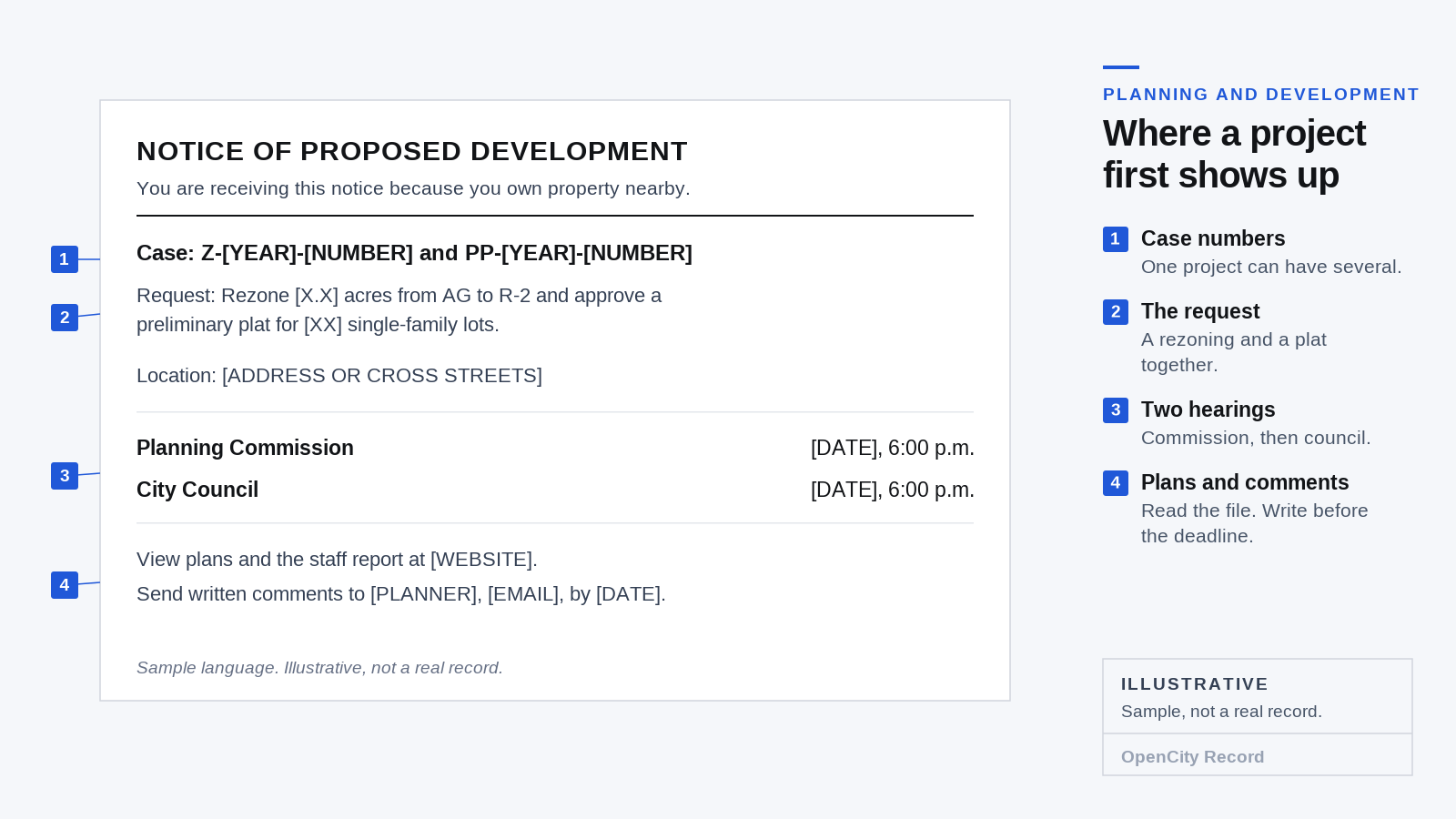 The notice in your mailbox is often the first sign of a project. It points to every record that follows.
How does planning and development work?
Many projects follow a similar path. A builder meets with city staff, files an application and goes through review by planning, engineering, fire and utility departments. If the project fits the zoning, staff or the planning commission can often approve the site plan or plat. If it doesn't fit, it needs a rezoning or special permit, with public hearings before the planning commission and then the council.
Behind every decision sits the comprehensive plan, the city's long-range map of what it wants each area to become. Boards cite it when they approve or deny a project. In Pinal County, Arizona, the planning commission voted 8-0 on Oct. 15, 2026 to recommend denying a plan amendment for one project, while recommending approval of amendments for others at the same meeting.
Where should you start?
Start with the planning commission guide if you're new to how local development works. Then pick the guide for the step you care about. If you'd rather see your own city first, find your city and open its latest planning agenda.
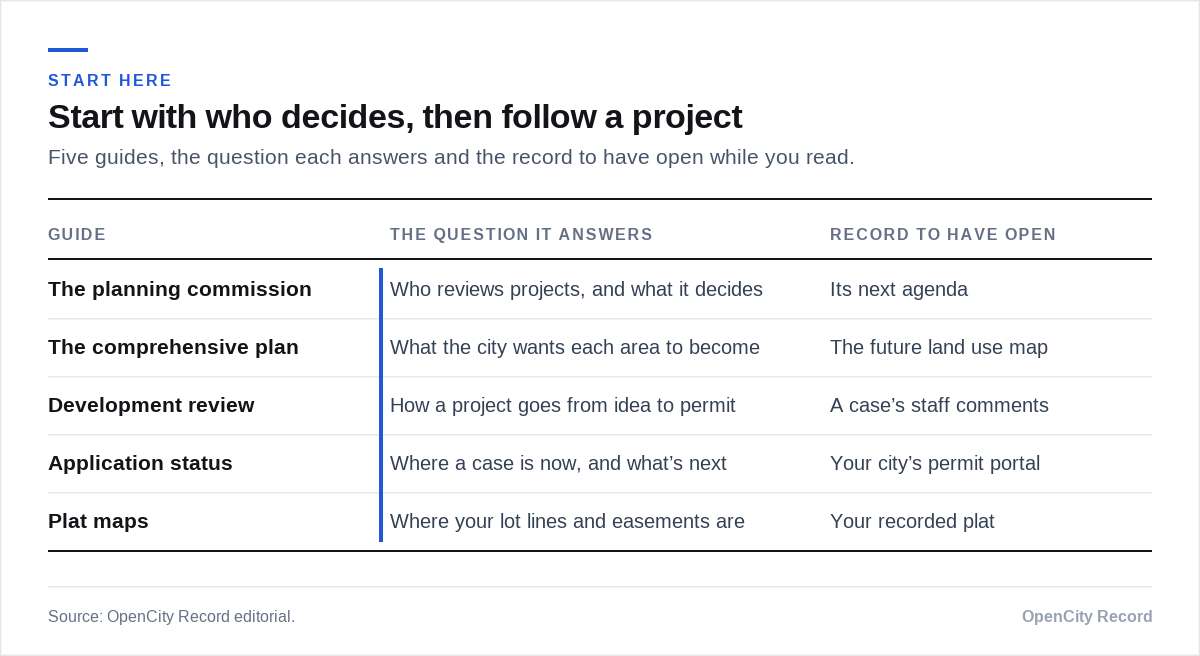 Start with who decides, then follow a project from plan to plat.
- What does the planning commission do? explains the board that hears most development cases, what it decides on its own and what it only recommends.
- Comprehensive plans explained covers the long-range plan, the future land use map and why a rezoning that conflicts with it faces an uphill fight.
- The development review process, step by step walks a project from the pre-application meeting to building permits, with real timelines.
- How to check development application status shows how to find a case, read portal status terms and follow it across meetings.
- How to read a plat map decodes lot lines, bearings, easements and building lines on the map that created your lot.
What can the meeting record tell you?
A lot more than a portal status. The agenda and staff report show what the city was asked to approve and what staff thought of it. The video and transcript show what the applicant, neighbors and board members said. The minutes show the motion, the vote and any conditions. OpenCity Record puts those together for the 2,232 cities it covers, so you can follow one project from its first hearing to its final vote.
That record matters most when a case drags on. A case can be held over more than once before a vote, and each delay moves the date you need to show up. In Kansas City, Missouri, a rezoning and 200-lot subdivision had come before a council committee three times when it was held again on Sept. 29, 2026. Prince George's County, Maryland's council passed two bills on Oct. 27, 2026 to let some development approvals be considered at the same time, one sign that the length of review is itself a live debate. To see what your city is reviewing now, search recent meetings for site plans.
Where do you go from here?
Planning connects to the rest of the library. The zoning guides explain rezonings, variances and district rules in detail, and our guide on how to oppose a zoning change covers what persuades a board. If you're buying a home, see how to find out what's planned near a property. If you want to speak at a hearing, start with how to speak at a council meeting.
New in your city
See what’s being built in your city
Rezonings, site plans, subdivisions and variances show up on city agendas weeks before the bulldozers do. Pick your city to see the development applications on its agendas, such as rezonings, site plans, subdivisions and variances, with the status of each. It lists the whole city; it does not search by address.
Find your cityCommon questions
What is the difference between planning and zoning?
Planning sets long-range goals for how a city should grow, mostly through the comprehensive plan. Zoning is the law that applies those goals lot by lot today. Rezonings are often judged by whether they fit the plan, and some states, such as North Carolina, require the board to say so in writing.
Who approves new development in my city?
It depends on the project and the state. Designated staff can approve many simpler permits. The planning commission usually advises the council on plans and zoning, and in some places it decides certain cases itself. The city council or county board usually makes the final call on rezonings and plan changes.
How can I find out what's being built near me?
Watch for notice signs and mailed notices, check your city's permit or planning portal and read planning commission agendas. OpenCity can alert you when projects near your address show up on an agenda.
Sources
- Standard State Zoning Enabling Act and Standard City Planning Enabling Act · American Planning Association
- Planning Commissions · MRSC
- Permit Review · MRSC
- G.S. 160D-605: Governing board statement · North Carolina General Assembly