Quick answer
A zoning variance is permission to break one rule in your zoning code, such as a setback or height limit, because your property has an unusual condition. You apply to the board of adjustment, the city notifies neighbors, and you prove hardship at a public hearing. Boards grant some requests and deny others, so a strong case matters.
Key facts
- Many boards use a version of a four-part hardship test: an unusual condition of the land, a problem the owner didn't create, the minimum relief needed, and no harm to neighbors or the public.
- The variance process traces back to the Standard State Zoning Enabling Act, a 1920s Commerce Department model law that created the board of adjustment.
- Use variances, which change what land can be used for, are much harder to get than area variances, and some states and cities don't allow them.
- Vote rules and court deadlines vary by state. Some states require a majority of all board members, some require more, and court deadlines run from 10 to 90 days in the states we compared.
A zoning variance lets you break one specific rule in your city's zoning code, such as a setback requirement, a height limit or a sign size, because something about your property makes the rule unfair to apply. To get one, you file an application with your board of adjustment (some places call it the zoning board of appeals), the city notifies nearby property owners, and you prove hardship at a public hearing. Boards grant some requests and deny others, so the case you bring matters more than the form you fill out.
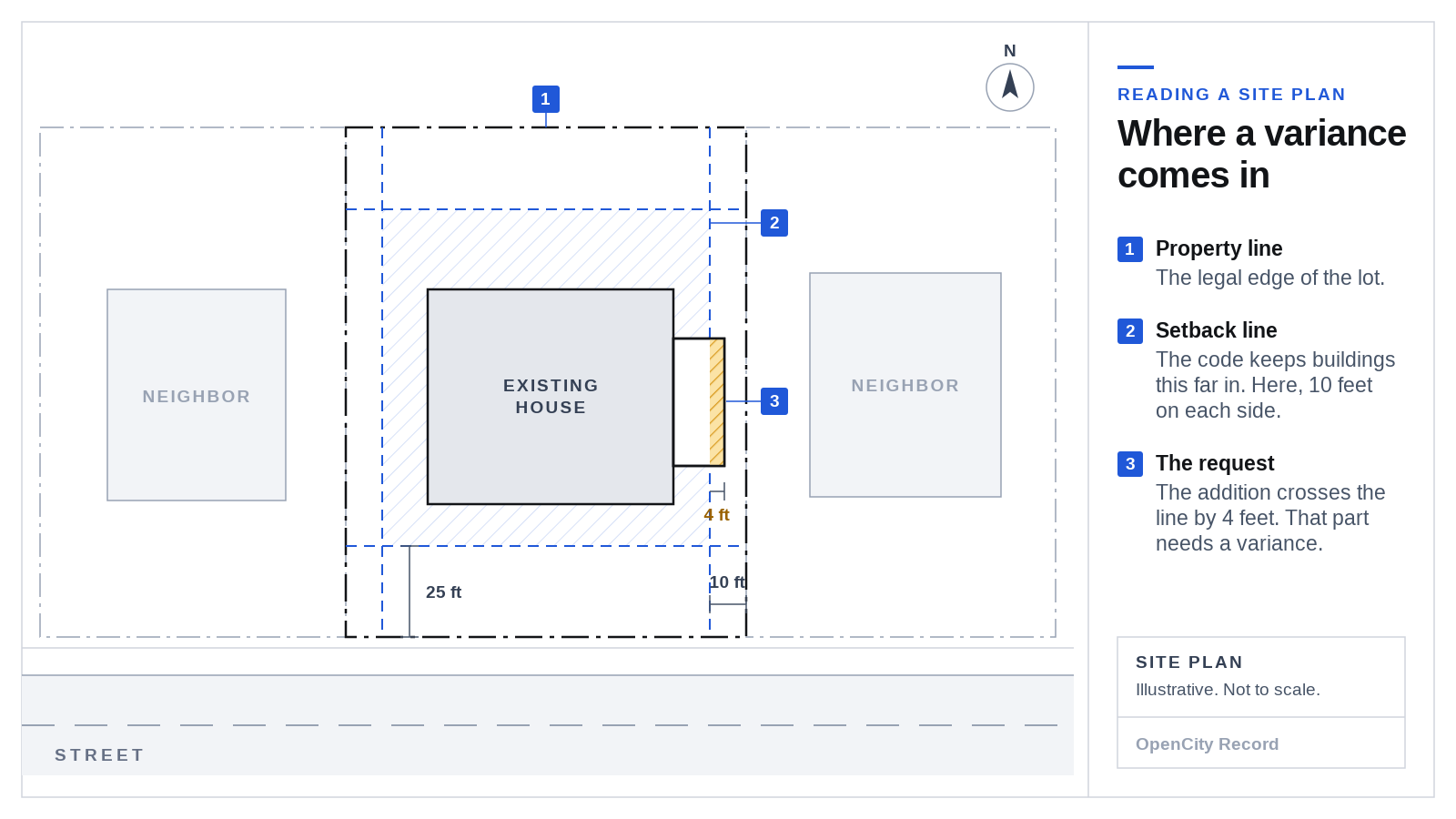
Most variances are small: a few feet past a setback line on one lot, while the rule stays the same for everyone else.
What is a zoning variance?
Every zoning district comes with regulations that set how close a house can sit to the street, how tall a building can be and how many parking spaces a store needs. A variance is a one-time exception to one of those requirements for one property, so it doesn't change the zoning map and it doesn't change the rule for anyone else.
The idea is about a century old. In the 1920s, the U.S. Department of Commerce published the Standard State Zoning Enabling Act, a model law that many states used as a template for their own zoning statutes. It created a board of adjustment that could grant a variance when strict enforcement would cause "unnecessary hardship," as long as the variance wasn't contrary to the public interest. Many states still use some version of that language.
In many states, variances run with the land, which means that if you sell, the next owner keeps the taller fence or the garage that sits a few feet closer to the side property line. Some state laws and city codes void a variance if it isn't used within a set time, so read your approval letter closely and note any deadline in it.
A variance is not a rezoning, which changes the district itself, and it's not a conditional use permit, which allows a use the code already lists as possible with approval. Our guide to variance vs. rezoning explains when you need which one.
What's the difference between a use variance and an area variance?
Most requests are area variances, which bend a size or placement rule. Use variances are rare because they let one owner do something that a rezoning, with its wider public process, would normally decide.
| Area variance | Use variance | |
|---|---|---|
| What it bends | A size or placement rule: setback, height, lot coverage, parking, sign size | What the land can be used for |
| Example | A garage 5 feet from the side line where the code says 10 | A small office in a house zoned single-family |
| How hard | Hard, but boards grant them | Much harder; some states and cities ban them |
| Usual test | Practical difficulty, weighed case by case | Unnecessary hardship, with every part required |
Some states give area variances a softer "practical difficulty" test and save the strict hardship test for use variances. One state, for example, makes a use-variance applicant prove with financial evidence that the land can't earn a reasonable return under any use the zoning allows, while its boards weigh five factors for an area variance.
What counts as a hardship for a variance?
Boards across the country use versions of the same four-part test, so check your request against each part before you pay an application fee.
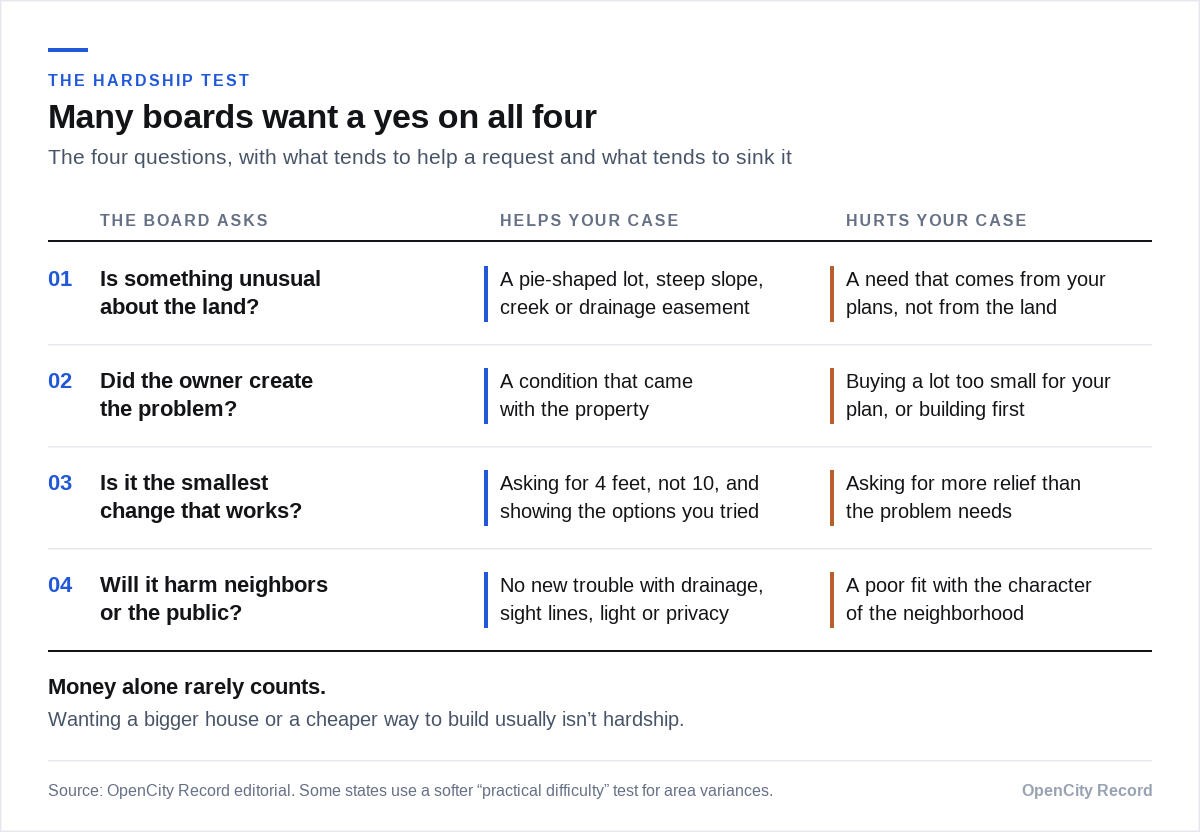
Many boards want a yes on all four parts of the hardship test, and money alone rarely passes.
The first question is about the physical land, such as a pie-shaped lot on a cul-de-sac, a steep slope, or a creek or drainage easement that takes up half the buildable area. The condition has to belong to the property, not to your plans for it.
Next, the board asks who created the problem. If you bought a narrow lot knowing your house plan wouldn't fit, or built first and asked for permission later, most boards will call the hardship self-created and deny the request.
The board will also weigh the size of the request. It's more likely to grant 4 feet of relief from a setback requirement than 10, so show the smaller options you tried and explain why each one falls short.
Last, the board looks past your property line. Members will consider drainage, sight lines at street corners, light and privacy next door, and whether the change fits the character of the neighborhood.
Money alone usually isn't enough, and in many places wanting a bigger house or a cheaper way to build doesn't count as hardship. A few states write extra factors into their zoning laws, so read your state's statute and your city's code before you draft your answers.
How do you apply for a zoning variance?
The steps below follow the order most cities use, though your local code sets the exact deadlines, fees and notice rules.
- Find the exact requirement. Look up your zoning district and the code section your project would break, then measure how far off you are. Our guide on how to find the zoning of a property shows where to look.
- Talk to zoning staff before you file. Some cities offer a pre-application meeting where staff can tell you whether you need a variance at all, or whether a smaller fix, like an administrative adjustment, is allowed.
- Build your evidence. You'll want a survey or a site plan drawn to scale, photos of the condition that causes the hardship, and a written answer to each criterion in your code. If plans are new to you, see how to read a site plan.
- Submit the application and pay the fee, which varies a lot from city to city.
- Wait for notice to go out. The city mails notices to nearby property owners, publishes the hearing date and, in some places, posts a sign on your property. Your code sets the distance and the deadline for each.
- Read the staff report as soon as it's posted. It lays out the facts and often recommends approval or denial, but the board of adjustment doesn't have to follow it.
- Make your case at the public hearing. You present first, residents speak for or against, and board members ask questions, so keep your case short and tie every point to a criterion.
- Count the votes you need. Many states require a majority of the board's full membership rather than a majority of the members present, and some require a supermajority, so an empty seat can work like a no vote.
- Plan for what comes after. An approval still leaves you needing building permits. After a denial, the deadline to challenge the decision in court is short and set by state law, so mark it on your calendar the day the decision is filed.
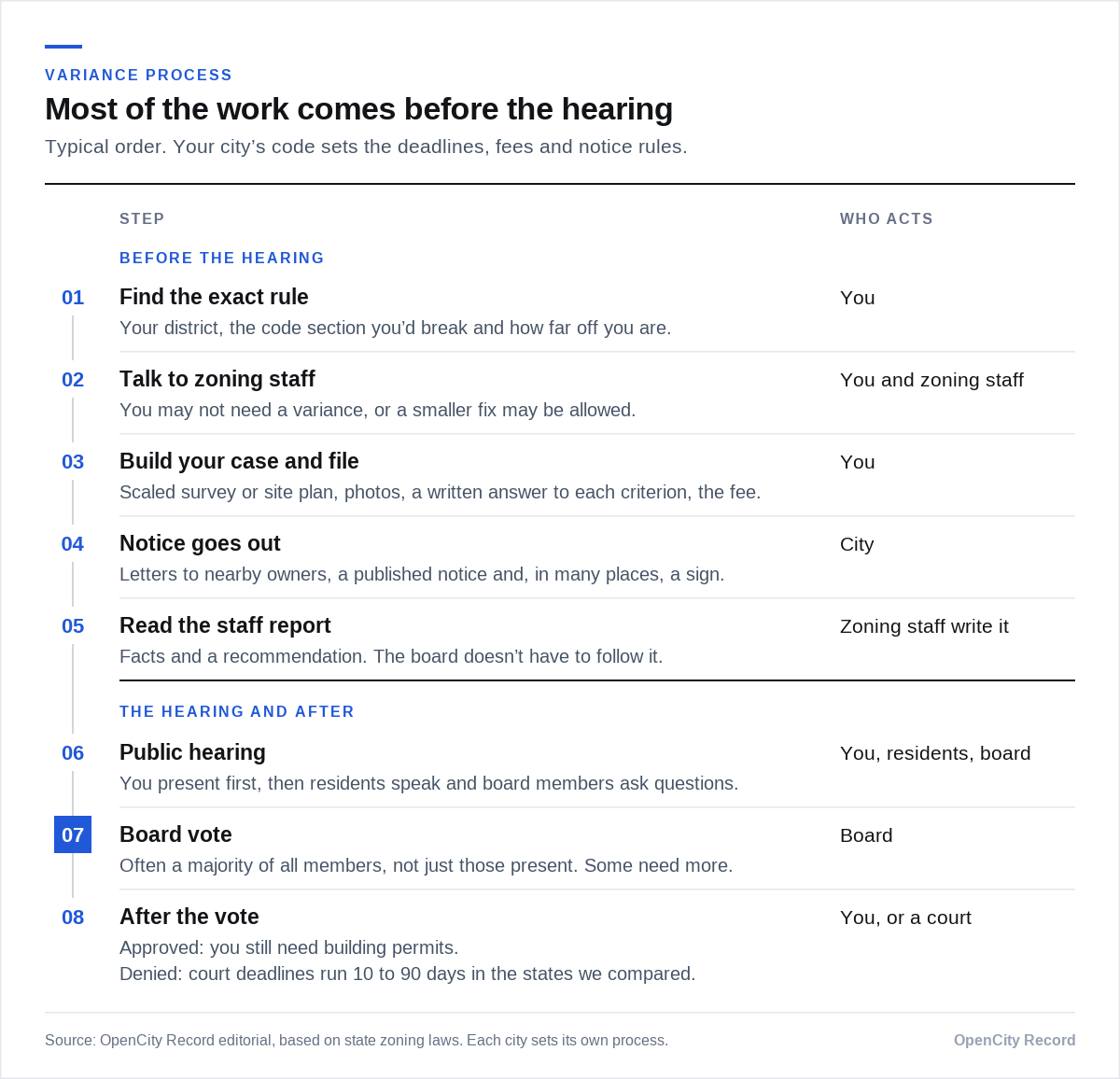
From application to vote, most of the work happens before the hearing, when you build your case for each criterion.
How many votes does a variance need, and how long do you have to appeal?
Both depend on your state. Some states write the vote and the court deadline into their zoning law, while others leave the vote to each city. Here are common patterns from six state laws we compared.
| What state law sets | Common patterns |
|---|---|
| Who decides | Usually a board of adjustment or zoning board of appeals; some states let a zoning administrator or hearing examiner decide |
| Votes needed to grant | A majority of all board members, not just those present, in some states; a supermajority in others, such as 75% of the members, or four of five on a five-member board; left to local ordinance in others |
| Deadline to challenge in court | 10 to 90 days, with several states at 20 to 30 days |
| When the clock starts | When the decision is filed with the clerk or the board's office, when it's issued, or when the written decision is signed or the minutes are approved |
Two lessons carry across states. A rule that counts all members, not just those present, means attendance matters on hearing night. And court deadlines are short, from 10 days to 90 days in the states we compared, so check your state's law and talk to a lawyer quickly if you think the board got it wrong.
Who decides: the board of adjustment or the city council?
In most cities, a board of adjustment or zoning board of appeals hears variance requests, and its members are residents appointed by the city council. The board works more like a court than a legislature, because it applies the criteria in the code to the facts in front of it instead of writing new policy. Some cities and counties hand variances to a hearing examiner, a single official who runs the hearing and writes the decision.
Some city councils hear certain variances themselves, such as the sign variance in Mission, Texas, below. In some cities, the planning commission hears small variances. The examples below went to a city council, two boards and a planning commission. Find your city to see its recent board and council agendas.
What do real variance votes look like?
These four decisions from four states in 2026 come from OpenCity's meeting records. They show what a variance vote looks like at a real meeting, though the rules behind them differ from state to state.
From the record
Four variance votes from 2026
- Approved 5-0
Mission, TX
City Council ·
Approved a 100-foot pylon sign at a gas station, 20 feet taller than the 80-foot maximum in the city code. City staff had recommended denial.
- Approved 5-0
Las Vegas, NV
Planning Commission ·
Approved a patio cover 5 feet from the corner side lot line, where 10 feet is required, even though staff had recommended denial.
From the meeting recording. The official minutes were not yet published.
- Denied 5-0
Nashville, TN
Board of Zoning Appeals ·
Denied a street setback variance for a new single-family home. Members said the owner had not shown a hardship and could fit the house to the lot.
From the meeting recording. The official minutes were not yet published.
- Denied 3-1
Louisville, KY
Board of Zoning Adjustment ·
Denied a variance for a raised porch near the sidewalk after a motion to approve it tied 2-2. The owner can still build a smaller porch that meets the code.
Two of these owners got a yes over a staff recommendation of denial, which shows that staff advice isn't the final word. The two denials make a useful pair, too. Both owners wanted to build closer to the street. In each case, the board said the project could be redesigned to fit.
How often are zoning variances approved?
We don't know of a national count of variance decisions, because each board keeps its own minutes and most never total them up. OpenCity hasn't yet published a count of its own records that others can reproduce, so this guide doesn't give a rate. The examples above show boards granting some requests and denying others, sometimes against the staff recommendation.
Any count from meeting records would also miss requests that never reached a vote because the owner withdrew the application or redesigned the project first. To see how your own board votes, read its recent minutes or search recent meetings for variance requests.
How long does a variance take?
Plan on at least one full meeting cycle plus the public notice period. If your board meets once a month, the application deadline can fall weeks before the meeting so the city has time to mail and publish notice. A board can also continue your case to a later meeting if it wants more information, which adds a month when the board meets monthly.
How can you improve your odds at the hearing?
- Answer every criterion in writing, in the same order your code lists them, so board members can follow along.
- Bring a scaled drawing that shows the exact relief you need from the setback requirement or height limit, in feet and inches.
- Show the alternatives you tried, and explain why each one doesn't work on your property.
- Talk to your neighbors before the public notice arrives in their mailbox, because a signed letter of support from the house next door carries weight.
- Lead with the condition of the land, not with cost or convenience.
- If staff recommends denial, answer their reasons one by one in your presentation.
What happens if your variance is denied?
If the board says no, you still have a few paths. You can ask a court to review the decision, but the deadline is short and set by your state, as the table above shows. You can redesign the project so it needs less relief, or none, and apply again after checking whether your city makes you wait before refiling the same request. Or you can ask the city council to change the ordinance itself through a text amendment, or to rezone the property.
This is general information, not legal or tax advice.
New in your city
See what’s being built in your city
Rezonings, site plans, subdivisions and variances show up on city agendas weeks before the bulldozers do. Pick your city to see the development applications on its agendas, such as rezonings, site plans, subdivisions and variances, with the status of each. It lists the whole city; it does not search by address.
Find your cityCommon questions
What is the hardship test for a zoning variance?
Many boards ask four things. Does the property have an unusual physical condition? Did the owner create the problem? Is this the smallest change that solves it? Would it harm neighbors or the public? Wanting more space or a cheaper build usually doesn't count as hardship.
What's the difference between a use variance and an area variance?
An area variance bends a size or placement rule, like a setback, a height limit or a sign size. A use variance lets you do something the zone doesn't allow, like run a shop in a residential district. Use variances are much harder to get, and some states and cities don't allow them at all.
How many votes does a variance need?
It depends on your state and city. Many states require a majority of the board's full membership, so an absent member works like a no vote. Some require more, such as 75% of the members or four of five.
Does a variance stay with the property if I sell?
Usually, yes. A variance generally runs with the land, so the next owner keeps it. Some cities void a variance that isn't used within a set time, so read the approval letter and your local code.
Can I appeal a denied variance?
Yes, in court, but the deadline is short and set by state law. In the states we compared, it ran from 10 to 90 days, and several gave 20 to 30 days. You can also redesign the project and apply again.
How often are zoning variances approved?
We don't know of a national count, because each board keeps its own minutes. Meeting records show boards both granting and denying variances, and they can't see requests dropped before a hearing. Your own board's recent minutes are the best guide to how it votes.
Sources
- Standard State Zoning Enabling Act and Standard City Planning Enabling Act · American Planning Association
- Variance Standards: What is hardship? And when is it unnecessary? · UNC School of Government
- Town Law §267-b: Permitted action by board of appeals · New York State Senate
- Town Law §267-a: Board of appeals procedure · New York State Senate
- Town Law §267-c: Judicial review · New York State Senate
- Government Code §65009: Time limits for challenges to land use decisions · California Legislative Information
- General Laws c. 40A §15: Board of appeals hearings and votes · Massachusetts Legislature
- General Laws c. 40A §17: Judicial review · Massachusetts Legislature
- MCL 125.3603: Zoning board of appeals; concurring vote · Michigan Legislature
- MCL 125.3606: Appeal to circuit court · Michigan Legislature
- Local Government Code, Chapter 211: Municipal Zoning Authority · Texas Legislature
- RCW 36.70C.040: Commencement of review, land use petition · Washington State Legislature
Keep reading
- GuideVariance vs. Rezoning: Which One Do You Need?A variance bends one zoning rule for one lot. A rezoning changes the zoning itself. Learn which you need, who decides, and how neighbors can weigh in.
- GuideConditional Use Permits vs. Special Use PermitsA conditional use permit and a special use permit are usually the same tool. Compare names and rules by state, the approval steps and real votes.
- GuideHow to Find the Zoning of Any PropertyHow to find zoning of a property: look up the address on the city zoning map, decode the district, read the rules and get a verification letter.
- GuideHow Rezoning Works: Process, Timeline and CostsRezoning explained: each step from application to council vote, how long it takes, what cities charge, and how neighbors can weigh in or protest.
- GuideHow to Read a Site Plan (Annotated Example)Learn how to read a site plan with an annotated example: north arrow, scale, property lines, setbacks, easements, utilities, drainage and parking.
- GuideCan I Build an ADU? Accessory Dwelling Unit Rules ExplainedCan you build an ADU? Learn how accessory dwelling unit rules on size, parking, owner occupancy and permits work, and how to check your city's rules.