Quick answer
Not always. The model building code skips the permit for a one-story detached shed of 200 square feet or less, but some cities use a smaller limit, such as 120 square feet. A detached garage, a bigger shed or any wiring or plumbing needs a permit. Zoning setbacks and height limits apply either way.
Key facts
- Section R105.2 of the 2024 International Residential Code exempts one-story detached accessory structures up to 200 square feet from a building permit.
- Local limits vary. Local codes we checked set the shed limit at 120 or 128 square feet, and one county allows 400.
- New wiring or plumbing in a shed isn't on the model code's exempt list. Running power to a shed needs an electrical permit even when the shed itself doesn't need a building permit.
- An exempt shed still has to meet zoning setbacks, height limits and any cap on total accessory building size.
Do I need a permit for a shed? Not always. The model building code most U.S. cities use skips the building permit for a one-story detached shed of 200 square feet or less. Some cities set a smaller limit, so a 10-by-14-foot shed can be fine in one town and need a permit in the next. A detached garage, a bigger workshop or any shed with new wiring or plumbing usually needs a permit. Zoning rules on setbacks and height apply even when no building permit does.
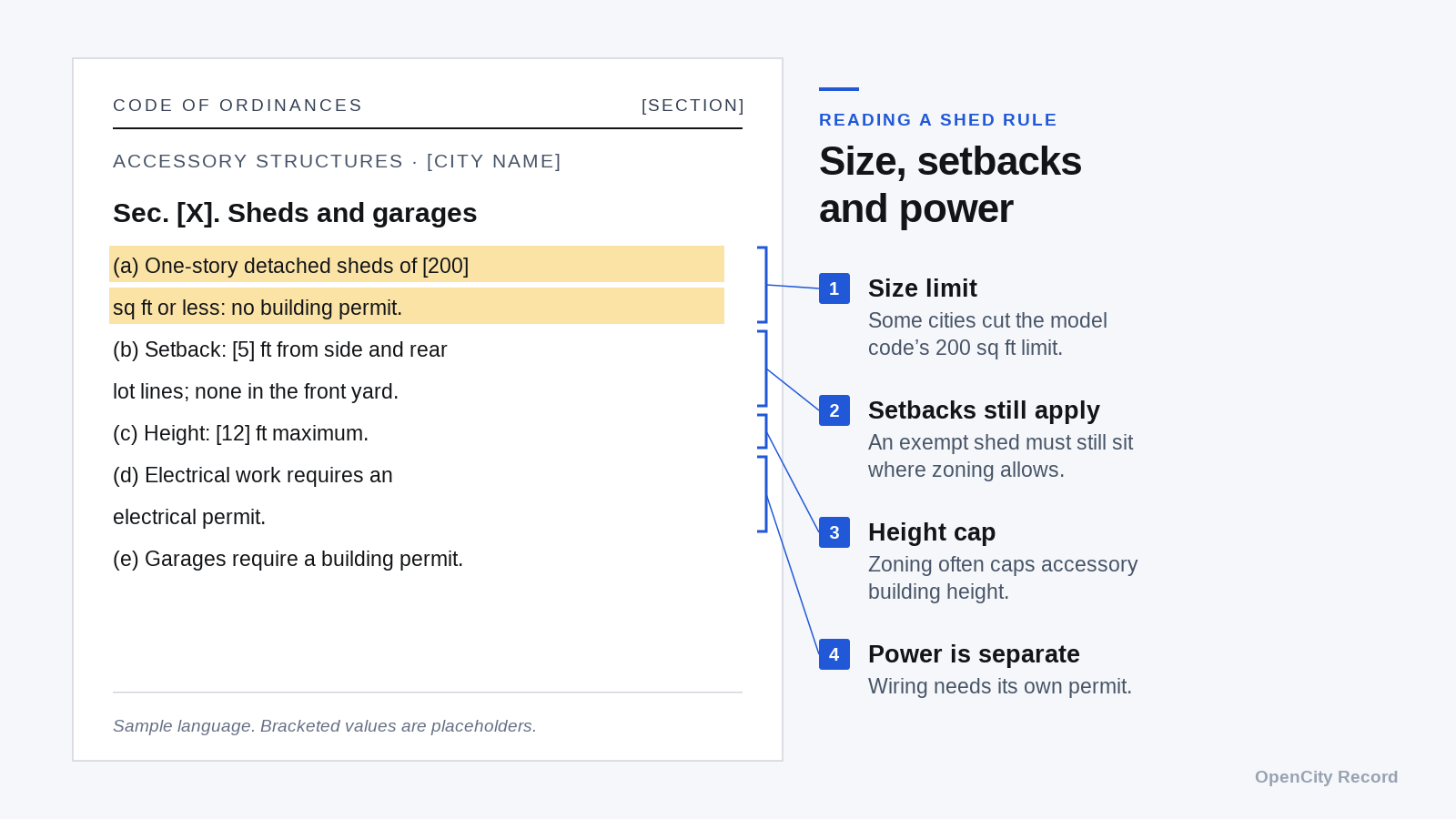 The size limit decides the building permit. Zoning decides where the shed can go.
What size shed can you build without a permit?
Section R105.2 of the 2024 International Residential Code lists "one-story detached accessory structures" up to 200 square feet as exempt from a building permit. Storm shelters are left out of that exemption. "Accessory" means it supports the main house: a shed, a playhouse, a small workshop.
Cities and counties change that number when they adopt the code. Local codes we checked set the limit at 120 or 128 square feet, and one county allows 400. So measure the outside footprint, and look up your own city's list of work exempt from permit before you buy a kit.
Do you need a permit for a garage?
Usually. A garage big enough for one car, say 12 by 20 feet, is 240 square feet, which is already past the model limit. Garages also tend to have a slab foundation, a wide door opening, wiring and sometimes a wall shared with the house, and all of that needs plan review and inspections.
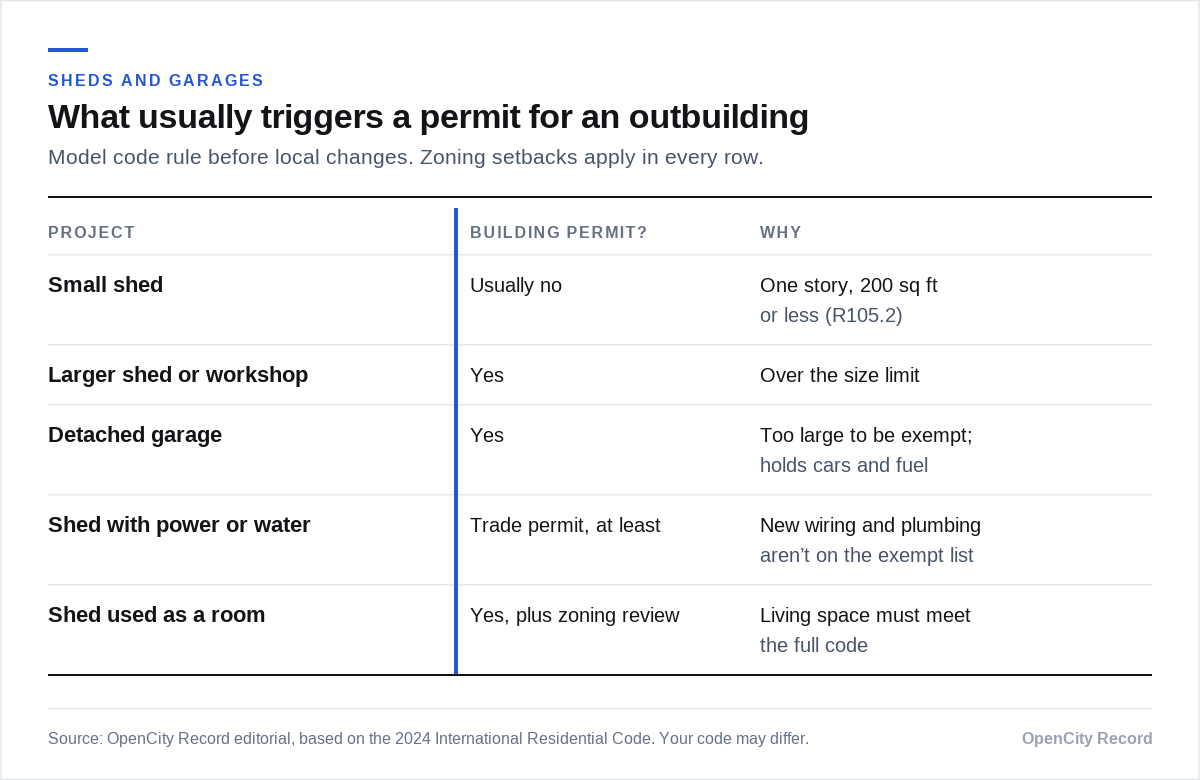 Size, wiring and how you use the space are what usually trigger a permit.
Zoning adds its own limits. Some codes cap the floor area of a detached garage or of all accessory buildings combined. In the Town of Brookhaven, New York, the record of the Board of Zoning Appeals' Oct. 21, 2026 meeting cites a 600-square-foot allowance for a detached garage, and the board voted 7-0 to deny a side yard variance for a proposed 672-square-foot garage.
What zoning rules apply to a shed?
Even an exempt shed has to meet zoning. Check four things:
- Setbacks. Your code may keep sheds out of the front yard and set a minimum distance from side and rear lot lines.
- Height. Accessory buildings may have a lower height cap than the house.
- Total size and number. Some codes limit how many accessory buildings you can have or their combined floor area.
- Easements. Utility and drainage easements, often along the back lot line, can be off limits to any structure.
What do shed and garage cases look like at a hearing?
When a shed doesn't fit the rules, the owner asks for a variance, and a board decides in public. Meeting records from 2026 show how these cases go:
- On May 12, 2026, the Las Vegas Planning Commission voted 7-0 to approve a variance for a proposed shed that didn't meet the city's setback and separation standards, even though staff found no hardship that would justify it.
- At a Jan. 22, 2026 hearing in Polk County, Florida, an owner asked the county's land use hearing officer to cut a rear shed setback from 10 feet to 2 feet. Tenants had placed the sheds in 2023, and code enforcement cited the owner. The hearing officer said a written decision would follow.
- On Oct. 6, 2026, the Lewisville, Texas Planning and Zoning Commission voted 4-0 to recommend a special use permit for a 750-square-foot wood carving workshop on a lot of about four-tenths of an acre.
The Polk County case shows one way a shed comes to light: a code enforcement citation, then a request to legalize it. To read cases like these from your own board, search recent meetings for accessory structures.
How do you check your city's shed rules?
- Search your city's website for "work exempt from permit." Some building departments post a one-page list with the shed size limit.
- Look up your zoning district and the accessory structure section of the code for setbacks, height and size caps.
- Check your plat or survey for easements before you pick a spot.
- Plan the wiring now. If you'll want lights or outlets later, the electrical permit is easier before the walls are finished.
- Read your HOA rules, which may limit size, color or location.
To see which code edition your council adopted, find your city and search its recent meetings. If a shed went up without a needed permit, our guide to unpermitted work explains how to fix it.
This is general information, not legal advice. Check your city's code and your state's law before you build.
New in your city
See what’s being built in your city
Rezonings, site plans, subdivisions and variances show up on city agendas weeks before the bulldozers do. Pick your city to see the development applications on its agendas, such as rezonings, site plans, subdivisions and variances, with the status of each. It lists the whole city; it does not search by address.
Find your cityCommon questions
What size shed can I build without a permit?
Under the 2024 model code, a one-story detached shed of 200 square feet or less needs no building permit. Some cities lower that to 120 square feet or so. Check your city's list of work exempt from permit before you buy a kit.
Do I need a permit for a detached garage?
Usually. A one-car garage is bigger than the model code's 200-square-foot limit, it often has a slab, a large door and wiring, and zoning rules control where it can sit and how big it can be. A few local codes allow more; one county exempts garages up to 400 square feet.
Does a shed on skids or blocks need a permit?
Usually the same rules apply. The model code's limit is about floor area and stories, not the foundation, and a shed you can move can still count as a structure for zoning setbacks. Check your city's code.
How close to the property line can I put a shed?
Your zoning code sets it, usually in its section on accessory structures. Utility easements along the back of a lot can also be off limits.
Do I need a permit to run electricity to a shed?
Yes. New wiring isn't on the model code's exempt list, so power to a shed needs an electrical permit and an inspection, even if the shed itself didn't need a building permit.
Sources
- 2024 International Residential Code, Chapter 1: Scope and Administration · International Code Council
- Aurora City Code Sec. 22-184: Residential code amendments · City of Aurora, Colorado
- Clallam County Code 21.01.045: Work exempt from permit · Clallam County, Washington
- International Residential Code (local amendments) · City of Aberdeen, Washington
- Town Code 7-1-2: Building code amendments · Town of Fountain Hills, Arizona
- Las Vegas Planning Commission, May 12, 2026 · OpenCity Record
- Brookhaven Board of Zoning Appeals, Oct. 21, 2026 · OpenCity Record
Keep reading
- GuideDo I Need a Building Permit? A Project-by-Project GuideDo I need a permit for a fence, shed, deck, roof or water heater? See the usual rule for 13 home projects, the 2024 IRC limits and how to check your city.
- GuideSetback Requirements Explained (with Diagram)Setback requirements set how close a building can sit to your property lines. See how front, side and rear setbacks are measured and what can go in them.
- GuideCan I Build an ADU? Accessory Dwelling Unit Rules ExplainedCan you build an ADU? Learn how accessory dwelling unit rules on size, parking, owner occupancy and permits work, and how to check your city's rules.
- GuideDo I Need a Permit for a Fence?Fences up to 7 feet skip the model code's building permit, but zoning may still require a fence permit. See how height limits work by yard.
- GuideUnpermitted Work: Risks, Buying a House With It and How to Legalize ItWhat unpermitted work can cost you in a sale, an appraisal or a code case, what buyers should check, and how to legalize it with an after-the-fact permit.
- GuideHow to Look Up Permits on a PropertyHow to look up permits on a property: search the right city or county portal by address, read each status and request older records that aren't online.