Quick answer
Setback requirements are the minimum distances a building must keep from each property line. Your zoning district sets a front, side and rear setback, usually measured from the property line, not the curb. The space inside those lines is where you can build. Fences, eaves and some small structures may be allowed in a setback, depending on your code.
Key facts
- Setbacks are usually measured from the property line, which can sit several feet behind the curb or sidewalk.
- Each zoning district sets its own front, side and rear setbacks, and corner lots may have two front setbacks.
- The U.S. Supreme Court upheld a city's front setback line in Gorieb v. Fox in 1927, one year after it upheld zoning itself.
- A plat can show its own building lines on top of the zoning setbacks, so check both before you build.
- If a setback doesn't fit your lot, the usual fix is a variance from the board of adjustment, or a special exception where the code allows one.
Setback requirements are the minimum distances a building has to keep from each edge of a lot. Your zoning district sets a front setback, a side setback and a rear setback, and together they draw an invisible box inside your property lines. You can build inside the box. Outside it, the code limits what can go, from a garage to an air conditioner. The trick is knowing where the property line really is, because the setback is usually measured from there, not from the curb.
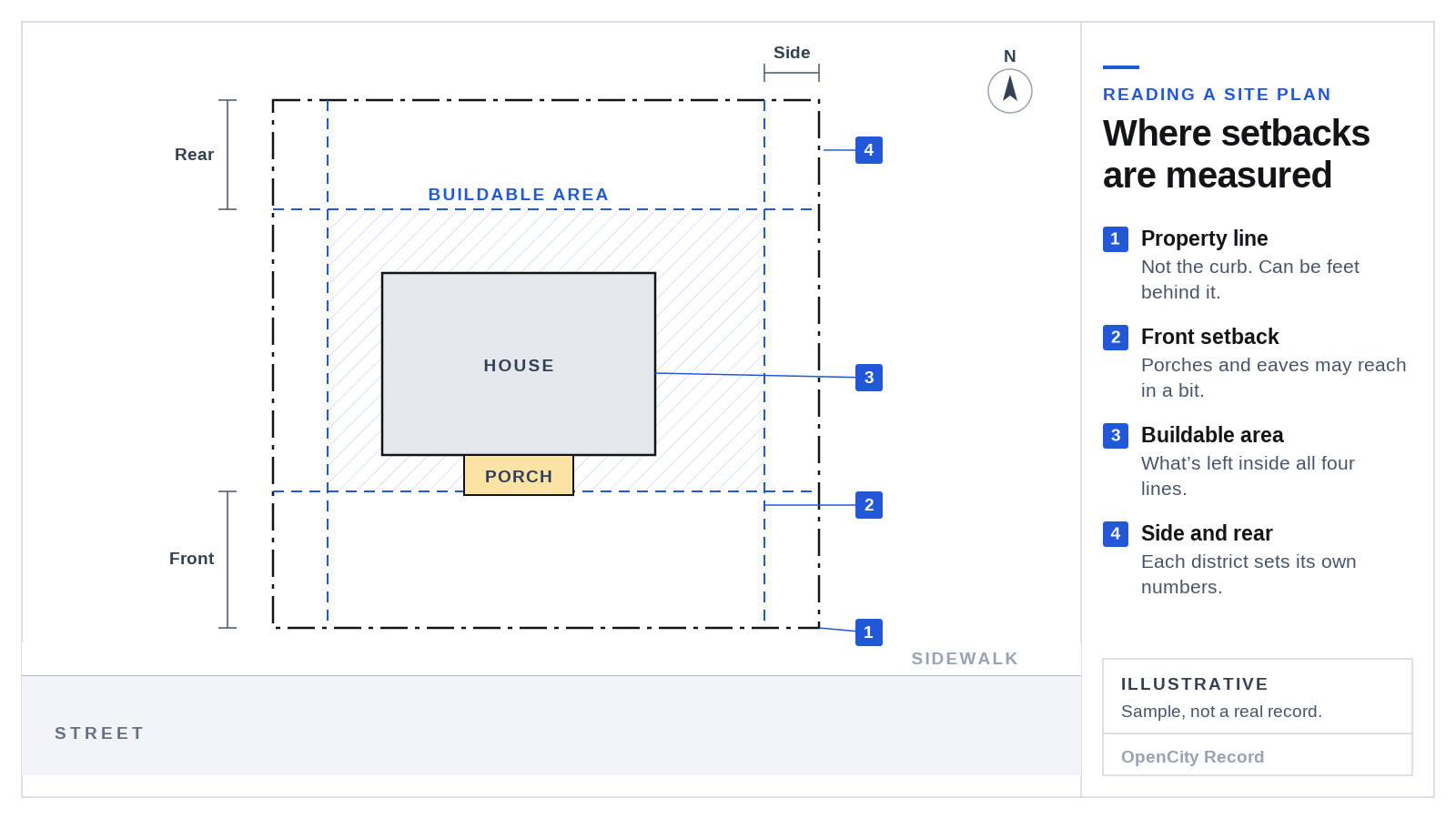
The hatched area is where the house can go. Everything between it and the property line is setback.
What are setback requirements?
A setback is a line drawn a set distance inside the property line. The zoning code says no building can cross it. Front setbacks keep a line of houses back from the street, side setbacks leave room for light, air, access and fire safety between neighbors, and rear setbacks protect backyards.
Setbacks are one of the oldest zoning tools. In 1927, in Gorieb v. Fox, the U.S. Supreme Court upheld a city's power to require buildings to stay behind a front setback line. The Court had upheld zoning itself the year before.
Your zoning district sets the numbers. A large-lot single-family district usually has bigger setbacks than a downtown district, where buildings often sit right at the sidewalk. Our guide to R-1 zoning shows where the setbacks sit in a typical district's rules.
How are setbacks measured?
In many codes, from the property line. That surprises a lot of homeowners, because the property line can sit several feet behind the curb. The strip between the curb and your yard, where the sidewalk and utility poles sit, can be public right-of-way. Some codes measure the front setback from the center of the street instead, so check how your code defines it.
A few rules come up in many codes:
- The front setback is measured from the front property line. On a corner lot, some codes treat both street sides as fronts, which shrinks the buildable area.
- Side setbacks apply on each side.
- The rear setback is measured from the back property line, and some codes allow smaller rear setbacks for detached garages.
- A recorded plat may show its own building line. If the plat line and the zoning setback differ, check both, since you may have to meet the stricter one.
To find your lines, start with a survey or your plat map, then match the numbers in your district's section of the code.
What can go in a setback?
Many codes allow some things to sit in a setback and limit others. The list below shows examples from real codes, but your code may treat each one differently.
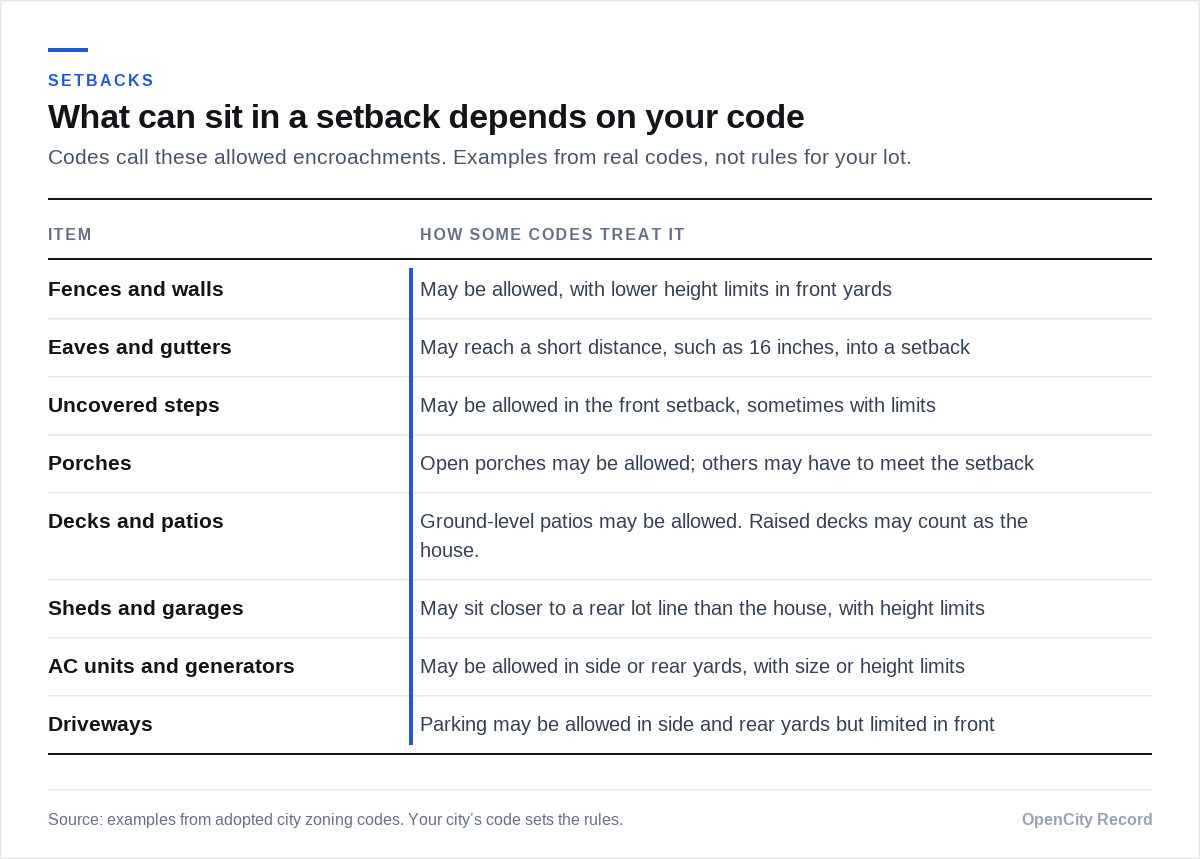
Codes call these allowed encroachments. Each city writes its own list and limits.
What happens when a building doesn't meet the setback?
There are three common situations.
If an older house was built legally before today's setback rule, it's usually nonconforming. It can stay as it is, but adding on may be limited.
If you want to build into a setback, you usually need a variance from the board of adjustment or zoning appeals. Boards look hard at whether the lot itself causes the problem, and the results go both ways:
- Nashville's Board of Zoning Appeals voted 4-0 on Feb. 19, 2026 to let a building on a corner lot with unusual dimensions sit 80 feet back from one of its streets, where the rule called for about 125 feet. The owner had asked for 60 feet, and the board settled on 80.
- The Las Vegas Planning Commission voted 5-0 on Sept. 8, 2026 to deny a setback variance for a shed that was already built.
- At a June 25, 2026 hearing in Polk County, Fla., a homeowner asked to cut a rear setback from 15 feet to 10 to roof over a screened patio. County staff recommended approval, noting that the county had approved roughly 54 variances in that community and a neighboring one since 2020. There, a hearing officer decides in a written order instead of a board vote.
Some codes skip the variance for common cases and offer a simpler special exception, with set standards, for things like carports in the front setback. Ask your planning staff whether your project fits one.
Do setbacks apply to big projects too?
Yes, and they can be among the most debated parts of a large case. Distance from homes can be a key condition on industrial projects. Fort Worth's City Council approved a zoning change for a data center with an on-site electrical substation 7-4 on Aug. 25, 2026, after amending it to double the building setback from 150 feet to 300 feet, according to its minutes. For examples near you, search recent meetings for setback decisions or find your city.
This is general information, not legal advice. Your city's adopted code and any recorded plat set the lines that apply to your lot.
New in your city
See what’s being built in your city
Rezonings, site plans, subdivisions and variances show up on city agendas weeks before the bulldozers do. Pick your city to see the development applications on its agendas, such as rezonings, site plans, subdivisions and variances, with the status of each. It lists the whole city; it does not search by address.
Find your cityCommon questions
Where is a setback measured from?
Usually from the property line, not the curb, the sidewalk or the edge of the street. The property line can sit several feet behind the curb. Some codes measure the front setback from the center of the street instead, so check your code's definitions. A survey or your plat shows where the property line is.
What is a typical side yard setback?
It depends on the district and the city. Your district's section of the zoning code lists the exact front, side and rear numbers.
Can I put a fence in my setback?
Often yes, but with height limits. Some codes allow taller fences or walls in side and rear yards than in the front yard. Check your code's fence section before you build.
Do setbacks apply to sheds and decks?
Often yes, though some codes let small accessory buildings sit closer to a rear lot line than the house. Decks may count as part of the house once they rise above a set height. Check the accessory structure section of your code.
What happens if my house already sits inside the setback?
If it was built legally before the current rule, it's usually treated as nonconforming and can stay. Rules for expanding or rebuilding it vary, and some cities make you meet the current setback if you rebuild.
How do I get permission to build in a setback?
Apply for a variance from your board of adjustment, or a special exception if your code offers one for your situation. You'll need to show why the rule doesn't fit your lot, at a public hearing.
Sources
- Gorieb v. Fox, 274 U.S. 603 (1927) · Legal Information Institute, Cornell Law School
- Zoning · Legal Information Institute, Cornell Law School
- Variance · Legal Information Institute, Cornell Law School
- Development Regulations and Zoning · MRSC
- Nonconforming Uses · MRSC
Keep reading
- GuideHow to Get a Zoning Variance: Steps, Hardship Test and VotesHow to get a zoning variance: the hardship test boards use, use vs. area variances, the application steps, vote rules and real board decisions.
- GuideWhat Is R1 Zoning? R-1 Residential Rules ExplainedR1 zoning usually means single-family homes on the largest lots. See what R-1 allows, what needs a permit, the standards to check and how to change it.
- GuideZoning Classifications Explained: What R-1, C-2 and M-1 MeanZoning classifications explained: what codes like R-1, C-2 and M-1 mean, why district names differ from city to city and how to read your zoning map.
- GuideHow to Read a Plat MapHow to read a plat map: find your lot and block, read bearings and distances, spot easements and building lines, and learn where to get a copy.
- GuideHow to Read a Site Plan (Annotated Example)Learn how to read a site plan with an annotated example: north arrow, scale, property lines, setbacks, easements, utilities, drainage and parking.
- GuideHow to Find the Zoning of Any PropertyHow to find zoning of a property: look up the address on the city zoning map, decode the district, read the rules and get a verification letter.