Quick answer
A building permit is your city's or county's written approval to build or change a structure, followed by inspections while the work goes on. These guides explain which home projects need a permit, how to look up the permits on any property, how to read a site plan and what to do about work done without one.
Building permits are how a city or county checks that construction is safe before and while it happens. You apply, the building department reviews the plans, inspectors visit at set stages, and a final inspection closes the permit. The four guides in this section answer the questions people ask most often. They cover which projects need a permit, how to look up a property's permit history, how to read a site plan, and what to do about work done without a permit.
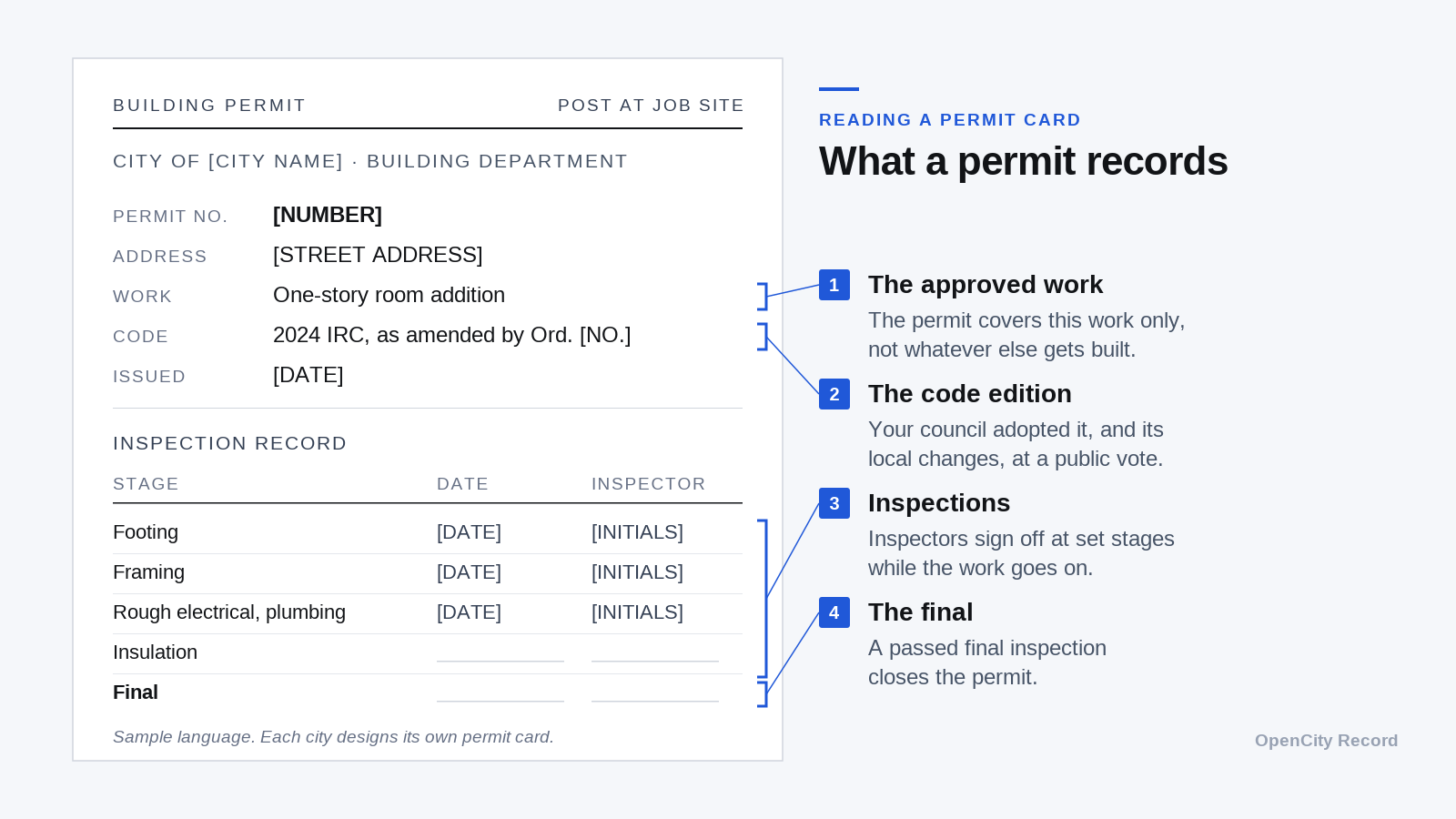
A permit follows a project from plans to final inspection, and the rules behind it are set by a public vote.
What does a building permit cover?
A building permit covers the structure itself, including foundations, framing, roofs, additions and any change in how a building is used. Electrical, plumbing, gas and heating work often needs a separate trade permit, even when it's part of a bigger project. Many cities post permits, inspection results and final approvals on an online portal, so the permit record follows the property after it's sold.
Where do the permit rules come from?
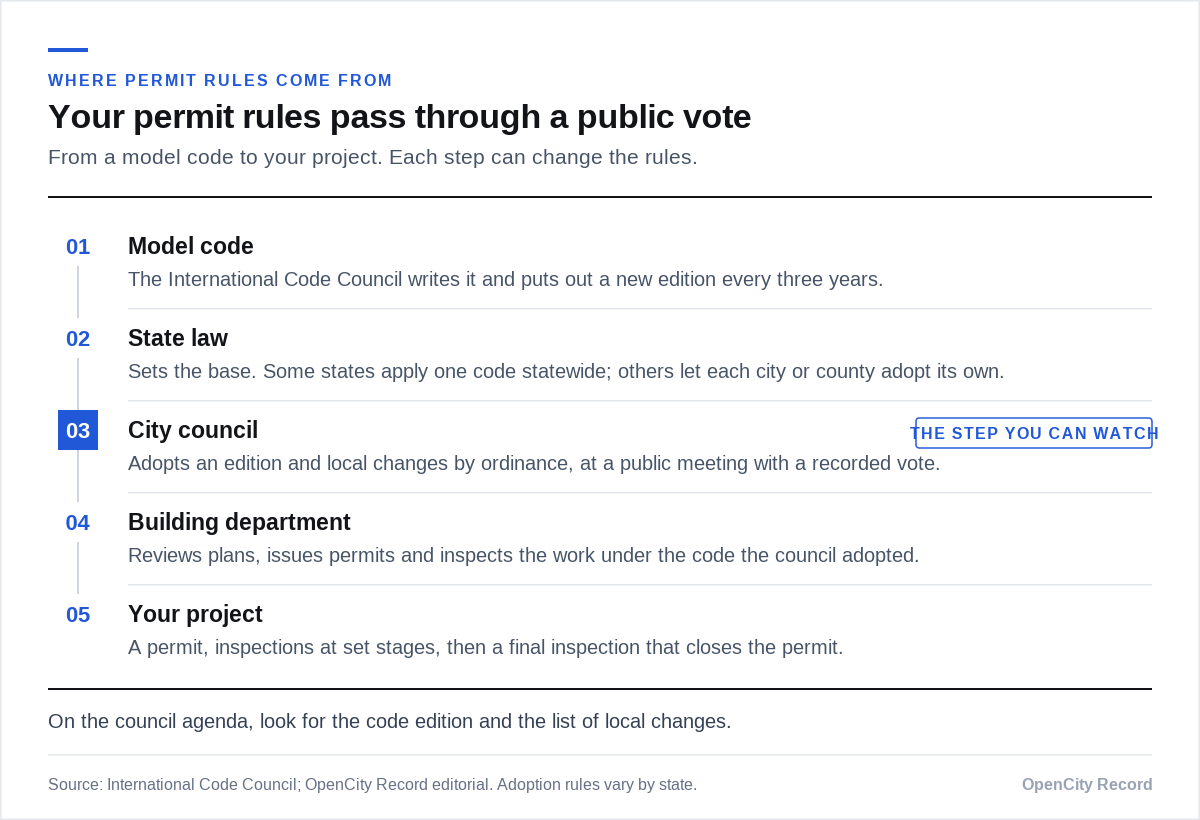
In many places, the step you can watch is the council vote, where your city picks a code edition and its local changes.
Most cities start from the International Residential Code, a model code that the International Code Council updates every three years. A state or city has to adopt the code before it has any legal force, and it can change the code when it does. States split on who does the adopting. Some states set one residential code that applies statewide, and local changes need approval from a state code board. Others have no statewide building code, so each city or county adopts its own edition and local changes.
Where cities adopt the code themselves, the vote happens in public. Two cities show how different the results can be. Longview, Texas's City Council chose the older 2021 edition on May 14, 2026, by a 7-0 vote. Almost five months later, on Oct. 6, 2026, Flagstaff, Arizona's City Council adopted the 2024 building and fire codes with no votes against. You can search recent council meetings for building code votes to see how your own city handled its last update.
Guides in this section
Do I need a building permit?
Start here if you're planning a project. A project-by-project table covers fences, sheds, decks, patios, windows, water heaters, remodels, roofs, solar panels, pools, retaining walls and driveways. It quotes the exempt-work list from the 2024 code and shows how much cities change the size limits.
How to look up permits on a property
Find a property's permit history step by step, whether the records sit with the city or the county. It also explains what statuses like Issued, Finaled and Expired mean, and how to request records that aren't online.
How to read a site plan
An annotated sample site plan walks you through the north arrow, the scale, property lines, setbacks, easements, utilities, drainage and parking. It helps before you file plans of your own or when a neighbor's project comes up for a public hearing.
Unpermitted work
Learn what happens when work was done without a permit, how it can affect insurance, appraisals and a sale, and the steps to legalize it with an as-built permit.
How long does a building permit last?
Under section R105.5 of the model code, a permit generally becomes invalid if work doesn't start within 180 days of issue, or if more than 180 days pass between inspections. The building official can extend that deadline, and some cities allow more time, so check the dates on your own permit.
Are building permits public?
Usually. Permit files are government records covered by your state's public records law, so many cities let you search any address on a permit portal, and you can request older files through a public records request. Check your state's law for any limits. Hearings on zoning permits, variances and special use permits also happen in public, with agendas, votes and minutes that anyone can read.
New in your city
See what’s being built in your city
Rezonings, site plans, subdivisions and variances show up on city agendas weeks before the bulldozers do. Pick your city to see the development applications on its agendas, such as rezonings, site plans, subdivisions and variances, with the status of each. It lists the whole city; it does not search by address.
Find your cityCommon questions
What is a building permit?
A building permit is a government's written approval to build, change or tear down a structure, or to change its wiring, plumbing, gas or heating. You apply with plans, the building department reviews them, and inspectors check the work at set stages until a final inspection closes the permit.
Who issues building permits?
The city's building department issues them for property inside city limits. Outside city limits, it's usually the county. Electrical, plumbing and mechanical work often needs its own trade permit, sometimes from the same office.
How long is a building permit good for?
Under section R105.5 of the model residential code, a permit generally becomes invalid if work doesn't start within 180 days of issue, or if more than 180 days pass between inspections. The building official can grant extensions, and some cities set a longer window.
Are building permits public record?
Usually. Permit files are government records, so your state's public records law generally covers them. Many cities let you search any address on a permit portal, and you can request older records through a public records request. Check your state's law for any limits.
Sources
- 2024 International Residential Code, Chapter 1: Scope and Administration · International Code Council
- G.S. 143-138: North Carolina State Building Code · North Carolina General Assembly
- Building Codes · Colorado Office of the State Architect