Quick answer
Unpermitted work is construction that needed a building permit but never got one, like a garage turned into a bedroom or new wiring. It tends to surface when you sell, refinance or apply for a new permit. Much of it can be legalized with an after-the-fact permit, inspections and repairs, often at extra cost.
Key facts
- Many states require sellers to fill out a written disclosure about the home's condition, and some forms ask about permits. Washington's form asks whether building permits were obtained for additions and remodeling. Virginia leans toward buyer beware.
- Fannie Mae's Selling Guide (B4-1.3-05) tells an appraiser who finds an addition built without a required permit to comment on its quality and its effect, if any, on market value.
- The International Residential Code, the model code most cities adopt for houses, lets a city charge an extra fee when work starts before a permit is issued. Some cities add a fee equal to the permit fee, doubling the cost.
- Unpermitted work that breaks a zoning rule, such as a setback or size limit, usually needs a variance or special exception, often from a board of adjustment, or it has to come out.
Unpermitted work is construction that needed a building permit but never got one. Common examples are a garage turned into a bedroom, an enclosed back porch, new wiring or a deck. It often surfaces at an inconvenient moment: when you sell, refinance or apply for another permit. Much of it can be legalized with an after-the-fact permit, inspections and repairs, although that can cost more than permitting the work the first time.
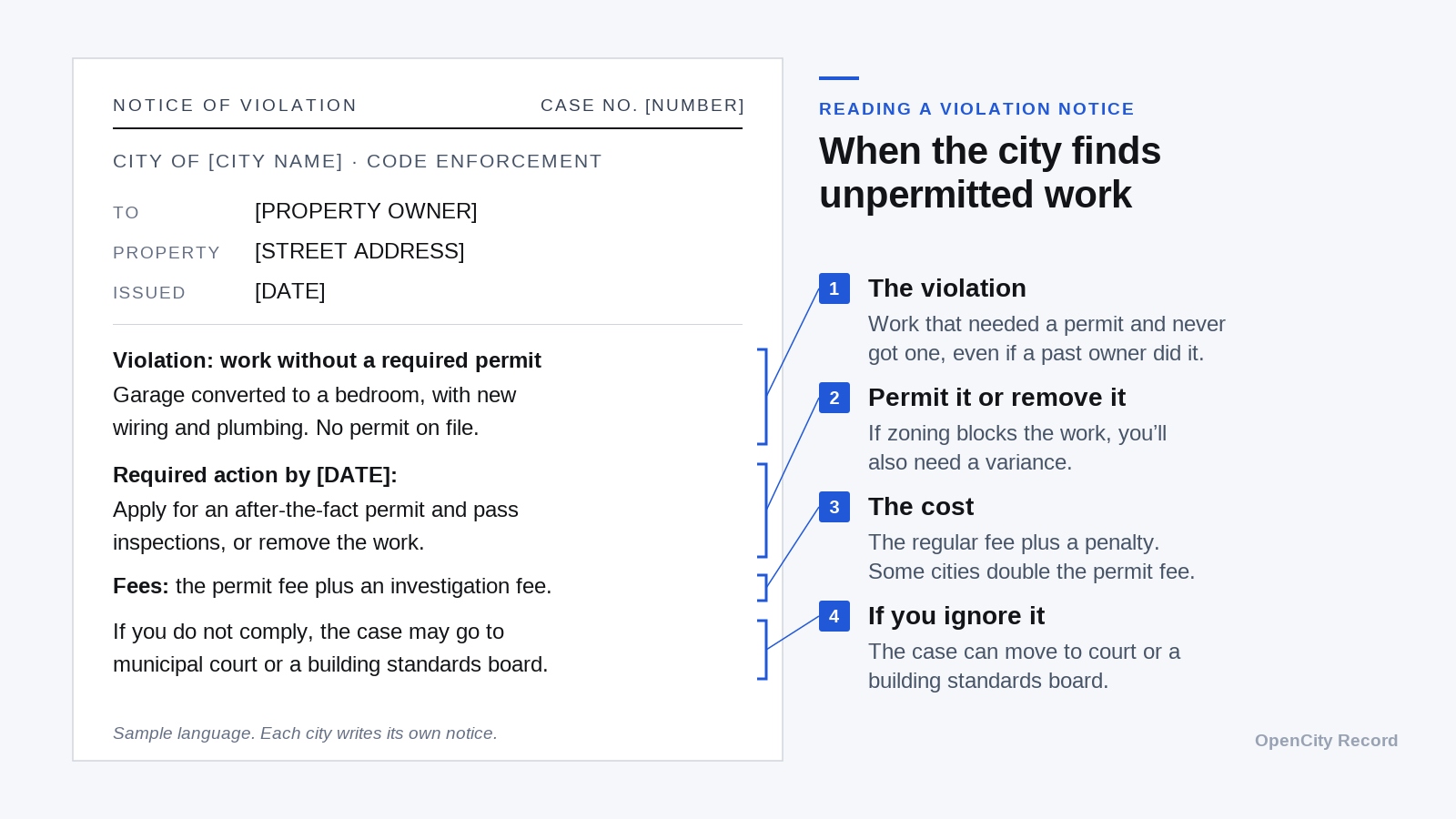
Work done without a permit can resurface at sale time or with the next permit application.
What counts as unpermitted work?
If your city required a permit for a job and nobody pulled one, the work is unpermitted, no matter whether a past owner or a contractor did it. A permit that was opened but never closed with a final inspection creates a similar problem, because the city's records still show the job as unfinished.
Garage conversions, finished basements, room additions, enclosed porches, decks and carports are common examples. So are electrical panels, relocated plumbing, water heaters and HVAC replacements. Some small projects need no permit at all, and your city's adopted building code and local amendments decide which ones. Our guide to whether you need a building permit goes project by project.
A missing permit file isn't automatic proof of a violation, though, since an older house may predate the city's permit requirements or its record keeping.
What are the risks of unpermitted work?
How bad it gets depends on the work itself and on who finds it. These are problems to plan for.
| Risk | What can happen | When it shows up |
|---|---|---|
| Insurance | Policies differ, so ask your insurer how it treats unpermitted work. | Before you buy or renovate |
| Appraisal | The appraiser may give the space little or no value. | Sale or refinance |
| Lender | The lender may ask for permit records, repairs or a re-inspection before funding the loan. | Underwriting |
| Resale | Buyers may walk away, offer less or ask you to permit the work before closing. | Listing and inspection period |
| Fines and fees | Cities can add a penalty or investigation fee on top of the permit fee. | When the city finds out |
| Safety | Work no inspector checked can hide faulty wiring or a weak deck. | Any time |
| Removal | If the work violates a zoning rule, the city can order it taken out. | A code case or a denied variance |
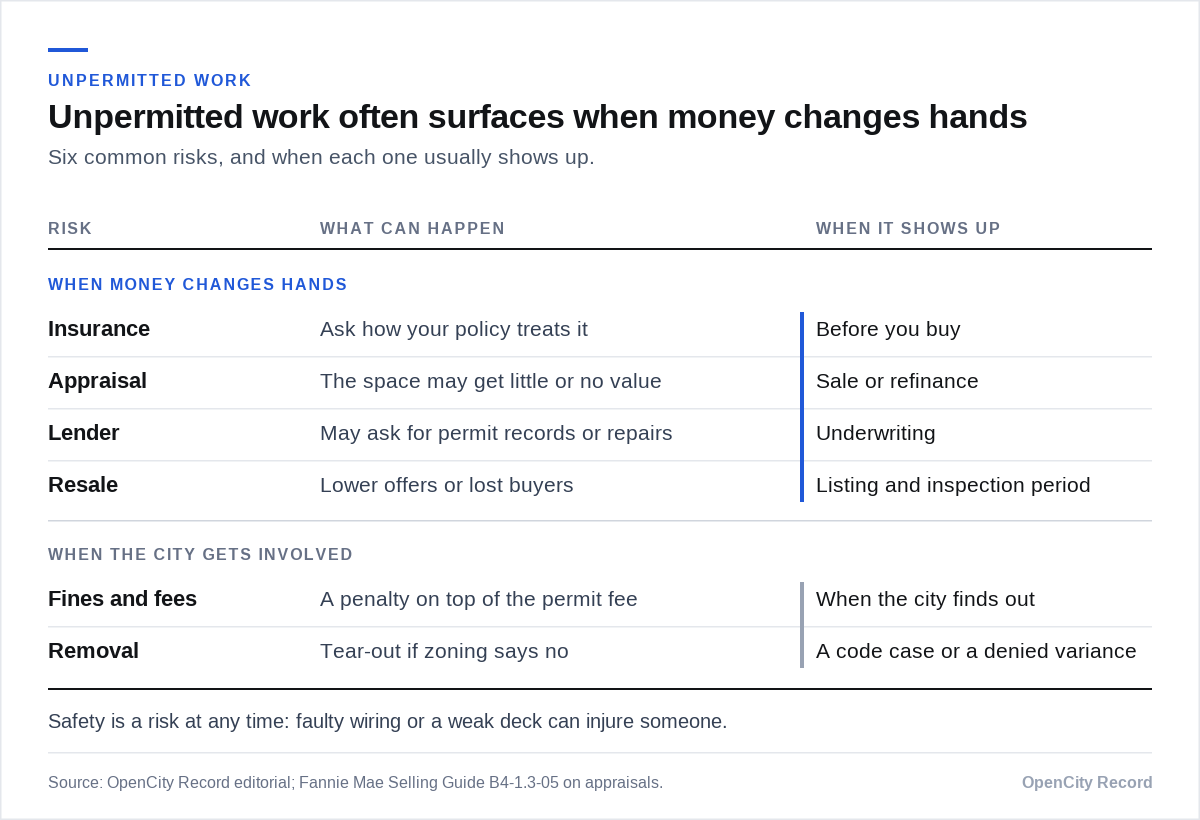
Unpermitted work often stays quiet until money changes hands in a sale or a refinance.
What happens if an inspector finds unpermitted work?
That depends on which inspector finds it. A city building inspector or code officer can issue a notice of violation and post a stop-work order if construction is still underway. They can also set a deadline to get a permit or remove the work. You'll pay the regular permit fee and often a penalty. The International Residential Code, the model code most cities adopt for houses, lets a city charge an extra fee when work starts before the permit is issued. That's Section R108.6 in the 2024 edition, and each city sets its own amount. If the notice is ignored, the model code lets the building official ask the city's lawyers to take the case to court.
A home inspector hired by a buyer works for the buyer. They can note work that looks unpermitted in the report, but they have no power to enforce anything.
One common way cities find older work is when an owner applies for a permit for something else, and the plan reviewer or inspector notices a carport, deck or room that isn't in the city's records.
How do you legalize unpermitted work?
The process works like a normal permit application, except that you have to show the city what's already hidden behind walls or under floors.
- Get the permit history for the address so you know exactly what was approved. Our guide to looking up permits on a property explains where to find it.
- Talk to the building department before filing anything, and ask what an after-the-fact permit requires and whether zoning allows the work.
- Document the construction. Photos and a sketch may be enough for small projects, but structural, electrical or plumbing work may need as-built drawings and sometimes a licensed engineer's letter.
- Apply for the after-the-fact permit, sometimes called an as-built permit, and expect higher fees. Moses Lake, Washington, for example, adds an investigation fee equal to the permit fee for work started without one.
- Schedule inspections, and be prepared to cut open drywall, expose wiring or dig beside a footing so the inspector can see what the code covers.
- Repair whatever fails inspection, and ask early which code edition the city will apply to the old work.
- Get the final inspection approved, and keep copies of the permit, approved plans and inspection record.
When the work violates a zoning regulation, like a setback or a size limit, a building permit can't solve the problem by itself. You'll usually need a variance or special exception, often from a board of adjustment, which some places call the zoning board of appeals, or the work has to come out. Our guide on how to get a zoning variance explains that hearing, and you can search recent meetings for variance cases to see how often your board grants them.
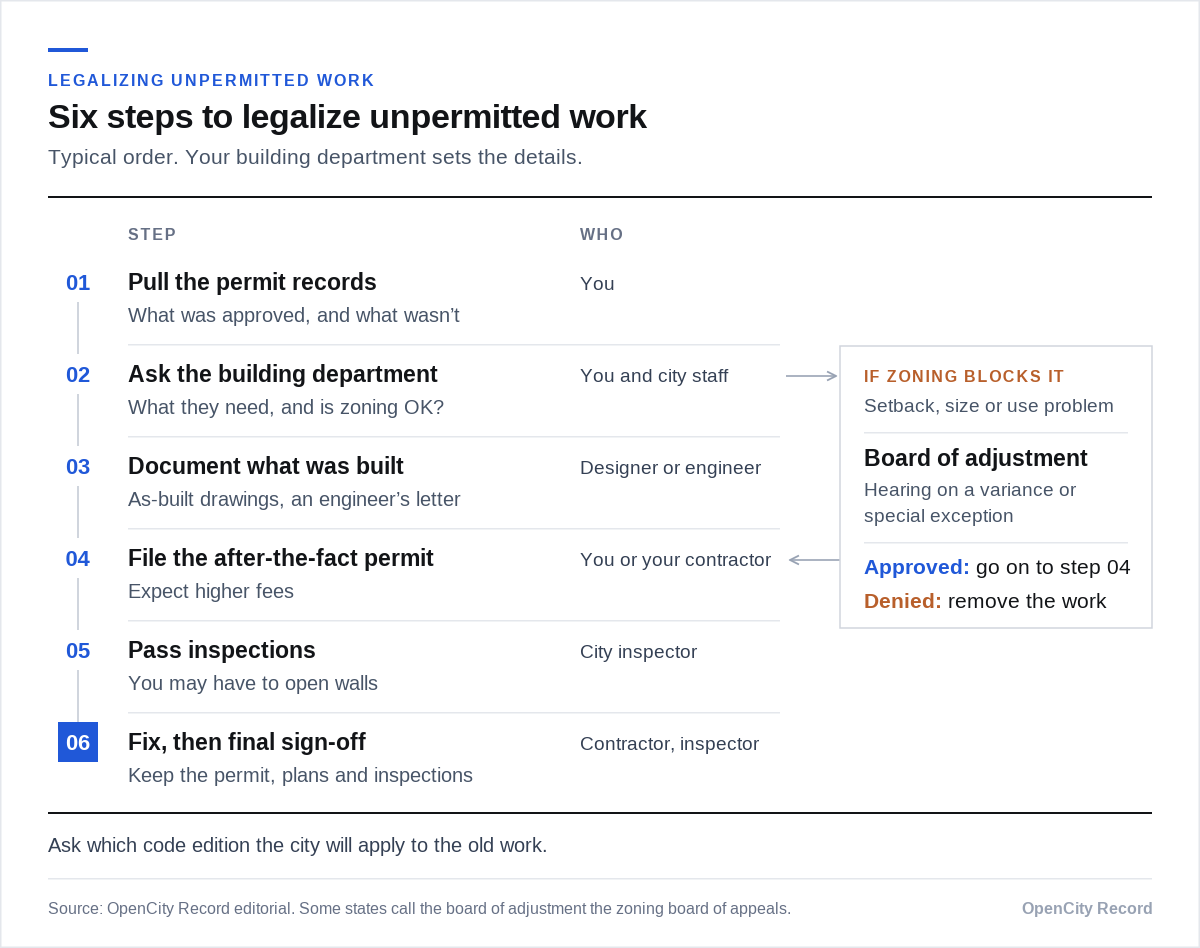
An after-the-fact permit follows the usual steps plus proof of what's hidden, and a zoning conflict adds a hearing before the board of adjustment.
Do appraisers count unpermitted work?
Sometimes. Fannie Mae's Selling Guide covers appraisers who find an addition built without a required permit. They must comment on the quality and look of the work and its effect, if any, on market value. Ask your lender for a copy of the appraisal to see how the appraiser treated the space.
Should you buy a house with unpermitted work?
You can, if you understand what you're buying and the price reflects it. Start with the seller's disclosure. Many states require sellers to fill out a written disclosure about the home's condition, and some forms ask about permits. Washington's form, for example, asks whether there have been any conversions, additions or remodeling, and if so, whether all building permits were obtained. Its answers are based on the seller's actual knowledge.
A few states lean toward "buyer beware," which puts more of the checking on you. In Virginia, the seller gives a statement that makes no representations about the property's condition. Even under buyer beware, a seller who hides important information they had to disclose can lose that protection. Check your state's disclosure law.
| Pattern | What the seller fills out | Does it ask about permits? |
|---|---|---|
| Form set by state law that asks about permits | A disclosure statement on the home's condition, like Washington's | Yes, whether building permits were obtained for additions or remodeling |
| Buyer beware | A statement that the seller makes no representations, like Virginia's | No, the buyer is told to do their own checking |
Then do your own checking:
- Compare the listing with the county assessor's record and the city's permit file, because an extra bedroom or bathroom with no permit is a warning sign.
- Ask the city whether the address has open permits or active code enforcement cases.
- Ask your home inspector to identify work that looks newer than the original construction.
- Get a contractor's estimate for legalizing the work and another for removing it.
- Call your lender and insurance agent before your inspection or contingency period ends.
With that information, you can negotiate a lower price, ask the seller to permit the work before closing, or walk away if your contract allows it. Our city hall checklist for buying a house covers other local records worth pulling.
What happens if you build without a permit?
If the city finds out, you can face fees, a deadline to permit the work and, when zoning is involved, a hearing that decides whether the structure stays. Here's what those decisions looked like at two hearings in 2026.
In Mesquite, Texas, a homeowner filled in a permitted 1990s swimming pool and capped it with concrete without city review or permits. City staff estimated the new deck at about 1,200 square feet, compared with the city's 500-square-foot limit for that kind of accessory structure, and recommended denial. On October 22, 2026, the city's board of adjustment voted to deny the request, according to the meeting recording.
In Las Vegas, the owner of a group home asked the planning commission to let an existing front carport stay with no side setback, where the code requires 5 feet. The applicant said they hadn't known the carport was unpermitted when they bought the house. At the Jan. 13, 2026, planning commission meeting, one commissioner said they couldn't remember approving a front carport like it in 14 years on the commission. The commission approved the group home's other requests but denied both carport variances. To find cases like these near you, search recent meetings for work built without a permit.
From the record
Real examples from public meetings
- Denied
Mesquite, TX
Board of Adjustment ·
Denied a request to keep a 1,200-square-foot concrete deck poured over a filled-in pool without permits, where the limit is 500 square feet.
From the meeting recording. The official minutes were not yet published.
- Denied 6-0
Las Vegas, NV
Planning Commission ·
Denied setback variances for an existing front carport at a group home, while approving the group home use permit and a rear storage structure.
From the meeting recording. The official minutes were not yet published.
- Approved 4-0
Louisville, KY
Board of Zoning Adjustment ·
Approved a 4-foot side setback variance for a 450-square-foot carport built about 1 foot from the property line.
From the meeting recording. The official minutes were not yet published.
This is general information, not legal or tax advice. Disclosure duties, fees and code requirements vary by state and city, so check with your building department and a real estate attorney in your state before you sign anything.
New in your city
See what’s being built in your city
Rezonings, site plans, subdivisions and variances show up on city agendas weeks before the bulldozers do. Pick your city to see the development applications on its agendas, such as rezonings, site plans, subdivisions and variances, with the status of each. It lists the whole city; it does not search by address.
Find your cityCommon questions
Do appraisers count unpermitted work?
Sometimes. Fannie Mae tells appraisers who find an addition built without a required permit to comment on its quality and appearance and its effect, if any, on market value. Ask your lender how it will treat the space.
What happens if an inspector finds unpermitted work?
A city building inspector or code officer can issue a notice of violation and set a deadline to permit the work or remove it. Expect the regular permit fee plus a penalty or investigation fee. A home inspector hired by a buyer only notes it in the report.
Can you buy a house with unpermitted work?
Yes. Ask the seller in writing, check the city's permit history for the address and get a home inspection. Then price in the cost to legalize or remove the work, or ask the seller to permit it before closing. Talk to your lender and insurer before your inspection or contingency period ends.
How do you legalize unpermitted work?
Apply for an after-the-fact permit, sometimes called an as-built permit, with drawings of what was built. Expect inspections that may require opening walls, plus repairs to meet code. If a zoning rule blocks the work, you'll also need a variance, or the work has to come out.
What happens if you build without a permit?
If the city finds out, you can be cited, charged extra fees and ordered to permit, fix or remove the work. Even if nobody notices for years, the work can cause trouble later with a sale or a refinance.
Sources
- RCW 64.06.020, Improved residential real property: seller's duty, format of disclosure statement · Washington State Legislature
- Code of Virginia § 55.1-703, Required disclosures for buyer to beware · Virginia General Assembly
- Caveat emptor · Legal Information Institute, Cornell Law School
- B4-1.3-05, Improvements Section of the Appraisal Report · Fannie Mae
- Moses Lake Municipal Code 16.02.087: Investigation fees, work without a permit · City of Moses Lake, Washington
- 2024 International Residential Code, Chapter 1: Scope and Administration · International Code Council
Keep reading
- GuideDo I Need a Building Permit? A Project-by-Project GuideDo I need a permit for a fence, shed, deck, roof or water heater? See the usual rule for 13 home projects, the 2024 IRC limits and how to check your city.
- GuideHow to Look Up Permits on a PropertyHow to look up permits on a property: search the right city or county portal by address, read each status and request older records that aren't online.
- GuideHow to Get a Zoning Variance: Steps, Hardship Test and VotesHow to get a zoning variance: the hardship test boards use, use vs. area variances, the application steps, vote rules and real board decisions.
- GuideHow to Read a Site Plan (Annotated Example)Learn how to read a site plan with an annotated example: north arrow, scale, property lines, setbacks, easements, utilities, drainage and parking.
- GuideHow to Get a Building Permit, Step by StepHow to get a building permit: check the rules, prepare plans, apply, get through plan review, pass inspections and close it, with a document checklist.
- GuideDo I Need a Permit for a Deck?Many decks need a permit. See the four tests a deck must pass to skip one under the model code, what inspectors check and how setbacks still apply.