Quick answer
To check a development application's status, get its case number from the notice, sign or agenda, then search your city's planning or permit portal. The record shows the current status, review comments and upcoming hearings. For cases with hearings, the agendas and minutes show each vote. Planning staff can answer what the portal doesn't.
Key facts
- Every development application gets a case or permit number, and that number is the fastest way to find it in a city portal, an agenda or the minutes.
- Portal status labels vary, but cases often move from submitted to under review, to scheduled for hearing, to a decision such as approved, approved with conditions or denied.
- Tabled, continued and deferred all mean the case was pushed to a later meeting. Withdrawn means the applicant pulled it.
- Notice problems can reset a case. In March 2026, Atlanta's zoning committee sent a rezoning back to its review board because of a public notice error.
- Case files are government records covered by state public records laws, so you can usually request them even when they aren't posted online.
To check development application status, you need two things: the case number and the place your city posts its records. The number is on the mailed notice, the sign on the site or the meeting agenda. The record is usually in an online planning or permit portal, where you'll see the current status, review comments and hearing dates. For cases that go to a public hearing, the agendas and minutes fill in the rest. Here's how to follow any project from filing to approval.
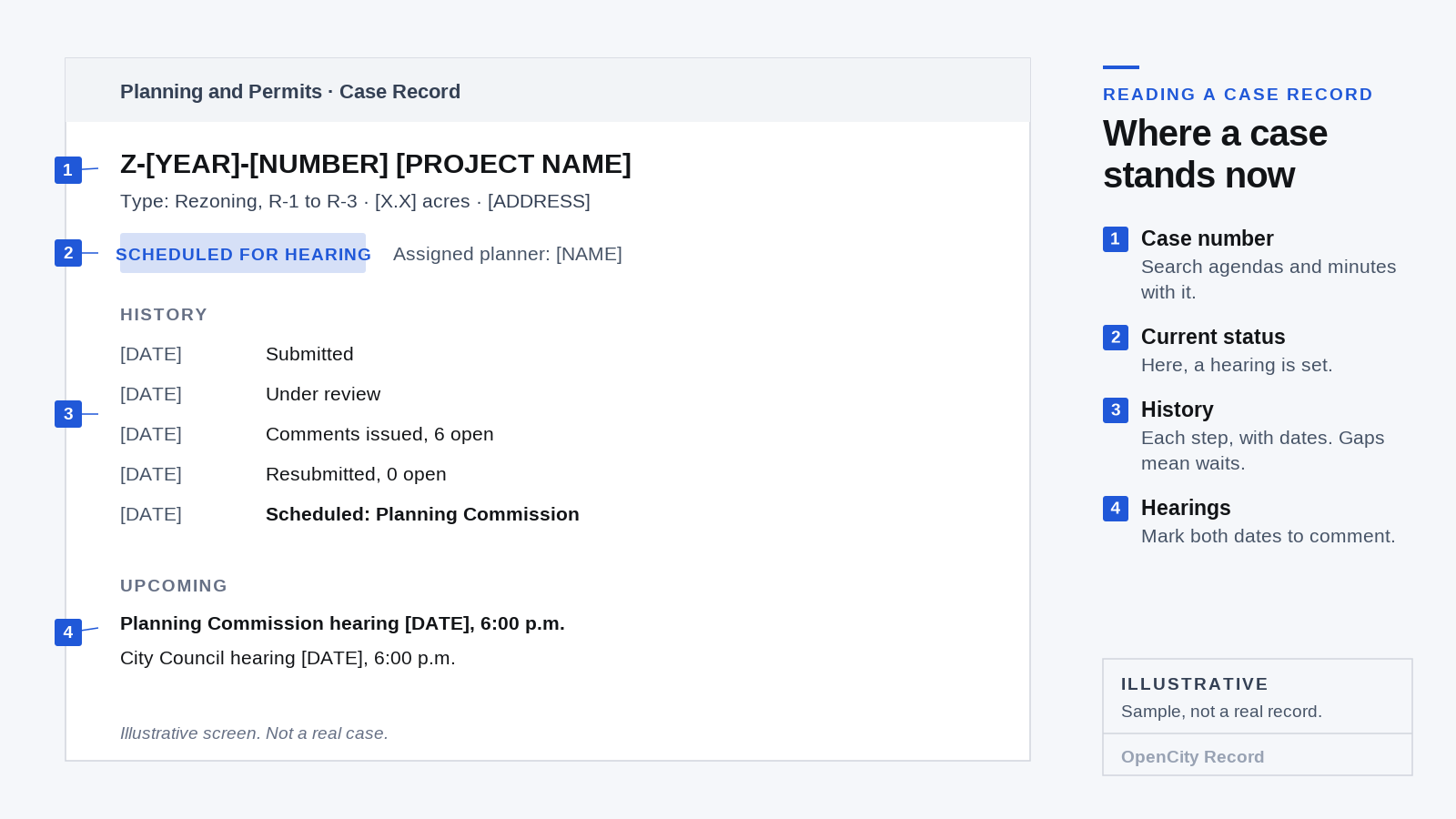
A portal record answers three questions: where the case is now, what's holding it up and when it's next heard.
How do you check development application status?
- Get the case number. Look on the notice letter, the posted sign or the agenda. If you only have an address, search the portal by address or call planning staff.
- Find your city's portal. Search your city's website for "permit portal," "development applications" or "planning cases." Some counties run the portal for the cities inside them.
- Search by number or address. Open the case record and note the status, the assigned planner and the next date.
- Read the documents. Look for the application, plans, staff comments and staff report. Comments show what the city still needs from the applicant.
- Check the agendas. If the case needs a hearing, find it on the planning commission or council agenda. Find your city to see its upcoming agendas on OpenCity.
- Read the outcome. After a hearing, the minutes and the video show the motion, the vote and any conditions.
- Ask the planner. Email the planner on the case if the portal is unclear. Ask to be added to the notice list.
What do development application status terms mean?
Every city uses its own labels, but many fit the pattern in the table below.
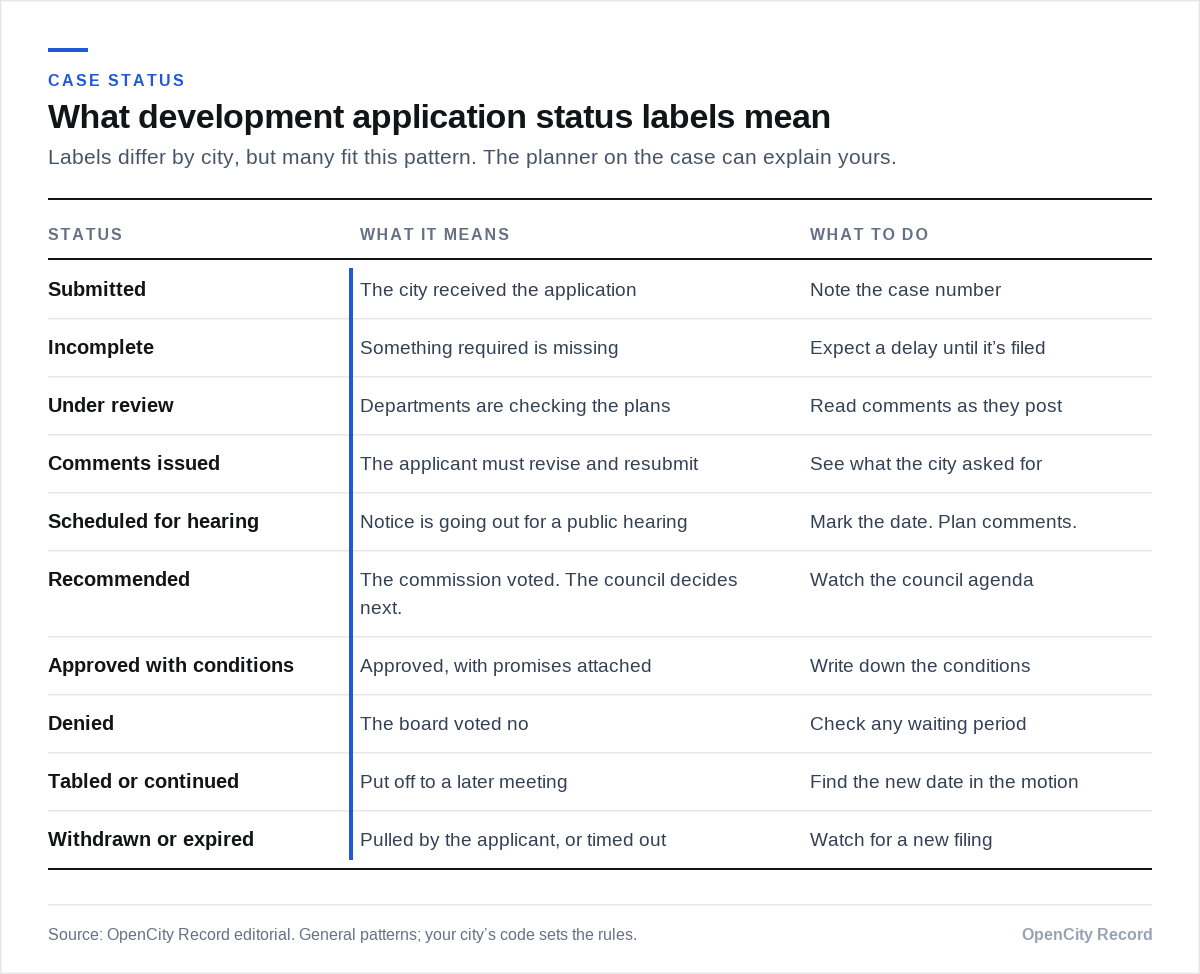
Labels differ by city. If a status isn't clear, the planner on the case can explain it.
Two pairs are easy to mix up. A recommended case has been through the planning commission but still needs a council vote. A tabled or continued case hasn't been decided at all. It's waiting for a later meeting.
Where do development applications show up?
A single project can leave records in several places. Check them in this order:
- The notice sign. Some states and codes require a sign on the property for rezonings and other hearings. North Carolina, for example, requires a posted notice for a zoning map change.
- Mailed notice. Nearby owners often get a letter before a hearing. North Carolina requires mailed notice to the owners of the affected and abutting parcels 10 to 25 days before a map change hearing. Your state's law and your city's code set the distance and timing.
- Legal notices. Some cities publish hearing notices in a newspaper or on an official notice page.
- The planning or permit portal. Many cities run an online system where applications have a record.
- Agendas and staff reports. Planning commission, board of adjustment and council agendas list each case with its number and link to the staff report.
- Minutes and video. These show what happened at each hearing.
- County records. Once a final plat is approved, it's recorded with the county, usually by the recorder or clerk.
For smaller projects, such as a new house on an existing lot, there may be no hearing at all. In that case the building permit record is the main source. Our guide on how to look up permits on a property covers that search.
What should you look for in the case file?
Once you find the case, a few documents tell you most of what you need:
- The application form names the applicant, the owner, the request and sometimes the agent or engineer.
- The site plan or concept plan shows what would be built, where it sits and where cars come and go. If plans are new to you, see how to read a site plan.
- Studies cover traffic, drainage, noise or the environment. Look for the summary first.
- Review comments show what the city still wants changed. Many open comments can mean the case isn't close to a hearing.
- The staff report comes out shortly before a hearing. It sums up the request, applies the code's criteria and recommends approval, approval with conditions or denial.
- Conditions of approval are the promises the applicant must keep, such as a buffer, a turn lane or limited hours. Write them down. If the project is built, those conditions are what you can hold the city to.
How can you get notified about a case?
Portals rarely send updates unless you ask. A few ways to stay current:
- Ask the planner on the case to add you to the notice or interested-parties list.
- Sign up for your city's agenda emails, if it offers them.
- Check the portal record each week, and note the date of every change.
- Use an alert service that watches agendas for you.
In many places, notice goes out only before hearings, so a case can move through review for months without a word to neighbors. Some states, such as Washington, also require a notice when an application is filed. Checking the status yourself is often the only way to know a hearing is coming before the sign goes up.
Why do cases stall, and what does that look like?
Delays often come from places like these, and OpenCity's records show each one:
- Open issues with the city. A Kansas City council committee held a 200-lot subdivision rezoning for a week on June 30, 2026 because the city's water department objected to the developer's request that the city pay for water main extensions.
- Notice errors. Atlanta's City Council zoning committee sent a rezoning back to the Zoning Review Board on March 9, 2026 because of a public notice error, which means the case needed new notice and a new hearing.
- Code problems. The Rosenberg, Texas, planning commission voted 6-0 on Sept. 16, 2026 to table a variance hearing to Nov. 18, 2026, because of an error in the city's development code.
- Neighbor opposition. The Clark County, Nevada, Board of County Commissioners, sitting as its zoning commission, denied a zone change and use permits without prejudice on May 20, 2026, after strong neighborhood opposition to a lodge's banquet hall and RV parking plan.
A denial "without prejudice" can let the applicant come back sooner with a new request. Read your code for the waiting period.
How long should each status last?
There's no national standard, but a few patterns help you tell whether a case is moving or stuck:
- Submitted to under review starts once the city confirms the application is complete. Some states set a deadline for that check. Washington, for example, allows 28 days.
- Under review can last weeks per round, and larger projects may go through several rounds of comments and resubmittals.
- Scheduled for hearing depends on notice rules. Notice has to go out ahead of the hearing, 10 to 25 days ahead for a map change in North Carolina, so a case is scheduled well before the hearing date.
- Recommended to approved depends on how often your council meets and whether the ordinance needs one reading or two.
- Tabled or continued can mean two weeks or several months. Read the motion for the new date.
If a case sits in one status much longer than others like it, ask the planner what it's waiting on. Some cities also expire applications that sit idle too long, so a quiet case can simply end.
How do you follow a project across many meetings?
Big projects can show up on several agendas: a planning commission hearing, one or more continuances, a council first reading, a final vote and later a plat or site plan. Following them one agenda at a time is slow. Three habits help:
- Save the case number and search every new agenda for it, not just the project name, which can change.
- Watch for related numbers. A rezoning, a plan amendment and a plat for the same site often have separate case numbers.
- Track dates, not just status. Write down each meeting date and outcome. That timeline tells you how fast your city moves and when to show up.
OpenCity Record builds that timeline automatically for the cities it covers, linking each meeting where a project appeared with the status and vote at each step. You can search recent meetings for development applications to see how it works.
What if you can't find the application?
Not every project shows up in a portal. Small projects may get staff approval with no hearing, and some cities only post agendas. If you can't find a case:
- Call or email the planning department with the address.
- Ask whether the project needs a hearing and when notice would go out.
- File a public records request for the application and plans. See our guide on what's being built near me for more places to look.
This is general information, not legal advice.
New in your city
See what’s being built in your city
Rezonings, site plans, subdivisions and variances show up on city agendas weeks before the bulldozers do. Pick your city to see the development applications on its agendas, such as rezonings, site plans, subdivisions and variances, with the status of each. It lists the whole city; it does not search by address.
Find your cityCommon questions
How do I find a development application's case number?
Look at the mailed notice, the sign posted on the site or the meeting agenda. Case numbers often start with letters for the type, like Z for zoning or SP for site plan, followed by the year and a sequence number.
What does 'under review' mean on a development application?
City departments are checking the plans against the code. They'll send comments, and the applicant usually has to revise and resubmit before the case moves forward.
What does it mean when a zoning case is tabled or continued?
The board put off a decision to a later meeting, often to get more information or give the applicant and neighbors time to talk. Check the motion for the new date. Some boards table with no date, so watch future agendas.
What is the difference between withdrawn and denied?
Withdrawn means the applicant pulled the request before a decision. Denied means the board voted no. Check your code for any waiting period before a similar request can be filed again, and whether a denial without prejudice changes it.
How can I find development projects near me?
Use your city's map-based permit or planning portal if it has one, watch for notice signs and mailed notices, and read planning commission agendas. OpenCity can also alert you when projects near your address show up on an agenda.
Can I see the plans for a development application?
Usually yes. Some cities post plans and staff reports online. If yours doesn't, ask the planner on the case or file a public records request.
Sources
- Permit Review · MRSC
- Public Hearings · MRSC
- Open Government Guide · Reporters Committee for Freedom of the Press
- G.S. 160D-602: Notice of hearing on proposed zoning map amendments · North Carolina General Assembly
- Atlanta City Council Zoning Committee meeting, March 9, 2026 · OpenCity Record
Keep reading
- GuideThe Development Review Process, Step by StepThe development review process, step by step: pre-application, filing, staff review, hearings, plats and permits, with real timelines and delay tips.
- GuideWhat Does the Planning Commission Do?What does the planning commission do? It reviews rezonings, plats and plans, holds hearings and advises the council. See its role and how to take part.
- GuideHow to Look Up Permits on a PropertyHow to look up permits on a property: search the right city or county portal by address, read each status and request older records that aren't online.
- GuideHow to Read a Plat MapHow to read a plat map: find your lot and block, read bearings and distances, spot easements and building lines, and learn where to get a copy.
- GuideComprehensive Plans (General Plans) ExplainedA comprehensive plan, also called a general or master plan, sets a city's long-range land use vision. See what's in one, how it's made and why it matters.