Quick answer
A comprehensive plan is a city's or county's long-range guide for growth, often looking 20 years ahead. Also called a general plan or master plan, it sets goals for land use, housing, transportation, parks and utilities, usually with a future land use map. It isn't zoning, but zoning decisions are often required to be consistent with it.
Key facts
- Comprehensive plans go by different names: general plan in some states, master plan or comprehensive land use plan in others.
- Many plans include a future land use map and chapters, often called elements, on land use, housing, transportation, infrastructure, parks and the economy.
- The plan is a policy guide, not a law that zones land. But some states, such as Washington, require development rules to conform to it, and boards cite it when they approve or deny rezonings.
- Plans get amended between rewrites. In 2026 OpenCity records, boards in Georgia, Maryland and Nevada each voted unanimously to amend theirs.
- In May 2026, Maricopa County, Ariz., adopted a new long-range plan after a two-year process.
A comprehensive plan is a city's or county's long-range guide for how it should grow, often looking 20 years or more ahead. Depending on your state, you may hear it called a general plan, a master plan or a comprehensive land use plan. It sets goals for land use, housing, transportation, parks and utilities, and it usually includes a future land use map. The plan doesn't zone land by itself. But when a rezoning comes up, the first question many boards ask is whether it fits the plan.
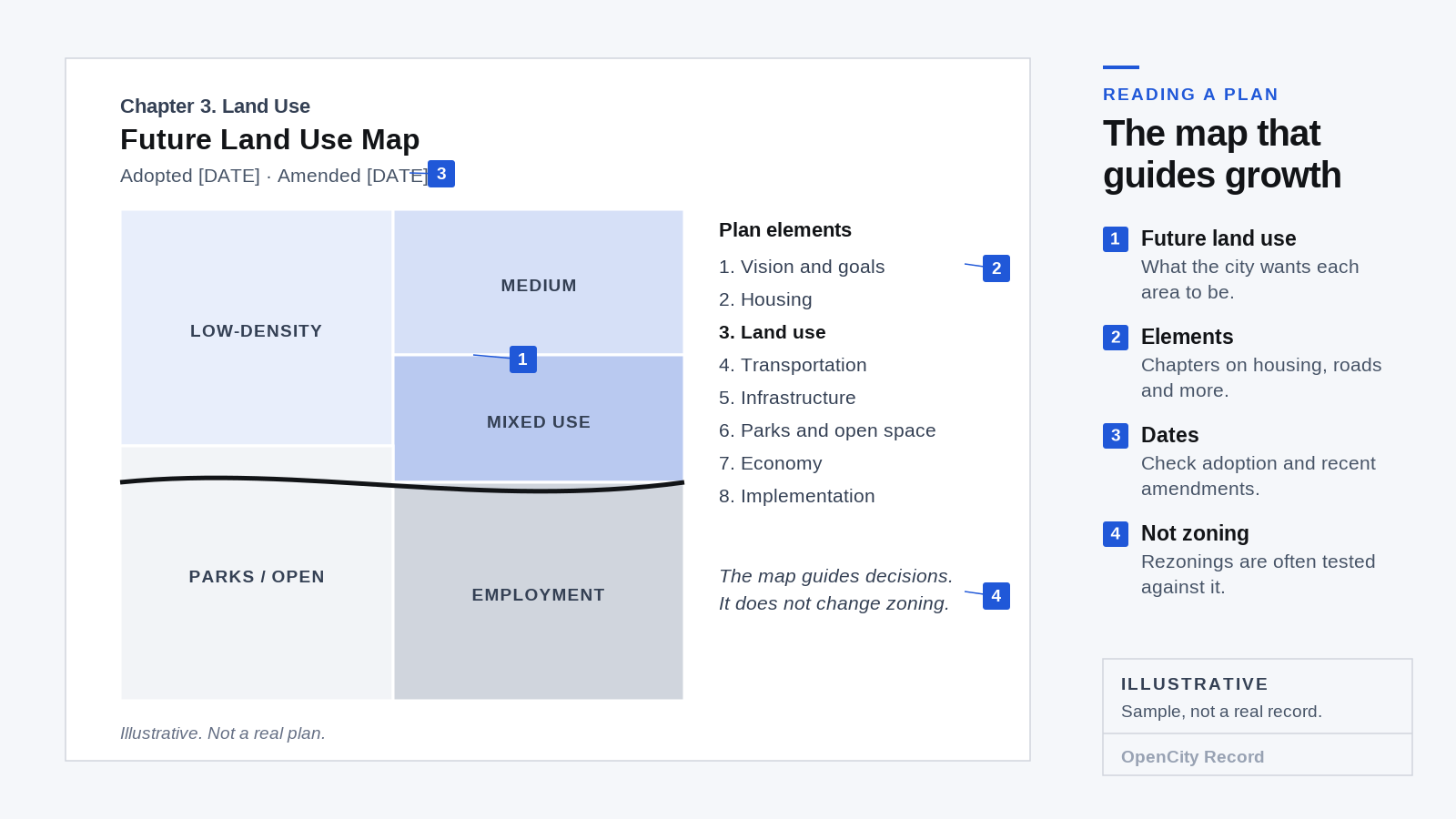
The future land use map shows what the city wants each area to become.
What is a comprehensive plan?
The idea goes back to the Standard City Planning Enabling Act, a 1928 model law from the U.S. Commerce Department. It asked each city's planning commission to make a "master plan" for its physical growth. Many states built their planning laws on that model, and some, such as Washington, now require cities and counties to adopt a plan.
A plan usually has two parts. The written policies set goals, such as more housing near jobs or protecting farmland. The maps show where those goals apply. A key map is the future land use map, which shades each area by the kind of development the city wants there, such as low-density residential, mixed use or industrial.
What's in a comprehensive plan?
Many plans are built from chapters, often called elements. The names differ, but common ones include:
- Land use, with the future land use map.
- Housing, including how many homes the city expects to need.
- Transportation, often with a thoroughfare plan that shows future roads.
- Infrastructure, such as water, sewer and stormwater.
- Parks, open space and the environment.
- Economic development.
- Implementation, a list of actions, who does them and when.
Many places add smaller area plans for a corridor or neighborhood. DeKalb County, Georgia's commissioners voted 6-0 on Sept. 24, 2026 to fold a small area plan for one aging corridor into the county's comprehensive land use plan.
How is a comprehensive plan made and updated?
A full rewrite can take a year or two, or longer. Staff and often a consultant gather data, hold surveys and workshops, and draft the plan. A steering committee of residents may guide the work. The planning commission holds a hearing and recommends the plan, and the council or county board adopts it.
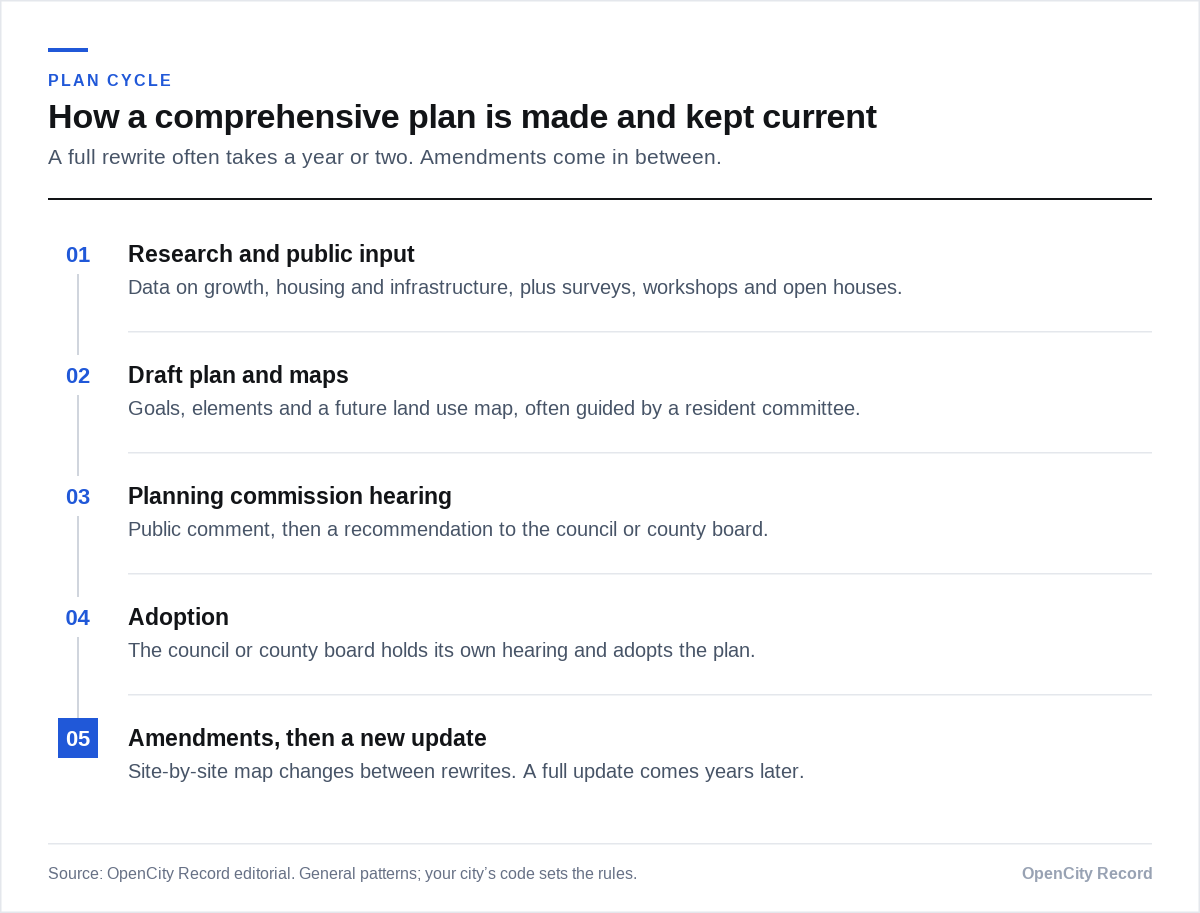
A full update can take years. Amendments come in between, and some states limit how often.
Maricopa County, Arizona's Board of Supervisors voted 5-0 on May 20, 2026 to approve a new long-range plan after a two-year process. Residents used the hearing to press the board on rural density limits and water supply. Beaumont, Texas's City Council adopted a new plan on Oct. 6, 2026, setting a 20-year framework for growth, housing and infrastructure.
Between rewrites, plans get amended, often one site at a time. Some states limit how often. Washington generally allows amendments once a year. Washoe County, Nevada's commissioners voted 5-0 on May 26, 2026 to amend their master plan text and maps for land released from a city's planning area. Prince George's County, Maryland's council voted 11-0 on Oct. 27, 2026 to adopt a minor amendment to a 2010 area master plan.
Some states set a schedule for updates, and others leave it to each city. Check your state's law.
How does the plan affect zoning decisions?
In some states, such as Washington, zoning has to conform to the plan, and a rezoning that conflicts with the future land use map may need a plan amendment first. North Carolina requires the board to state whether each rezoning is consistent with the plan. That's why applicants often file a plan amendment and a rezoning together.
The plan also gives boards a reason for their votes. The Contra Costa County, California, planning commission voted 4-0 on April 8, 2026 to recommend rezoning a parcel to commercial so its zoning would match the county's general plan. Neighbors worried about future development, and the commission added a condition that any new project needs its own application.
For residents, this cuts both ways. If the plan already calls for apartments near you, opposing a rezoning that matches it is an uphill fight. If it doesn't, the plan may be your strongest argument. Our guide to how to oppose a zoning change explains how to use it.
How can you find and use your city's plan?
Search your city's website for "comprehensive plan," "general plan" or "master plan." The planning department page often has the full plan and the future land use map. Look for the adoption date and any amendments since. To see what your city has been changing, search recent meetings for comprehensive plan amendments or find your city.
This is general information, not legal advice.
New in your city
See what’s being built in your city
Rezonings, site plans, subdivisions and variances show up on city agendas weeks before the bulldozers do. Pick your city to see the development applications on its agendas, such as rezonings, site plans, subdivisions and variances, with the status of each. It lists the whole city; it does not search by address.
Find your cityCommon questions
What is the difference between a comprehensive plan and zoning?
The plan sets goals and a future land use map, often for the next 20 years. Zoning is the law that sets what you can build on each lot today. In some states, zoning has to be consistent with the plan.
Is a general plan the same as a comprehensive plan?
Yes. General plan, master plan and comprehensive plan are different names for the same kind of long-range plan. The name depends on your state's planning law.
How often are comprehensive plans updated?
It varies by state and city. Some states set a schedule. Washington, for example, requires a full review every 10 years and generally allows amendments once a year in between. Check your state's law.
Can a comprehensive plan be amended?
Yes. Property owners, staff or the council can propose amendments, often to change the future land use map for a site. Amendments usually get hearings before the planning commission and council.
How can I get involved in a comprehensive plan update?
Watch for surveys, open houses and workshops when your city starts an update, then comment at the planning commission and council hearings. A full update can take a year or more, so there are many chances to weigh in.
Sources
- Standard State Zoning Enabling Act and Standard City Planning Enabling Act · American Planning Association
- Comprehensive Planning · MRSC
- G.S. 160D-605: Governing board statement · North Carolina General Assembly
- Land Use · Legal Information Institute, Cornell Law School
- Maricopa County Board of Supervisors meeting, May 20, 2026 · OpenCity Record
Keep reading
- GuideWhat Does the Planning Commission Do?What does the planning commission do? It reviews rezonings, plats and plans, holds hearings and advises the council. See its role and how to take part.
- GuideThe Development Review Process, Step by StepThe development review process, step by step: pre-application, filing, staff review, hearings, plats and permits, with real timelines and delay tips.
- GuideHow Rezoning Works: Process, Timeline and CostsRezoning explained: each step from application to council vote, how long it takes, what cities charge, and how neighbors can weigh in or protest.
- GuideHow to Oppose a Zoning Change (or Support One)How to oppose a zoning change, or support one: read the notice, find the criteria, comment on time, organize neighbors and make arguments that persuade.
- GuideZoning Classifications Explained: What R-1, C-2 and M-1 MeanZoning classifications explained: what codes like R-1, C-2 and M-1 mean, why district names differ from city to city and how to read your zoning map.
- GuideHow to Read a Plat MapHow to read a plat map: find your lot and block, read bearings and distances, spot easements and building lines, and learn where to get a copy.