Quick answer
The development review process is how a city checks a project before it can be built. It usually runs from a pre-application meeting to a formal filing, staff review by several departments, public hearings if zoning must change, then plat, site plan and building permit approval. Simple projects take weeks. Rezonings and large subdivisions can take many months.
Key facts
- Getting the land use approvals a project needs, such as a rezoning, plat or special permit, is often called entitlement.
- Many cities route each application to several departments, such as planning, engineering, fire, utilities and transportation, and send back written comments to fix.
- Projects that match existing zoning are often approved by staff or the planning commission. Rezonings usually need hearings before the planning commission and the council.
- Deferrals can add months. In 2026, DeKalb County, Ga., deferred a 214-home rezoning twice before approving it, about eight months after its first hearing.
- Some places are trying to shorten review. In October 2026, Prince George's County, Md., passed laws allowing some development approvals to be considered at the same time.
The development review process is how a city or county checks a project before it can be built. A builder files plans, staff from several departments review them against the code, and the city sends back comments to fix. If the project needs a zoning change or a special permit, it also goes to public hearings. At the end come plat, site plan and building permit approvals. Here's each step, what slows it down and what real cases show about timing.
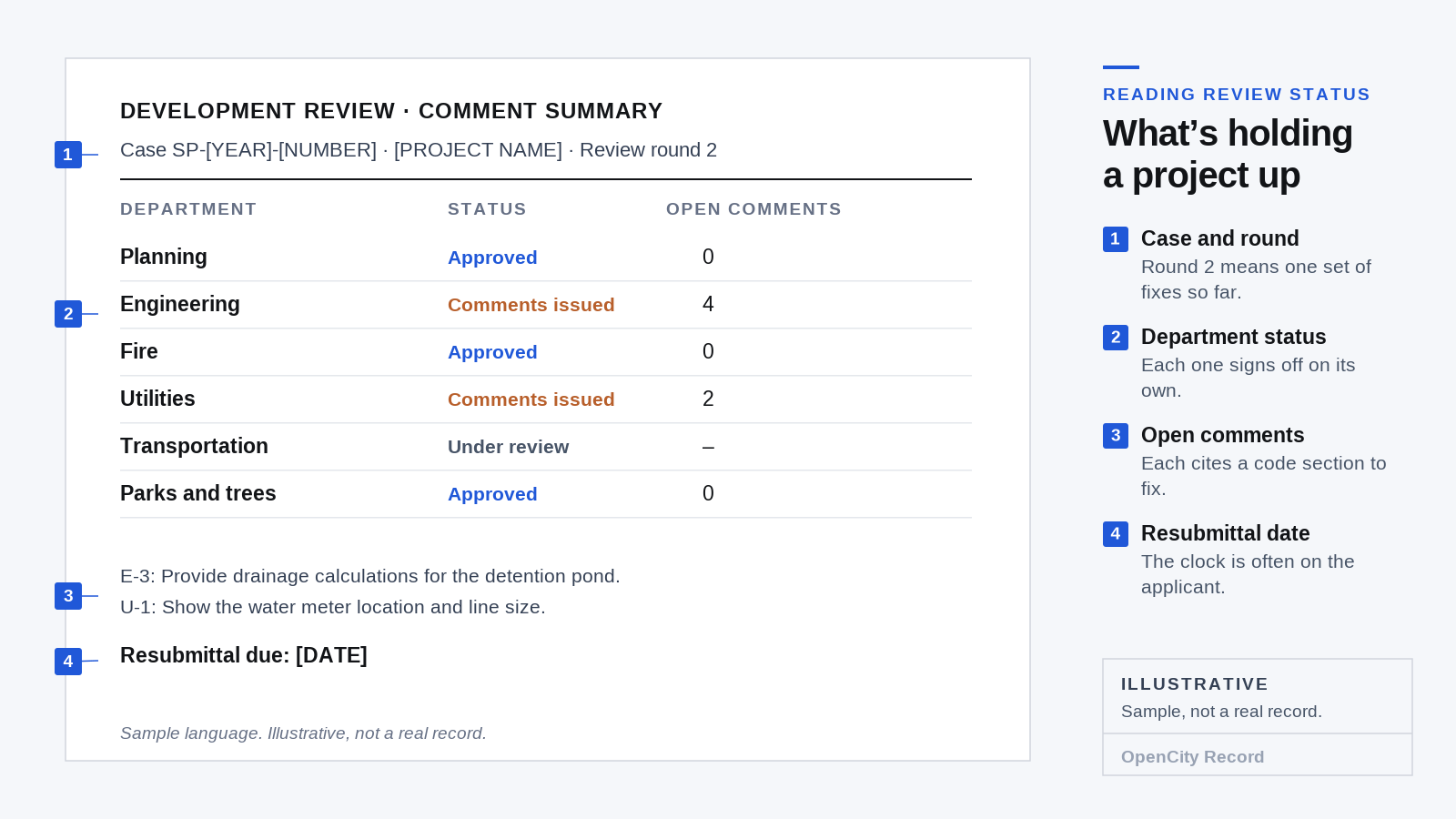
Every department signs off before a project moves to a hearing or a permit. Open comments mean another round.
What is the development review process?
Development review covers every approval a project needs before construction starts. Builders and lawyers often call the land use part the entitlement process: getting a rezoning, special use permit, subdivision plat or site plan approved. Building permits come after that and focus on construction safety.
Which approvals you need depends on the project:
- Fits the zoning: usually site plan review and building permits, often decided by staff.
- New lots: a preliminary and final subdivision plat. Our guide on how to read a plat map explains them.
- Use not allowed: a rezoning, often with a comprehensive plan amendment, or a special use permit, each with public hearings.
Large projects often need several at once. The Las Vegas Planning Commission voted 6-0 on Aug. 11, 2026 to recommend a single package for a 57-lot subdivision that included a rezoning, a special use permit for a gated community, a right-of-way vacation, a site plan and a tentative map.
What are the steps in development review?
The steps below follow a typical order. Your city's code sets the exact names, fees and deadlines.
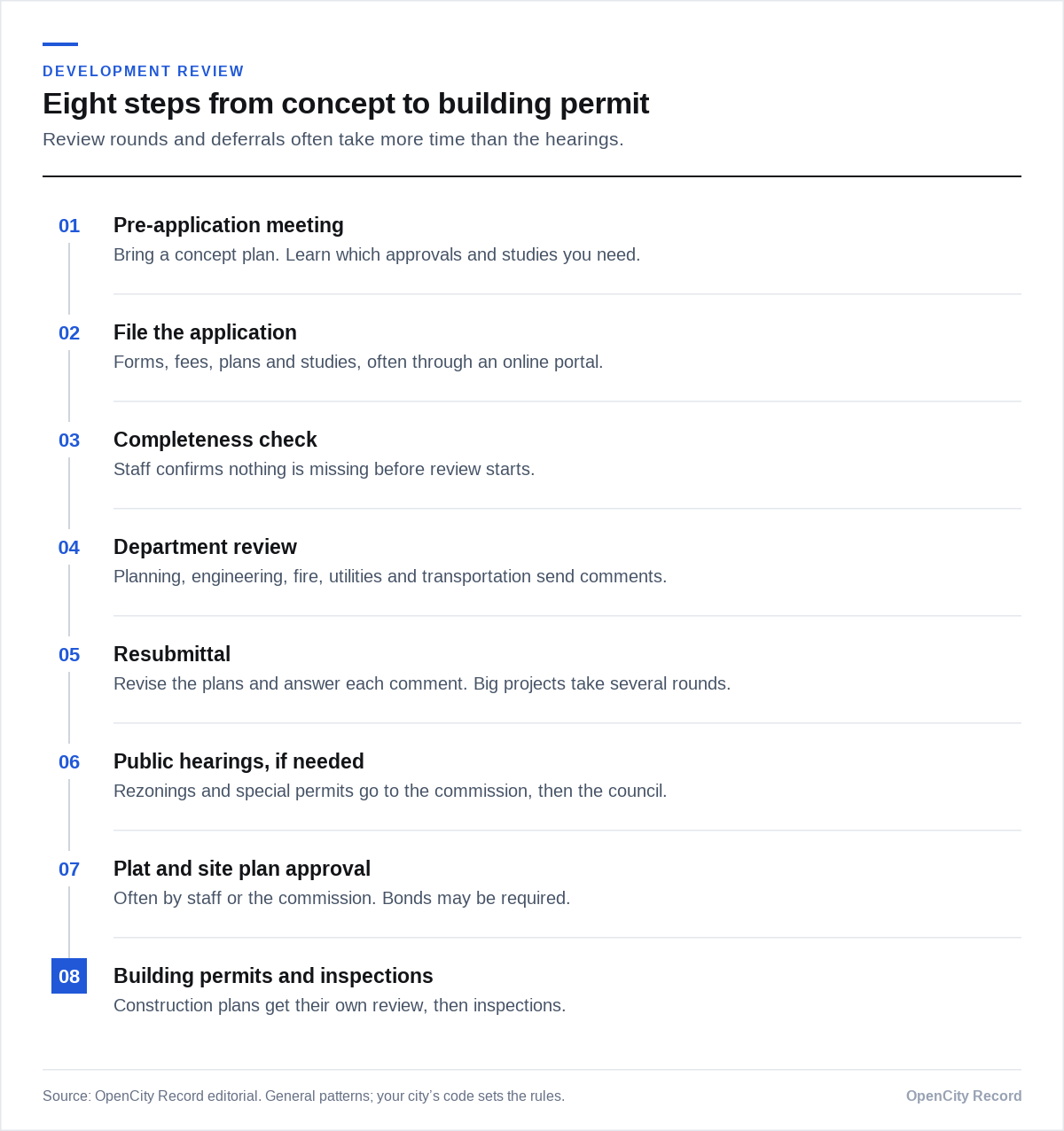
Review rounds and deferrals often take more time than the hearings themselves.
- Pre-application meeting. Bring a concept plan to planning staff. They'll tell you which approvals you need, which studies to include and what problems they see. This is the cheapest time to change a design.
- File the application. Submit forms, fees, plans and studies, such as a traffic study, drainage report or utility plan. Some cities take filings through an online portal.
- Completeness check. Staff confirms that nothing is missing before review starts. Some states set a deadline for this check. Washington, for example, gives local governments 28 days. Check your state's law.
- Department review. Planning, engineering, fire, utilities, transportation and parks each review the plans. Comments come back in writing, often in a single letter.
- Resubmittal. You revise the plans and answer each comment. Big projects can take several rounds.
- Public hearings, if needed. Rezonings and special permits go to the planning commission and then the council, with mailed notice to neighbors.
- Plat and site plan approval. Final plats and site plans are approved, sometimes by the commission, sometimes by staff. Some cities let a developer post a bond for unfinished streets and utilities before a final plat records.
- Building permits and inspections. Construction plans get their own review, then inspections during building.
Who reviews a development application?
A planner usually manages the case, but several departments read the plans. Each one checks its own part of the code and signs off separately. The names differ from city to city, but the jobs are similar:
- Planning or zoning checks use, density, setbacks, height, parking, landscaping and consistency with the comprehensive plan.
- Engineering or public works checks streets, grading, drainage, stormwater ponds and sidewalks.
- Utilities checks water and sewer capacity and where lines connect.
- Fire checks hydrant spacing, fire lanes, turning room for trucks and building access.
- Transportation reviews traffic studies, driveway locations and turn lanes.
- Parks, trees or environmental staff check tree preservation, open space dedications and protected areas.
Outside agencies may review too. A state highway department can control driveways on a state road, a school district may comment on new homes, and a separate utility district may serve the site.
What's in a review comment letter?
After each round, the planner often sends one letter with every department's comments. Each comment points to a code section and says what to change, such as "Show the 25-foot front building line on the site plan" or "Provide drainage calculations for the detention pond." Some comments are firm requirements. Others are suggestions, so ask the planner if the letter doesn't say which is which.
The applicant answers with revised plans and a numbered response to each comment. Clear, complete answers are the fastest way through. A vague answer usually earns the same comment again in the next round.
What's the difference between by-right and discretionary approval?
This is the most important question for timing.
- By-right approval means the project meets the code, so the city generally has to approve it once staff confirms that. There's usually no public hearing. Many site plans, final plats and building permits work this way.
- Discretionary approval means a board gets to weigh the project and can say yes, no or yes with conditions. Rezonings, special use permits, variances and plan amendments are discretionary, and they come with public notice and hearings.
A project that fits the zoning can often move from filing to permits in weeks. One that needs a rezoning adds at least two hearings, each with its own notice period, and the chance of a denial.
How long does development review take?
It depends on the project, the city and the number of rounds. A small project that fits the zoning can clear in weeks. Rezonings can take months, because each hearing needs notice ahead of time, and boards may meet only once or twice a month.
Two real cases show the range:
- A quicker rezoning. Mansfield, Texas's planning and zoning commission recommended a shopping center rezoning on Aug. 20, 2026. The City Council approved it 6-1 on Sept. 28, 39 days after the commission vote.
- A slower one. In DeKalb County, Georgia, a builder's request to rezone land for up to 214 single-family homes was deferred for two cycles on Jan. 22, 2026 while a regional traffic study was finished. It was deferred again on May 28, then approved 6-0 with six conditions on Sept. 24, about eight months after that first hearing.
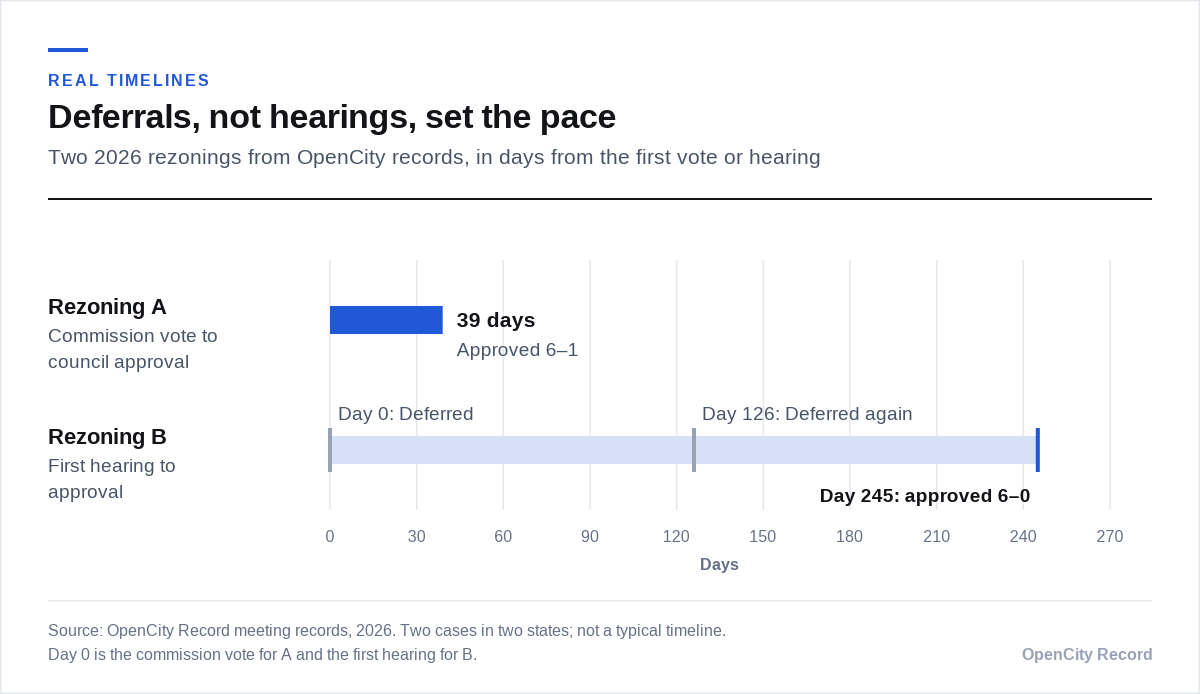
Deferrals, not hearings, made the difference. Each one pushed the second case back months.
What slows a project down?
- Incomplete applications. Missing studies can stop review until they arrive.
- Slow resubmittals. Each round of comments adds time, and the clock is often on the applicant's side.
- Infrastructure disputes. Who pays for roads, water and sewer can be a sticking point. A Kansas City council committee held a 200-lot subdivision for another week on Sept. 29, 2026, its third time before the committee, over a $500,000 road contribution.
- Neighbor opposition. Strong opposition can lead boards to defer for more meetings or ask for redesigns.
- Notice errors. A mistake in mailed or posted notice can force a new hearing.
What should neighbors watch for during review?
If you live near a proposed project, the review stage is your quiet window. There's often no hearing yet, but the plans are public and they can still change. A few things to look for:
- Access points. Where driveways and new streets connect decides where traffic goes.
- Drainage. Look at the grading plan and where the detention pond sits, especially if your lot is downhill.
- Buffers and lighting. Check the landscaping plan and the lighting plan along your property line.
- Height and placement. Compare the building's height and setbacks to what's on your side of the line.
- Open review comments. If staff has raised the same concern you have, say so in writing. It strengthens the comment.
Send questions to the planner named on the case. Staff can't stop a project that meets the code, but they can often fix a detail before plans are final.
Are cities trying to speed up review?
Some are, and the debate over it is real. Supporters say long reviews add cost to every home and storefront, and that predictable timelines help small builders most. Critics worry that faster reviews skip steps that catch problems and cut the public's chance to weigh in.
Prince George's County, Maryland's council voted on Oct. 27, 2026 to pass two bills that let some development approvals be considered at the same time instead of one after another. The site plan bill passed 8-0 and the subdivision bill 9-0. Opponents warned that the change collapses separate legal review stages.
Other reforms include staff-level approval for projects that meet the code, set review deadlines and online portals. HUD's Regulatory Barriers Clearinghouse collects local laws and policies like these.
How can you avoid delays?
- Hold a pre-application meeting and take notes on every issue staff raises.
- File a complete application the first time, with all studies.
- Answer each comment in a numbered response letter.
- Meet neighbors before the hearing notice goes out.
- Track your hearing dates and notice deadlines on a calendar.
- Watch similar cases. Search recent meetings for site plan decisions or find your city to see how your planning commission handles them.
This is general information, not legal advice.
New in your city
See what’s being built in your city
Rezonings, site plans, subdivisions and variances show up on city agendas weeks before the bulldozers do. Pick your city to see the development applications on its agendas, such as rezonings, site plans, subdivisions and variances, with the status of each. It lists the whole city; it does not search by address.
Find your cityCommon questions
What is the development review process?
It's the set of reviews a city uses to approve a project before construction. Staff from several departments check plans against the code, and some projects also need public hearings. The result is the approvals needed to get building permits.
What is the entitlement process?
Entitlement means getting the land use approvals a project needs, such as a rezoning, special use permit, plat or site plan. It comes before building permits, which cover construction safety.
How long does development review take?
It depends on the project and the city. A project that fits the zoning can clear review in weeks. A rezoning or large subdivision often takes several months, and deferrals or resubmittals can add more.
What is a pre-application meeting?
It's an early meeting with city staff before you file. You bring a concept plan, and staff tells you which approvals you need, what issues they see and what to include in the application. Ask your city whether it charges a fee.
Why do projects get deferred?
Reasons include missing studies, unresolved staff comments, neighbor concerns, notice errors or disputes over who pays for roads or utilities. A deferral pushes the case to a later meeting, sometimes months out.
Can residents comment during development review?
Yes, at public hearings and often in writing before them. For staff-level approvals with no hearing, you can still contact the planner assigned to the case and ask to be notified.
Sources
- Permit Review · MRSC
- Site Plans · MRSC
- Subdivisions · MRSC
- Regulatory Barriers Clearinghouse · U.S. Department of Housing and Urban Development
- HUD Creates Web Site to Help Eliminate Barriers, Produce More Affordable Housing · U.S. Department of Housing and Urban Development
- Standard State Zoning Enabling Act and Standard City Planning Enabling Act · American Planning Association
Keep reading
- GuideHow to Check Development Application Status, From Filing to ApprovalHow to check development application status: find the case number, use your city's portal, read status terms and follow hearings to approval.
- GuideWhat Does the Planning Commission Do?What does the planning commission do? It reviews rezonings, plats and plans, holds hearings and advises the council. See its role and how to take part.
- GuideHow to Read a Plat MapHow to read a plat map: find your lot and block, read bearings and distances, spot easements and building lines, and learn where to get a copy.
- GuideHow Rezoning Works: Process, Timeline and CostsRezoning explained: each step from application to council vote, how long it takes, what cities charge, and how neighbors can weigh in or protest.
- GuideHow to Read a Site Plan (Annotated Example)Learn how to read a site plan with an annotated example: north arrow, scale, property lines, setbacks, easements, utilities, drainage and parking.
- GuideComprehensive Plans (General Plans) ExplainedA comprehensive plan, also called a general or master plan, sets a city's long-range land use vision. See what's in one, how it's made and why it matters.