Quick answer
A planning commission is a board of residents, appointed by the mayor or council, that reviews growth and land use. It holds public hearings on rezonings and big projects and recommends approval or denial to the council. In many places it also approves subdivision plats and site plans itself and helps write the comprehensive plan.
Key facts
- Size and appointment rules vary by state. In Washington, for example, county planning commissions have five, seven or nine members, and town commissioners serve without pay. Members are appointed, not elected.
- On rezonings, the commission usually recommends and the council decides. On plats and some site plans, the commission often has the final say.
- The idea comes from the Standard City Planning Enabling Act, a 1928 Commerce Department model law that created the planning commission and the master plan.
- Councils don't always follow the commission. In 2026, Las Vegas's council approved a project 7-0 that its planning commission had recommended denying.
- Names vary: planning commission, planning board, plan commission, or planning and zoning commission, often shortened to P&Z.
What does the planning commission do? It's the board that looks at how your city grows. A planning commission is a group of residents, appointed by the mayor or council, that holds public hearings on rezonings, subdivisions and big projects. On many cases it makes a recommendation and the council decides. On others, like subdivision plats, it often has the final say. It also helps write and update the city's long-range plan.
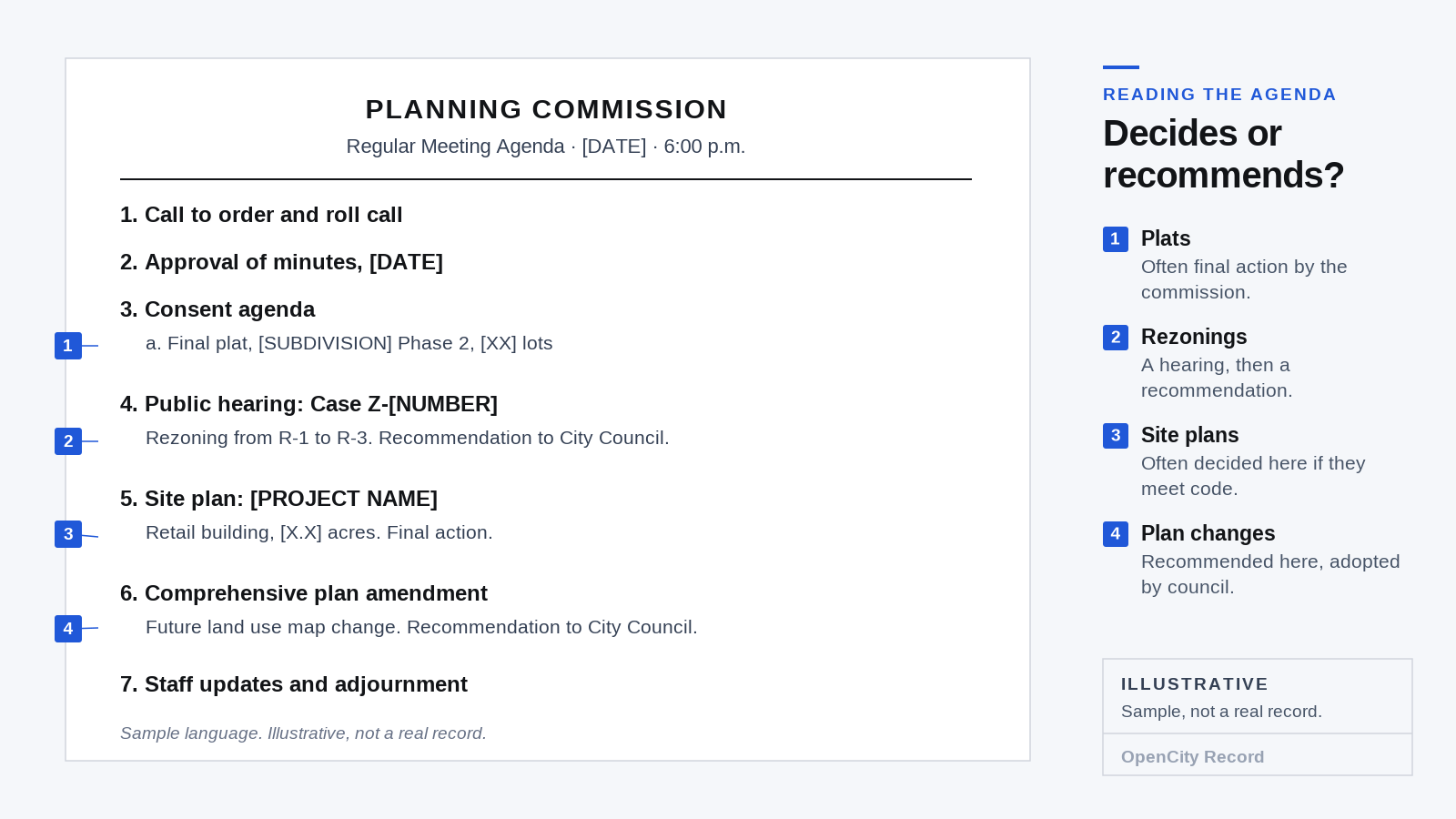
A typical agenda mixes items the commission decides with items it only recommends to the council.
What is a planning commission?
The planning commission goes by several names, including planning board, plan commission and planning and zoning commission, often shortened to P&Z. Size and appointment rules vary. In Washington, for example, county commissions have five, seven or nine members, and town commissioners serve without pay. Members are appointed residents, supported by the city's professional planning staff.
The model comes from the Standard City Planning Enabling Act, which the U.S. Commerce Department published in 1928. It set out the planning commission's powers and gave it the job of making a master plan. In many states these model acts still supply the basic structure, so the role is similar across the country, even though each state sets its own details.
What does a planning commission decide?
Its work falls into three groups.
Recommendations to the council. The commission holds a public hearing on each rezoning, zoning code change and comprehensive plan amendment, then votes to recommend approval, approval with conditions or denial. The council makes the final decision.
Final decisions. In many places the commission approves subdivision plats and site plans itself, as long as they meet the code. Some commissions also decide special or conditional use permits.
Long-range planning. The commission helps write the comprehensive plan, holds hearings on it and recommends it to the council.
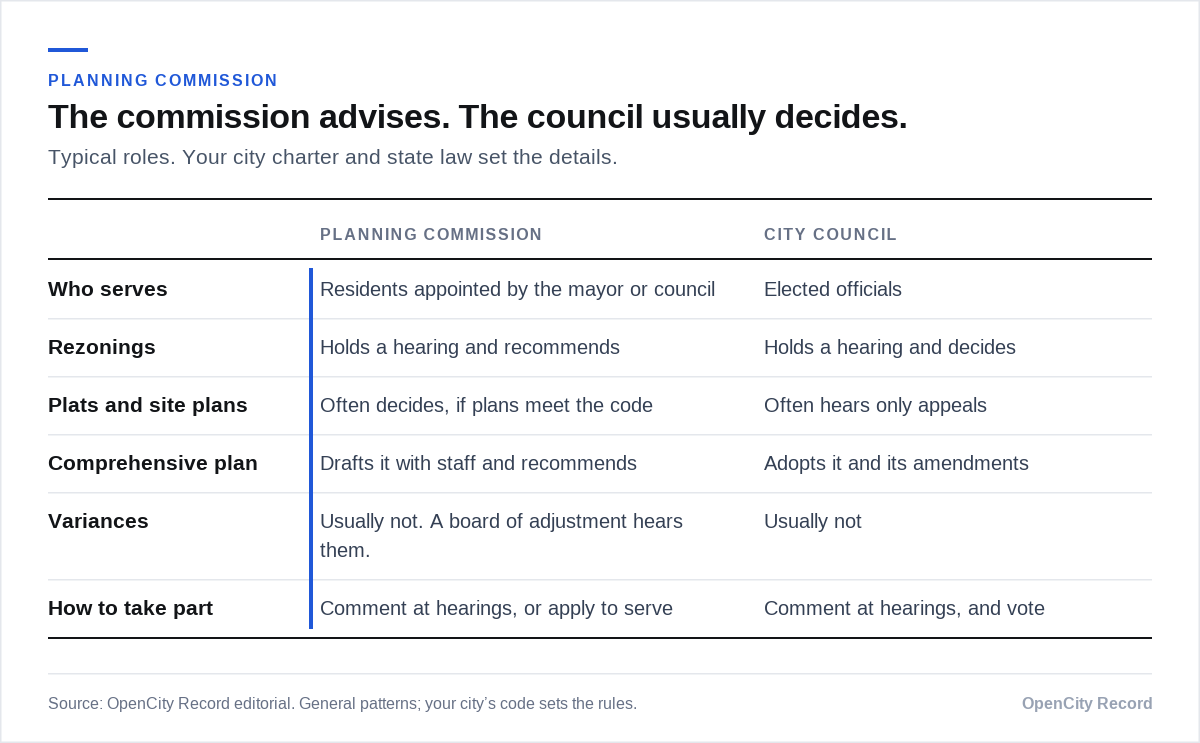
The planning commission advises on most big land use decisions. The council usually decides.
What happens at a planning commission meeting?
Many meetings follow a similar order. The chair opens the meeting, the commission approves the last minutes and then takes up a consent agenda of routine items, often plats that meet the code. Public hearings come next. For each one, staff presents the case, the applicant speaks, the public comments, the applicant may respond and then members ask questions and vote. Meetings often end with staff updates on upcoming cases or plan work.
How much weight does a commission recommendation carry?
A lot, but it isn't binding. A clear recommendation tells the council where the commission and the public stood. OpenCity's records show both outcomes:
- Greenville County, South Carolina's council denied a commercial rezoning on June 16, 2026, following its planning commission's recommendation.
- The Las Vegas City Council voted 7-0 on Oct. 7, 2026 to approve a multi-family project, overriding recommendations for denial from both staff and the planning commission.
- Mansfield, Texas's planning and zoning commission recommended a shopping center rezoning on Aug. 20, 2026, and the City Council approved it 6-1 on Sept. 28, 39 days later.
Commissions don't always follow staff, either. Nashville's Planning Commission approved a two-lot subdivision plat on Feb. 26, 2026 even though staff had recommended disapproval. And when a case is complicated, a council can give its commission more time. Raleigh's City Council voted 8-0 on Jan. 6, 2026 to give its planning commission a 45-day extension to review a rezoning.
How is the planning commission different from the city council?
The council is elected and makes law. The commission is appointed and advises. That difference matters to you in two ways. First, if you want to change a recommendation, the commission hearing is where staff and members are still forming their views. Second, if you want to change a decision, the council is where you need the votes. Our guide to how to oppose a zoning change covers both hearings.
The commission is also different from the board of adjustment, which hears variances and appeals. Some smaller cities have one board do both jobs.
How can you take part?
- Read the agenda. Commissions post agendas days ahead, often with a staff report for every case. Find your city to see its latest planning agenda.
- Send written comments. Address them to the planner named in the staff report, with the case number.
- Speak at the hearing. Keep it short and tie it to the code's criteria.
- Apply to serve. Many cities post openings on boards and commissions and take applications from residents.
To see what planning commissions near you have been deciding, search recent meetings for planning commission recommendations.
New in your city
See what’s being built in your city
Rezonings, site plans, subdivisions and variances show up on city agendas weeks before the bulldozers do. Pick your city to see the development applications on its agendas, such as rezonings, site plans, subdivisions and variances, with the status of each. It lists the whole city; it does not search by address.
Find your cityCommon questions
Is the planning commission the same as the zoning board?
Often not. The planning commission reviews rezonings, plats and plans and advises the council. The zoning board of adjustment or appeals often hears variances and appeals of staff decisions. Some places assign both jobs to one board.
Who serves on the planning commission?
Residents appointed by the mayor, the council or both, for terms set by state or local law. In Washington towns, for example, members serve four- or six-year staggered terms without pay. Check your city's code for its rules.
Does the planning commission have the final say?
On rezonings and plan changes, usually not. It recommends and the council decides. On subdivision plats and some site plans, the commission often makes the final decision, unless someone appeals.
Can I speak at a planning commission meeting?
Yes. Public hearings on rezonings and similar cases are open to anyone. Many commissions also take general public comment. Check the agenda for sign-up rules and time limits.
How often does the planning commission meet?
It varies, so check your city's meeting calendar. Agendas are posted ahead of time under your state's open meetings law, often with staff reports for each case.
Sources
- Standard State Zoning Enabling Act and Standard City Planning Enabling Act · American Planning Association
- Planning Commissions · MRSC
- Public Hearings · MRSC
- Zoning · Legal Information Institute, Cornell Law School
Keep reading
- GuideComprehensive Plans (General Plans) ExplainedA comprehensive plan, also called a general or master plan, sets a city's long-range land use vision. See what's in one, how it's made and why it matters.
- GuideThe Development Review Process, Step by StepThe development review process, step by step: pre-application, filing, staff review, hearings, plats and permits, with real timelines and delay tips.
- GuideHow Rezoning Works: Process, Timeline and CostsRezoning explained: each step from application to council vote, how long it takes, what cities charge, and how neighbors can weigh in or protest.
- GuideHow to Oppose a Zoning Change (or Support One)How to oppose a zoning change, or support one: read the notice, find the criteria, comment on time, organize neighbors and make arguments that persuade.
- GuideHow to Read a Plat MapHow to read a plat map: find your lot and block, read bearings and distances, spot easements and building lines, and learn where to get a copy.
- GuideHow to Check Development Application Status, From Filing to ApprovalHow to check development application status: find the case number, use your city's portal, read status terms and follow hearings to approval.