Quick answer
A special district tax is a charge on your property bill from a separate local district, not your city or county. Developers often use these districts to pay for roads, water lines and parks in new neighborhoods. Names vary by state, including MUDs, PIDs, CDDs, Mello-Roos and metro districts. Some charge a tax rate, others a fixed yearly assessment.
Key facts
- Special districts drove most of the recent growth in local governments. The U.S. Census Bureau counted 91,438 local governments in 2025, up from 90,837 in 2022, largely because of new special districts in four states.
- A district tax is a rate times your home's value, often set by the district board each year. An assessment is a charge levied under a plan for the district, such as a Texas PID's service and assessment plan.
- Many district charges are tied to bonds that take years to pay off. In Colorado, for example, the state says bond repayment periods are often 20 years.
- Several states, including Texas, Florida, California and Colorado, require a written notice to buyers about district taxes, but the rules and timing vary.
- District charges can be a large share of a new home's tax bill, so compare total tax bills, not just home prices.
A special district tax is a charge on your property bill from a separate local district, not from your city or county. Developers often use these districts to pay for the roads, water lines, drainage and parks in a new neighborhood. The cost is then paid back by the people who buy the homes, often over many years. The names change from state to state: municipal utility districts (MUDs), public improvement districts (PIDs), community development districts (CDDs), Mello-Roos districts and metropolitan districts. Some charge a tax rate on your home's value. Others charge a set yearly assessment.
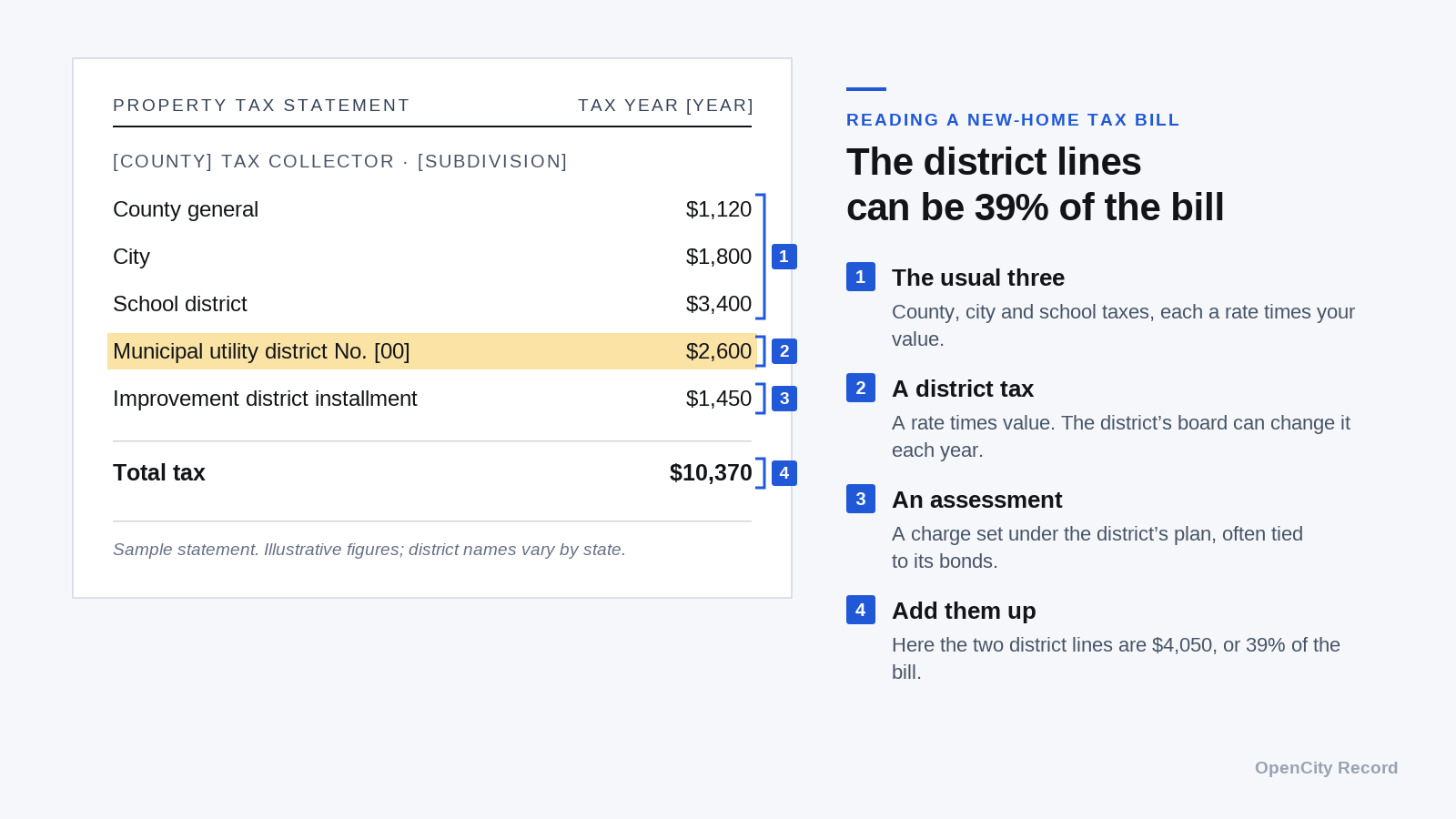 On a newer home, the district lines can be a big share of the bill.
What is a special district tax?
A special district is a local government with one job, such as water, roads or parks, and a set boundary. The U.S. Census Bureau counted 91,438 local governments in 2025, up from 90,837 in 2022. It said the growth was largely due to more special districts in four states: Colorado, Florida, Nebraska and Texas.
In a new subdivision, a developer may ask the city or county to form a district before the first house is built. Colorado's state government notes that metro districts are often set up by developers. The district sells bonds to pay for the pipes and streets, and the homeowners repay those bonds through their tax bills. Supporters say this makes new growth pay for itself, so existing residents don't foot the bill. Critics say it hides part of a home's real cost in the tax bill, where buyers may not look until after closing.
How do MUDs, PIDs, CDDs and Mello-Roos compare?
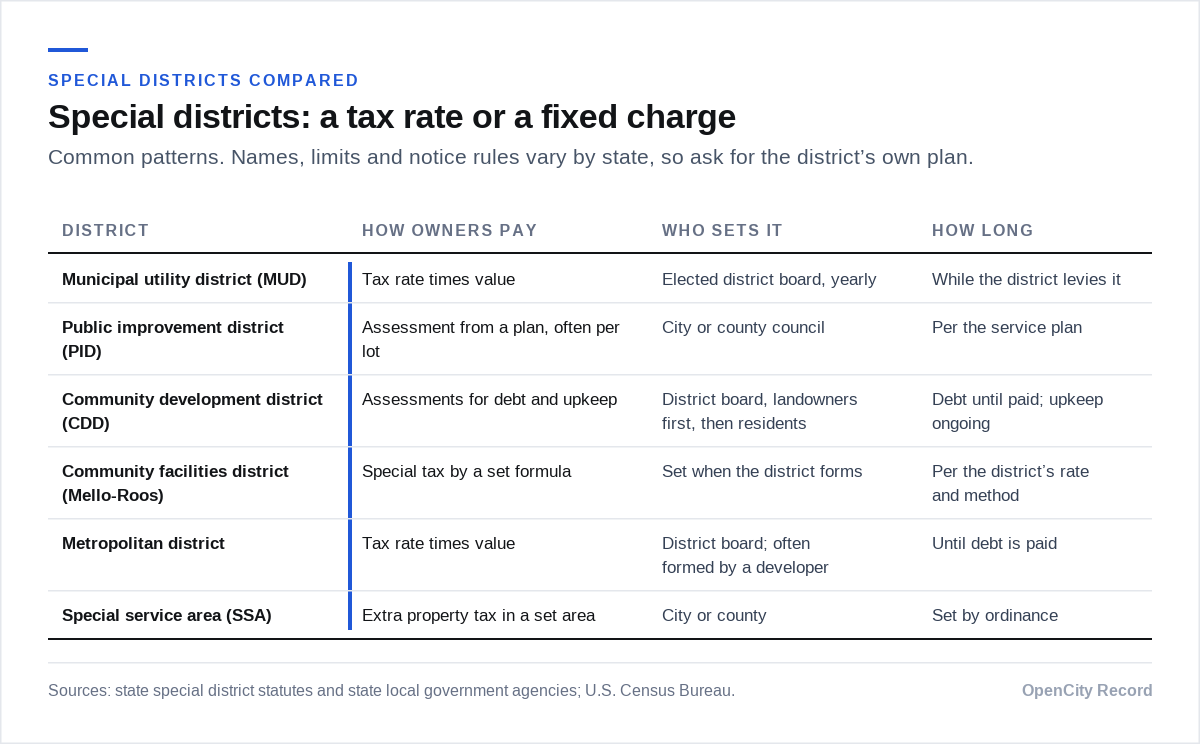 Two questions matter most for a buyer: is it a rate or a fixed amount, and who can change it?
The biggest difference is how you pay. A tax is a rate times your home's value, like a MUD or a metro district. An assessment is a charge spread across properties under a plan, like a Texas PID, where the city or county apportions the cost by the benefit to each property. A special tax, the Mello-Roos model, follows a rate and method set when the district forms, which can be based on factors other than value.
How are special districts created?
Districts form at public meetings, often before future buyers are around to notice, since the homes don't exist yet. Here's how that looks in different states.
- In Riverside County, California, supervisors voted 5-0 on June 2, 2026 to form a community facilities district for a 226-home project. The district will pay for landscaping, street lights, trails and drainage. No one spoke at the public hearing.
- In Jacksonville, Florida, the City Council voted 15-0 on Oct. 13, 2026 to establish a new community development district.
- In Colorado Springs, Colorado, the City Council approved a service plan for a new metropolitan district on Aug. 25, 2026 as part of an 8-0 consent vote.
- In Fort Worth, Texas, the City Council voted 10-0 on Sept. 29, 2026 to create a public improvement district after a public hearing on the petition asking for it.
You can search recent meetings for district votes where you're buying.
How do you find out if a home is in a special district?
- Pull the current tax bill from the county tax collector or assessor website. If you aren't sure which county covers the address, find the city first. Every district shows up as its own line.
- Ask the seller for every district notice your state requires. Texas, Florida, California and Colorado all require some form of written notice, but the timing and form vary, so check your state's law.
- Look up each district's rate or assessment, its bond payoff date and whether the charge can rise.
- Ask the title company to list every district that covers the parcel.
- Compare total yearly taxes between homes, not just prices. A cheaper home with a large district charge can cost more each month.
Can special district taxes go up?
It depends on the type and the state. A MUD board can levy taxes within the limits set by its voters, its bonds and state law. In Colorado, a metro district generally needs voter approval to raise its mill levy. In Florida, the notice buyers get says CDD taxes and assessments are set each year by the district board. District boards are public bodies, so you can usually watch the vote that sets your rate.
This is general information, not tax or legal advice.
New in your city
See what’s being built in your city
Rezonings, site plans, subdivisions and variances show up on city agendas weeks before the bulldozers do. Pick your city to see the development applications on its agendas, such as rezonings, site plans, subdivisions and variances, with the status of each. It lists the whole city; it does not search by address.
Find your cityCommon questions
What is a special district tax?
It's a tax or assessment charged by a separate local district that pays for things like water lines, roads, drainage or parks. It shows up on your property tax bill on top of city, county and school taxes.
What is the difference between a MUD and a PID?
A municipal utility district is its own government with an elected board that can levy a tax on property value. A public improvement district is created by a city or county, which levies assessments based on the benefit to each property under a service plan.
What is Mello-Roos?
It's the common name for a California community facilities district, which charges a special tax using a rate and method set when the district forms. The formula can be based on things other than home value. It pays for facilities or services in the area.
How long do special district taxes last?
It depends on the district. Charges for debt last until the bonds are paid, and in Colorado bond repayment periods are often 20 years. Some districts also charge for ongoing services like landscaping or street lights. Ask for the district's bond and budget documents.
How do I find out if a house is in a special district?
Look at the current tax bill on the county tax or assessor website, where each district appears as its own line. Ask the seller for any district notices your state requires, and ask the title company to confirm every district that covers the parcel.
Are special district taxes deductible?
It depends on the charge. The IRS says deductible real estate taxes are levied for the general public welfare at a like rate across the jurisdiction, and taxes for local benefits, like new streets or sidewalks, generally are not, unless they're for maintenance, repair or interest. Ask a tax professional.
Sources
- Government Organization Summary Report: 2022 and 2025 · U.S. Census Bureau
- Texas Water Code, Chapter 49 (§49.452, Notice to Purchasers) · Texas Legislature
- Texas Local Government Code, Chapter 372: Improvement Districts in Municipalities and Counties · Texas Legislature
- Florida Statutes §190.048, Sale of real estate within a district; required disclosure to purchaser · Florida Senate
- California Civil Code §1102.6b, Notice of special tax (Mello-Roos) · California Legislative Information
- Special Districts in Colorado: A Brief Review for Residents and Prospective Homeowners · Colorado Division of Local Government
- Cal. Gov. Code 53325.3: Special tax not a special assessment · California Legislature
- Fla. Stat. 190.006: Board of supervisors; members and meetings · Florida Senate
- 35 ILCS 200/27-5: Special Service Area Tax Law · Illinois General Assembly
- Topic No. 503, Deductible Taxes · Internal Revenue Service
Keep reading
- GuideThings to Check Before Buying a House: The Local Government ChecklistThings to check before buying a house that an inspector won't: zoning, permits, special district taxes, flood zone, planned roads and nearby rezonings.
- GuideHow to Check Zoning Before You Buy a HouseHow to check zoning before buying a house: find the zone, read its rules, spot overlays and nonconforming uses, and see what's pending next door.
- GuideParcel Lookup and County GIS Maps: How to Use ThemA parcel lookup shows a property's owner, size, value and tax districts. Learn to search county GIS maps, read the record and use the right layers.
- GuideHow to Find Out What's Planned Near a PropertyHow to find out if a road is planned near your property, plus new subdivisions, rezonings and utility work, using capital plans, road plans and agendas.