Quick answer
Before you buy a house, check what local government knows about it: the zoning, the permit history and open code cases, special district taxes, easements, the FEMA flood zone, planned roads, rezonings nearby, HOA and city rules, annexation plans, the school zone and how the taxes will change after the sale. Much of it is online.
Key facts
- FEMA says almost one-third of National Flood Insurance Program claims from 2014 to 2024 came from outside high-risk flood areas.
- A federally backed mortgage on a home in a FEMA high-risk zone, those starting with A or V, requires flood insurance.
- Special taxing districts go by different names from state to state, such as municipal utility districts, community development districts, community facilities districts and metropolitan districts.
- In several states with yearly assessment caps, such as California, Florida and Michigan, a sale resets the capped value, so the buyer's bill can jump. In Oregon, assessed values don't reset at a sale.
- Mailed notice of a zoning change generally goes to current owners near the site, so a buyer who hasn't closed has to check agendas to find out.
The most important things to check before buying a house aren't all inside it. A home inspector looks at the roof and the wiring, but city hall, the county and a few special districts decide what can be built next door, what you'll pay in taxes and whether the street floods. Before you buy, check the zoning, the permit history and any open code cases, special district taxes, easements, the FEMA flood zone, planned roads, rezonings nearby, HOA and city rules, annexation plans, the school zone and how the taxes will change after the sale. Much of it is online, and with the parcel ID you can get through a lot of it in a few hours.
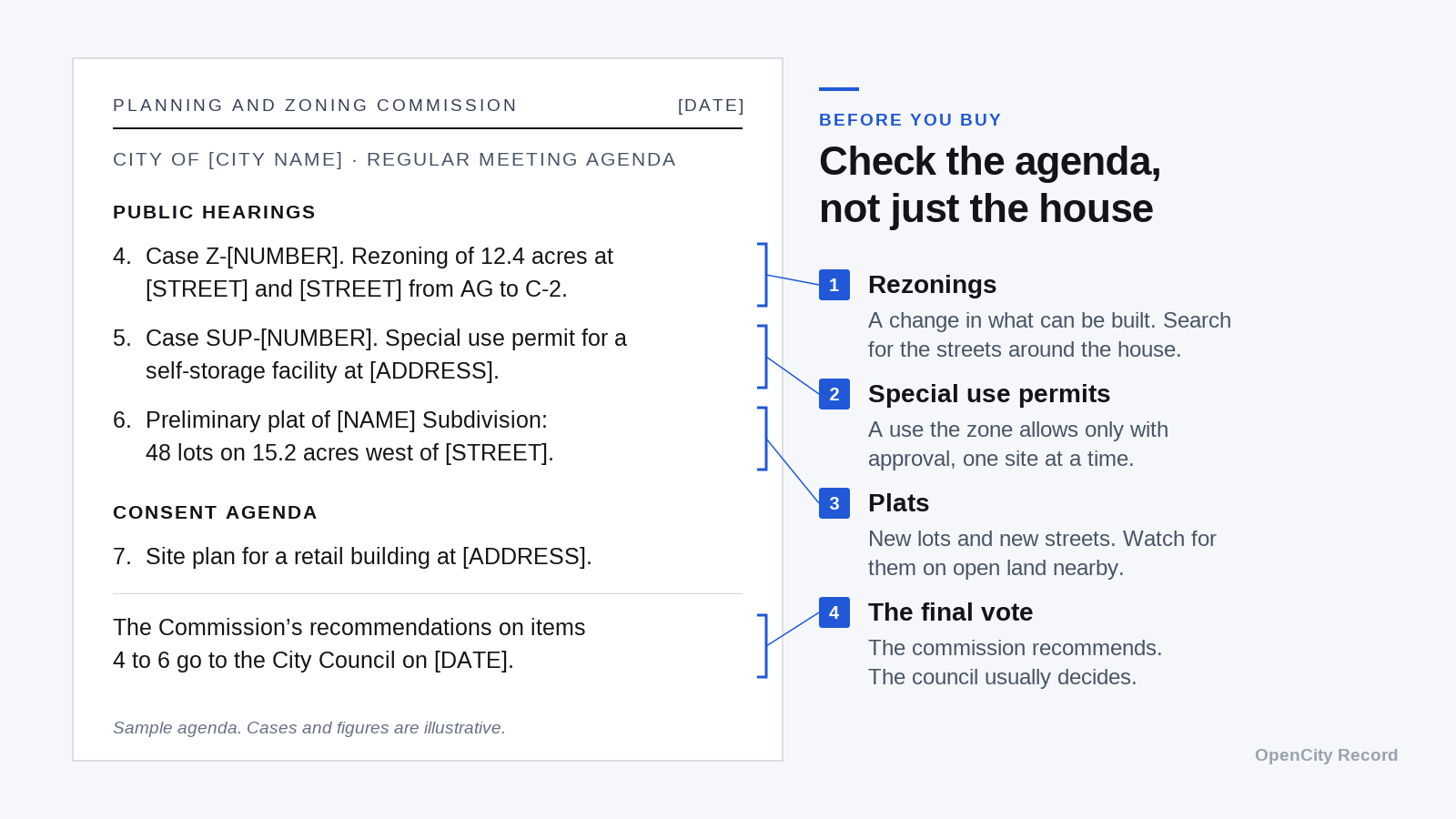
The inspector checks the house. This checklist covers the decisions made around it.
Why check with local government before you buy a house?
Your purchase contract covers the house, but local government controls almost everything around it. A council can rezone the field behind your backyard, and a new flood map can change what your lender requires. None of that shows up in an inspection report.
The notice system isn't built for buyers, either. Rules vary by state and city, but mailed notice of a zoning change generally goes to nearby owners listed on the tax roll. North Carolina, for example, requires it for the affected and abutting owners. A buyer who hasn't closed won't get that letter, so you have to go look. You can find the city that covers the address and read its recent agendas.
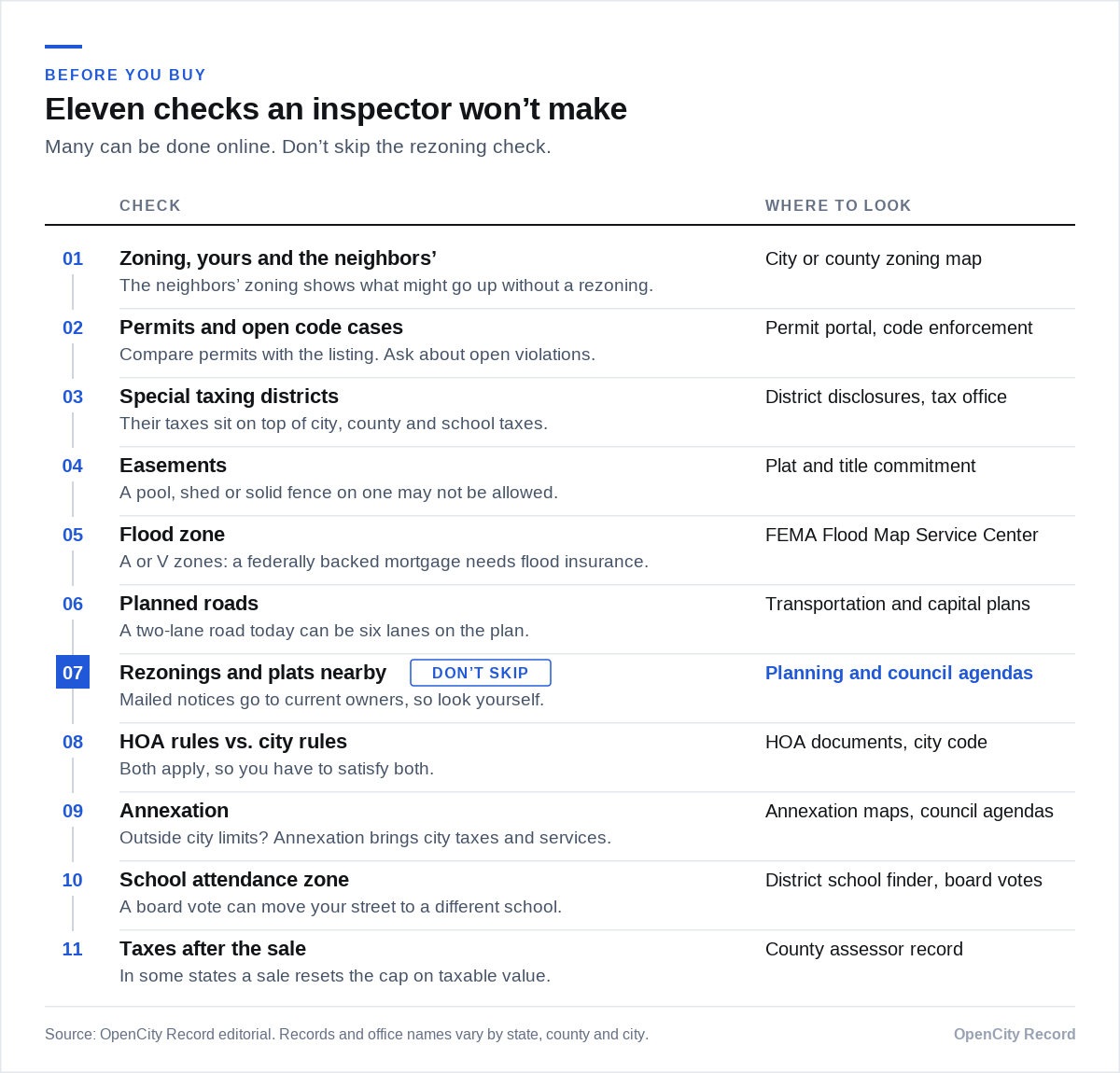
Eleven checks, many of them online. Don't skip the rezoning check.
What is the property zoned, and what can be built next door?
Start with the zoning map. Find the zoning district for the house and for every lot within a few blocks, because the neighbors' zoning tells you what might go up there without a rezoning. Uses already allowed on land zoned for commercial or apartments may not need a public hearing. Look for overlay districts too, such as historic districts, which add their own rules on top of the base zone. Our guide to finding the zoning of a property walks through the map tools.
Zoning also protects you. On Oct. 15, 2026, Nashville's Board of Zoning Appeals voted 5-0 to deny a request to build a new house closer to the street than the code allows, after members found no hardship. Setbacks like that are what keep a new house from being built up to the sidewalk next to yours.
Were past additions permitted, and are there open code cases?
Search the city or county permit portal by address and compare what you find with the listing. If the listing says four bedrooms and the permits show a three-bedroom house with no addition, ask why. Unpermitted work can draw an appraiser's comment on its quality and value, and it can mean the city makes the next owner open walls or remove the work. Our guides on looking up permits on a property and unpermitted work cover both.
Then call or email code enforcement and ask whether any cases are open on the address. It's far easier to get a violation fixed, or the price adjusted, before you own the house.
Is the house in a special taxing district?
Some newer subdivisions sit inside a special taxing district. That's a separate local government that paid for the streets, water lines or parks, and it collects its own tax or assessment to pay off the debt. That charge sits on top of the city, county and school taxes, and it can run for many years. Each state has its own name for these districts and its own rules for telling buyers. These are some of the most common.
| Common district name | How owners pay | How buyers are often told |
|---|---|---|
| Municipal utility district (MUD) | District property tax | A written notice from the seller before the sale |
| Community development district (CDD) | Taxes or assessments on the property | A disclosure in the contract for the first sale after the district forms |
| Community facilities district | Special tax on the property | The seller must make a good-faith effort to get and deliver a notice of special tax |
| Metropolitan district | District property tax | A special taxing district disclosure in residential contracts |
| Special service area (SSA) | Extra property tax in the area | Rules vary, so ask the seller and the title company |
Common patterns from several states' laws. Names and notice rules vary, so ask the seller or title company for every district that covers the parcel.
Ask for every district disclosure early, then look up each district's current rate on the county tax or assessor website. Many district boards set rates each year at public meetings.
What easements cross the lot?
An easement gives someone else, usually a utility or a neighbor, the right to use part of your land. Building a pool, a shed or a solid fence on top of one may not be allowed, and the easement holder may have the right to dig there. Easements show up on the recorded subdivision plat and in the title commitment your title company sends before closing, where they're listed as exceptions to the title coverage. Read that list line by line and ask the title company to show you any easement that crosses the backyard or the spot where you'd want to build.
Is the house in a flood zone?
Look up the exact address on FEMA's Flood Map Service Center. Zones that start with A or V are high-risk areas, where a flood with a 1% chance of happening in any year would reach, and a federally backed mortgage on a home there requires flood insurance. Being outside those zones doesn't mean the house is safe, though. FEMA says almost one-third of flood insurance claims from 2014 to 2024 came from outside high-risk areas.
Check whether only part of the lot is mapped, and ask the seller directly about past flooding. Maps change, so search council and planning agendas for new flood studies or map updates, and look at the city's capital plan for drainage projects on your street.
Are new roads or widenings planned nearby?
A quiet two-lane road on today's map can be a future six-lane road on the city's thoroughfare or transportation plan. Check that plan, the city's capital improvement plan, which lists funded projects by year, and your state transportation department's project map for highways. Budget and capital plan hearings are a good place to see what's actually funded. A widening can mean years of construction, a smaller front yard or a new traffic signal at your corner.
Is anything being rezoned or built nearby?
This is where the public record matters most. A zoning sign goes up only on the parcel being changed, and mailed notices go to current owners, so a buyer is the last to know. Search the last six months of planning commission, zoning board and council agendas for the streets around the house, then check what's scheduled next. Watch for rezonings, specific or special use permits, site plans and subdivision plats. You can search recent meetings for rezoning cases to see how often they come up where you're buying.
Here's what that looks like at real meetings. On Oct. 27, 2026, Bexar County, Texas, commissioners tabled a subdivision plat over an aquifer recharge zone that was reportedly meant for a data center, according to the meeting recording. The same day, San Diego's City Council voted 9-0 to pause new data center approvals citywide for 45 days while it works on permanent rules. A buyer near industrial land in either place would want to know about both.
From the record
Real examples from public meetings
- Approved 6-1
Mansfield, TX
City Council ·
Approved a zoning change for a commercial center with a 22,000-square-foot package store on 15.8 acres, after the planning and zoning commission recommended it.
From the meeting recording. The official minutes were not yet published.
- Denied
Greenville County, SC
County Council ·
Denied a rezoning from POD to C-1 on second reading, following the planning commission recommendation.
From the meeting recording. The official minutes were not yet published.
- Approved 10-0
Kane County, IL
Development Committee ·
Approved a preliminary plat for a two-lot subdivision on 4.6 acres next to a forest preserve.
From the meeting recording. The official minutes were not yet published.
- Approved 3-2
Washoe County, NV
Planning Commission ·
Approved a 34-lot subdivision map of 2.5-acre lots after residents testified against it over groundwater, fire and flooding.
From the meeting recording. The official minutes were not yet published.
Do HOA rules or city rules decide what you can do?
Both apply, so in practice you have to satisfy both. A city might allow a backyard cottage or a short-term rental that the HOA's deed restrictions ban, and an HOA approval doesn't replace a city permit. Some states require the association to hand over HOA documents for a sale. In Texas, for example, that packet includes the restrictions, the bylaws and rules, and a resale certificate with the assessments and the current operating budget. Read the deed restrictions themselves, not just a summary, and check the city code for anything you plan to do, like adding a pool, parking a work truck or renting out a room.
Could the city annex the property?
If the house sits outside city limits, find out whether a nearby city could annex it. Annexation brings city taxes and services, and sometimes city zoning, so it changes the math on a house. State laws range widely, and some require the owners' consent or a vote. Tennessee, for example, has allowed annexation only with the owners' written consent or by referendum since a 2014 law. Some states also let a city control development just outside its limits. North Carolina calls this extraterritorial jurisdiction. Check the city's annexation and planning maps, and search council meetings for annexation items.
Which school zone is the house in?
Attendance zones for individual schools can change. Check the district's school-finder tool, then search school board agendas for boundary studies or new campuses, because a board vote can move your street to a different school after you close. While you're there, note the school district's tax rate, since school taxes are part of the bill.
What will your property taxes be after you buy?
Don't plan your budget around the seller's tax bill. Some states cap how fast a home's taxable value can rise, and in several of them the cap ends when the house sells. When the house sells, the value can jump to market value or the sale price, and the buyer's first full bill shows it.
| Type of cap | How it works | What happens at a sale |
|---|---|---|
| Cap that resets at a sale (California) | Value can rise up to 2% a year | The home is reassessed at market value as of the change in ownership |
| Homestead cap (Florida 3%, Texas 10%) | Limits yearly increases on a primary home | The seller's cap ends; the buyer's own cap starts after they qualify, and Florida lets an owner move part of the savings to a new home |
| Inflation-linked cap (Michigan) | Inflation or 5%, whichever is less | Taxable value uncaps the year after the transfer |
| Cap that stays with the house (Oregon) | Assessed value can rise about 3% a year | No reset at a sale |
Examples from state statutes and state and county sources. Local details vary, so check your state's rules.
Look up the property on the county assessor's website and compare the market value with the taxable or assessed value on the current bill. If there's a big gap and your state resets at a sale, expect your bill to grow by that gap times the combined tax rate. Our guide to how property tax is calculated walks through the math for rates in mills, dollars per $100 and percent.
How do you run this checklist in one afternoon?
Work through these in order, and keep a folder of screenshots and PDFs as you go.
- Get the parcel ID from the listing or the county assessor, since many government search tools find a property faster by parcel ID than by street address.
- Open the city or county zoning map and note the zone for the house and the blocks around it.
- Search the permit portal by address, then ask code enforcement about open cases.
- Look up the address on FEMA's Flood Map Service Center and save a copy of the map panel.
- Ask the seller or your agent for every special district disclosure and the HOA documents, and read the easements and exceptions in the title commitment.
- Pull the assessor's record and the tax rate of every taxing unit on the bill.
- Search the last six months of planning and council agendas for the surrounding streets, plus the next month's agendas.
- Check the transportation plan, the capital improvement plan, the city's annexation map and the school attendance zones.
Try to finish before your inspection or due diligence period ends. In many purchase contracts, that's the window when you can still back out without losing your deposit. If something on the list looks off, ask about it in writing before then.
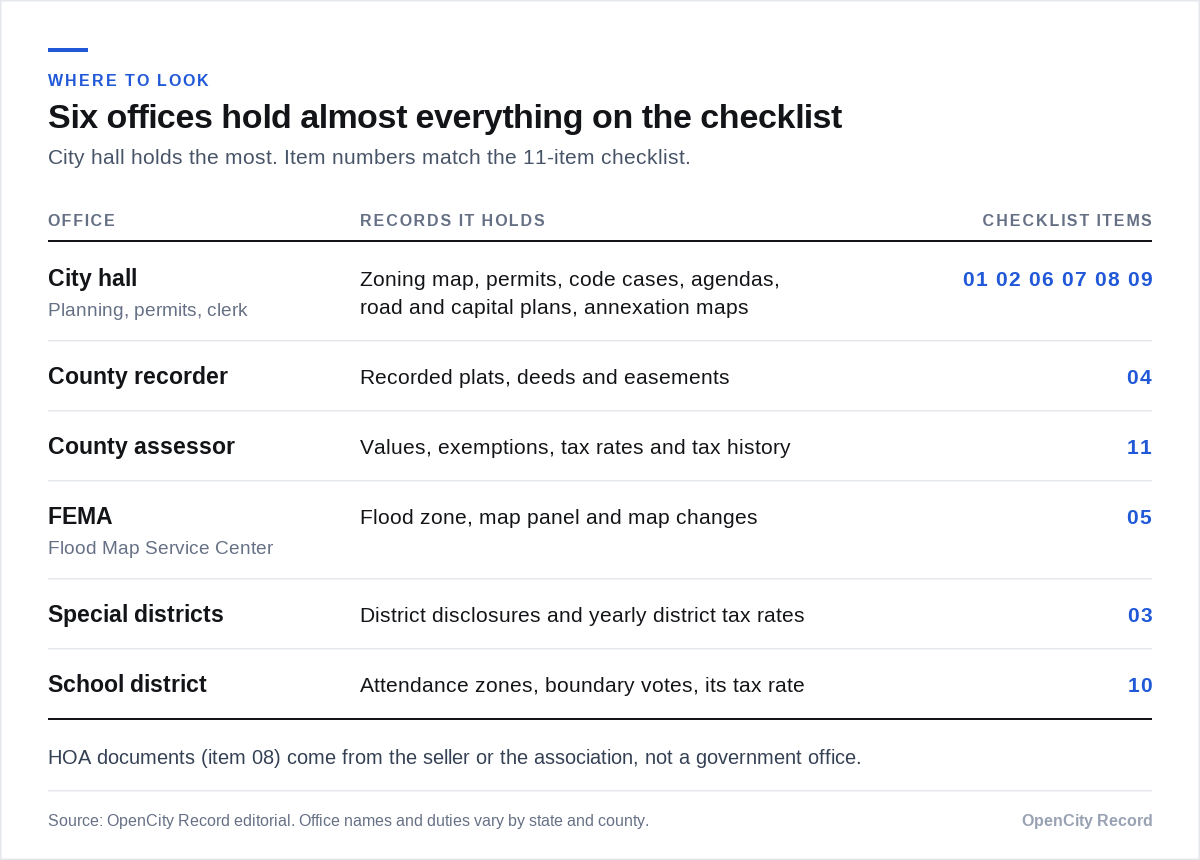
Six offices hold most of the records on the checklist.
This is general information, not legal or tax advice.
New in your city
See what’s being built in your city
Rezonings, site plans, subdivisions and variances show up on city agendas weeks before the bulldozers do. Pick your city to see the development applications on its agendas, such as rezonings, site plans, subdivisions and variances, with the status of each. It lists the whole city; it does not search by address.
Find your cityCommon questions
What should I check at city hall before buying a house?
Check the zoning of the house and the land around it, the permit history, open code cases, special district taxes, easements, the flood zone, planned roads, pending rezonings, HOA and city rules, annexation plans, the school zone and the tax history. Most of it is on city, county and assessor websites.
How do I find out if a house is in a flood zone?
Enter the exact address in FEMA's Flood Map Service Center. Zones starting with A or V are high-risk areas where a federally backed mortgage requires flood insurance. Also ask the seller about past flooding, since FEMA says almost one-third of claims from 2014 to 2024 came from outside high-risk areas.
What is a special taxing district?
It's a separate local government that pays for things like water lines, roads or parks in a new subdivision with its own tax or assessment on top of city, county and school taxes. Names vary by state, such as municipal utility districts, community development districts and metropolitan districts.
How can I find out what's being built near a house?
Search the last six months of planning commission, zoning board and council agendas for the streets around the house, and watch for rezonings, special use permits, site plans and subdivision plats. Mailed notices generally go to current owners nearby, so a buyer has to look.
Why did my property taxes go up after I bought my house?
In several states that cap yearly assessment increases, such as California, Florida and Michigan, the cap resets when a home sells, so the buyer's value can jump to market value or the sale price. Tax rates set by each taxing unit can change too, so check both.
Sources
- What Is My Flood Risk? · FEMA National Flood Insurance Program
- Cal. Rev. and Tax. Code 51 and 110.1 · California Legislature
- Fla. Stat. 193.155: Homestead assessments · Florida Senate
- Texas Tax Code 23.23: Limitation on appraised value of residence homestead · Texas Legislature
- MCL 211.27a: Taxable value · Michigan Legislature
- Significant Features of the Property Tax: Oregon · Lincoln Institute of Land Policy
- The Annexation Process Going Forward: Consent and Referendums · Tennessee Advisory Commission on Intergovernmental Relations
- Texas Property Code 207.003: Delivery of subdivision information · Texas Legislature
- FEMA Flood Map Service Center: Search by Address · Federal Emergency Management Agency
- What's Your Flood Risk? · FEMA FloodSmart
- Texas Water Code §49.452, Notice to Purchasers · Texas Legislature
- Florida Statutes §190.048, Sale of real estate within a district; required disclosure to purchaser · Florida Senate
- California Civil Code §1102.6b, Notice of special tax (Mello-Roos) · California Legislative Information
- Special Districts in Colorado: A Brief Review for Residents and Prospective Homeowners · Colorado Division of Local Government
- Illinois Property Tax Code, Article 27, Special Service Area Tax Law (35 ILCS 200/27) · Illinois General Assembly
- Common Interest Developments Require Special Care by Agents · California Department of Real Estate
- Annexation and Municipal Boundary Changes after Public Chapter 707 · Tennessee Advisory Commission on Intergovernmental Relations
- Change in Ownership, Homeowners · San Joaquin County Assessor, California
- House Bill 33 analysis (Save Our Homes assessment limitation) · Florida Legislature
- Proposal A · Bloomfield Township, Michigan, Assessing Department
- ORS Chapter 308, Assessment of Property for Taxation (§308.146) · Oregon Legislature
- Texas Tax Code §23.23, limitation on appraised value of residence homestead · Texas Legislature
Keep reading
- GuideHow to Find the Zoning of Any PropertyHow to find zoning of a property: look up the address on the city zoning map, decode the district, read the rules and get a verification letter.
- GuideHow to Look Up Permits on a PropertyHow to look up permits on a property: search the right city or county portal by address, read each status and request older records that aren't online.
- GuideUnpermitted Work: Risks, Buying a House With It and How to Legalize ItWhat unpermitted work can cost you in a sale, an appraisal or a code case, what buyers should check, and how to legalize it with an after-the-fact permit.
- GuideHow Rezoning Works: Process, Timeline and CostsRezoning explained: each step from application to council vote, how long it takes, what cities charge, and how neighbors can weigh in or protest.
- GuideHow to Check Zoning Before You Buy a HouseHow to check zoning before buying a house: find the zone, read its rules, spot overlays and nonconforming uses, and see what's pending next door.
- GuideHow to Find Out What's Planned Near a PropertyHow to find out if a road is planned near your property, plus new subdivisions, rezonings and utility work, using capital plans, road plans and agendas.