Quick answer
To check zoning before buying a house, find the parcel on the city or county zoning map, note its district, then read that district's rules in the zoning code. Check for overlay districts and whether the home is legally nonconforming. Look at the neighbors' zoning and recent agendas for pending changes, and ask the planning office to confirm in writing.
Key facts
- Zoning is set by the city, or by the county if the home is outside city limits, so first confirm which government covers the address.
- The base zone tells you what the lot allows, and overlay districts, such as historic or flood districts, can add stricter rules on top.
- A legally nonconforming home can generally stay as it is, but local rules often limit expanding it, and a nonconforming building can lose its status if it's destroyed.
- Mailed notice of a rezoning generally goes to current owners near the site, so a buyer has to check agendas to find out.
- Some planning offices, like Hagerstown, Maryland's, issue a zoning verification letter for a fee, which gives you the zone and any zoning violations in writing.
Here's how to check zoning before buying a house. Find the parcel on the city or county zoning map and note its district. Read that district's rules in the zoning code, then check for overlay districts and whether the home itself is legal under today's rules. Look at the zoning around the house and at recent agendas for changes in the works. Finally, ask the planning office to confirm what you found in writing. Much of this can be done online, and it can save you from buying a house you can't use the way you planned.
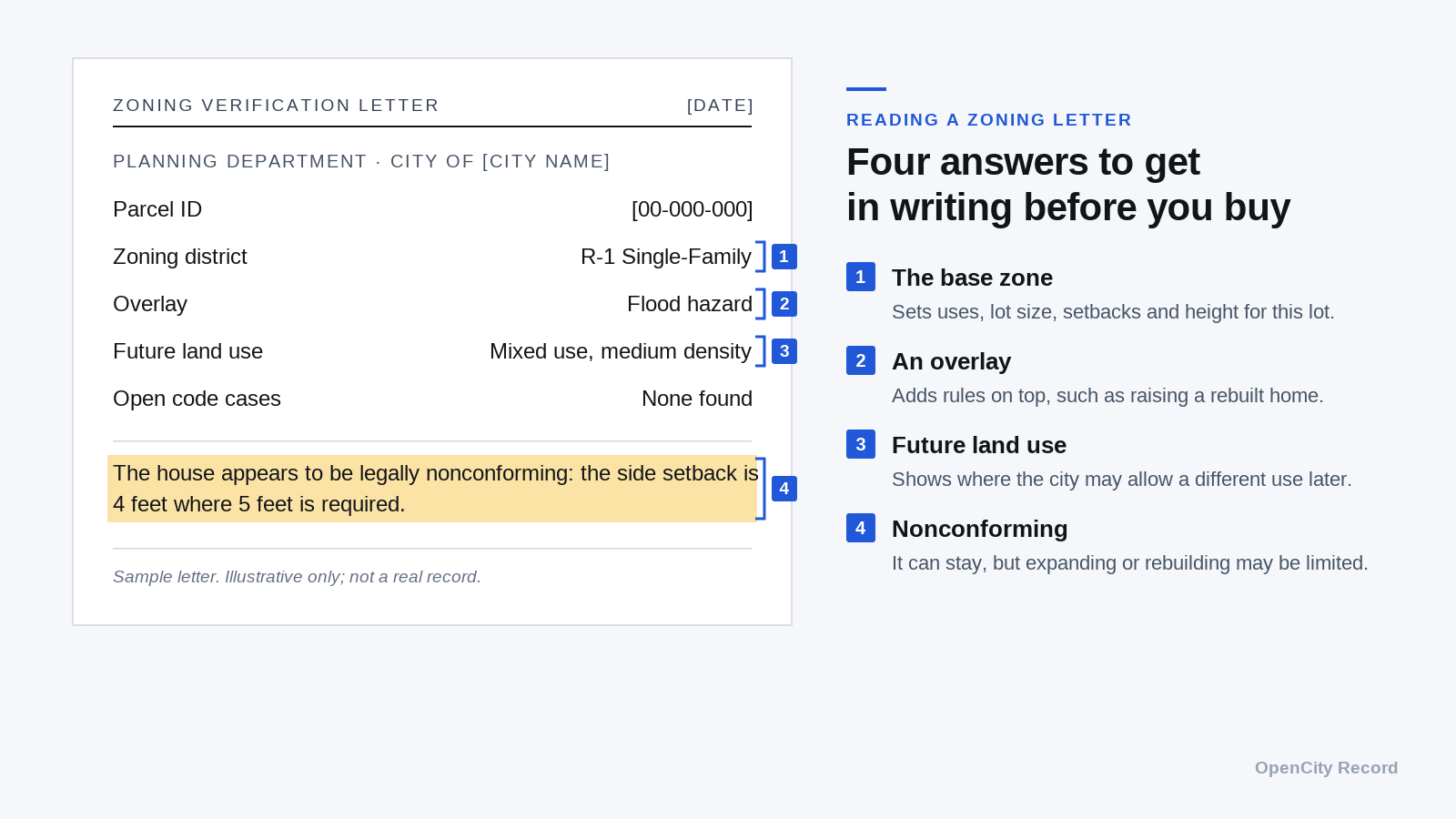 A zoning verification letter puts the answers in writing before you close.
Why should you check zoning before buying a house?
Zoning decides what you can do with the lot and what your neighbors can do with theirs. It controls whether you can add a backyard cottage, run a business from home, rent the house short term, keep chickens or build a second story. It also decides whether the empty field behind the house can become apartments or a warehouse.
Zoning rules change, and they don't always protect what's already there. In Madison, Alabama, the City Council adopted short-term rental rules on June 22, 2026. One vote, 4-2, made short-term rentals a conditional use in most zoning districts. A second vote, 5-1, capped them at 190 citywide. The rules gave existing operators no grandfathering, so they had to get a permit within 90 days. A buyer counting on rental income there would need to read the new rules first.
How do you check zoning before buying a house, step by step?
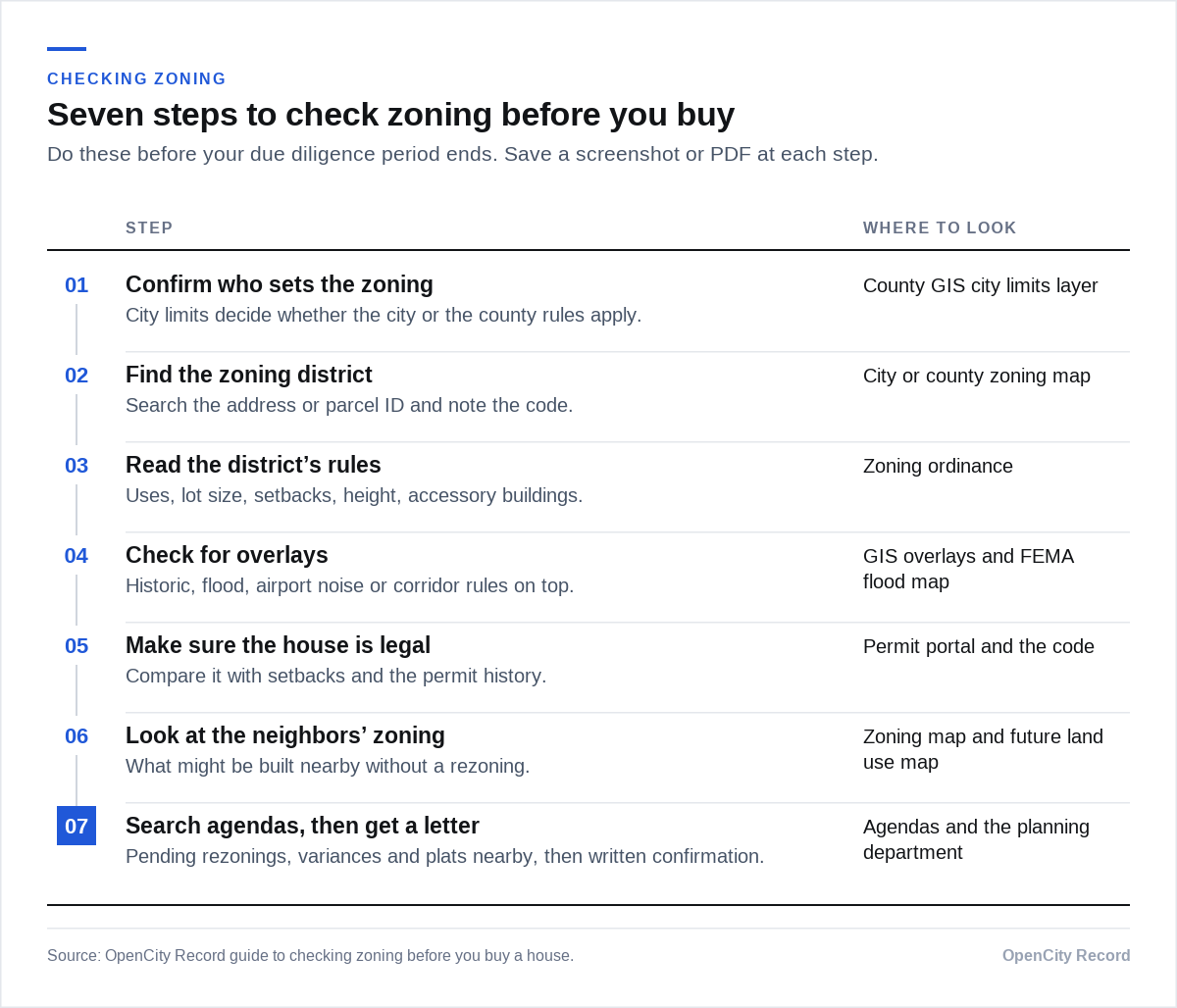 Seven steps, most of them online. Save a screenshot or PDF at each one.
1. Confirm which government sets the zoning
Zoning comes from the city if the home is inside city limits. If it's outside, the county usually sets the rules. Some states also let a city control development in an area just outside its limits, which North Carolina calls extraterritorial jurisdiction. A mailing address isn't proof, since many addresses use a nearby city's name. Check the county assessor's record or GIS map for the city limits line, or find the city that covers the area.
2. Find the zoning district on the map
Open the zoning map and search the address or the parcel ID from the listing. Note the district code, such as R-1, RS-7 or PD-12. Some cities use plain names like "Neighborhood Residential." Our guide to finding the zoning of a property covers the map tools.
3. Read the rules for that district
Look up the district in the zoning ordinance, which is often online through the city's website or a code publisher. Read these parts first:
- the list of allowed uses, including which uses need a special or conditional use permit
- the minimum lot size and width
- setbacks from the front, side and rear lot lines
- height limits and how much of the lot buildings can cover
- rules for accessory buildings, backyard cottages, fences and pools
- home business, parking and animal rules
Some rules live outside the zoning code. Short-term rental permits, for example, may be in a separate licensing chapter.
4. Check for overlay districts
An overlay adds rules on top of the base zone. Examples include historic districts, flood hazard areas, airport noise zones and corridor design districts. A historic overlay can require approval for exterior changes. A flood overlay can require a rebuilt home to be raised. Turn on the overlay layers in the GIS map, and check the FEMA flood map separately.
5. Find out if the house itself is legal
Compare the house with the rules. If it sits four feet from the side lot line and the code requires five, it may be legally nonconforming. That generally means it can stay, but local rules often bar expanding it, and it can lose its status if it's destroyed. Check the permit history too. An addition built without a permit is a different and bigger problem.
6. Look at the zoning around the house
The neighbors' zoning tells you what might be built without a rezoning. Uses already allowed on land zoned for commercial or apartments may not need a public hearing. Then check the city's future land use map in its long-range master plan. It shows where the city expects to allow different uses later, and rezonings that match it are easier to approve.
7. Search agendas for pending changes
Search the last six to twelve months of planning commission, zoning board and council agendas for the streets near the house. Watch for rezonings, variances, special use permits and subdivision plats. You can search recent meetings for rezoning cases to see how often they come up.
Then read how they went. Neighbors often shape these votes:
- In Raleigh, North Carolina, the Planning Commission voted 8-1 on April 14, 2026 to recommend denying a rezoning that would have allowed more homes on 3.79 acres. Members cited traffic, narrow streets and safety near a high school. The council makes the final call.
- In Long Beach, California, the Planning Commission voted 4-1 on Feb. 19, 2026 to recommend a neighborhood rezoning package that included a lot neighbors had opposed. The chair's attempt to remove that parcel failed.
What if the zoning doesn't fit your plans?
You have three common options, and none of them is guaranteed. Each one goes through a public hearing, so plan on months, not weeks.
- A variance. This asks the zoning board to bend a numeric rule, like a setback or a height limit, because of something unusual about the lot. In North Carolina, for example, the hardship has to come from conditions peculiar to the property, not personal circumstances. Our guide to getting a zoning variance explains the tests boards use.
- A special or conditional use permit. Some uses are allowed in a zone only with a permit and conditions, such as a day care or a short-term rental in some cities. The planning commission or council decides after a hearing.
- A rezoning. This changes the zone itself. It's the hardest path for one house, since the council has to agree that the change fits the area and the city's plans. Our guide to how rezoning works covers the steps.
If your plans depend on one of these, make the purchase contingent on approval, or talk with a land use lawyer before you sign. Don't count on getting a variance or rezoning after you close.
How do you get zoning confirmed in writing?
Call or email the planning department with the address and parcel ID. Ask four questions: what the zoning is, whether any overlays apply, whether the current use and the house are legal, and whether any cases are open or pending nearby. Some offices will also issue a zoning verification letter for a fee.
Fees and wait times vary. Hagerstown, Maryland, for example, says to allow up to 14 days for a letter, so ask early. Keep the letter with your closing papers. If the zoning changes later, it shows what the rules were when you bought.
Ask before your inspection or due diligence period ends. In many purchase contracts, that's the window when you can still back out without losing your deposit, so check yours.
What about HOA rules and deed restrictions?
Zoning and HOA rules both apply, so in practice you have to satisfy both. A city might allow a backyard cottage that the HOA bans, and an HOA approval doesn't replace a city permit. Ask for the deed restrictions and the HOA's rules early, and read them yourself rather than relying on a summary.
What zoning surprises do buyers run into?
- A rental plan that doesn't fit. Short-term rentals may need a permit, may be capped or may be banned in your zone.
- A garage apartment that isn't legal. A second unit without permits can't always be rented, and the city may order it removed.
- A home business limit. Some residential zones cap customer visits, employees or signs.
- A big change next door. Uses already allowed on vacant land zoned for commercial or apartments may not need a public hearing.
- A rebuild limit. A nonconforming home can lose its status if it's destroyed.
- A missing permit for a past addition. The city may make the next owner open walls or remove the work.
This is general information, not legal advice.
New in your city
See what’s being built in your city
Rezonings, site plans, subdivisions and variances show up on city agendas weeks before the bulldozers do. Pick your city to see the development applications on its agendas, such as rezonings, site plans, subdivisions and variances, with the status of each. It lists the whole city; it does not search by address.
Find your cityCommon questions
How do I find out what a property is zoned?
Open your city's online zoning map, or the county's if the home is outside city limits, and search the address or parcel ID. The map shows a district code such as R-1. Then look up that code in the zoning ordinance to see what it allows.
What is a zoning verification letter?
It's a letter from the planning department that confirms a parcel's zoning district. In Hagerstown, Maryland, for example, it also says whether a use is allowed, lists variances granted and reports pending or resolved zoning violations. Offices that issue them usually charge a fee.
What does legally nonconforming mean?
It means the home or use was legal when built but doesn't meet today's rules, such as a house that sits closer to the lot line than the current setback allows. It can generally stay, but local rules often limit expanding it, and it can lose its status if it's destroyed.
Can the zoning next to my house change after I buy?
Yes. A rezoning, a special use permit or a new subdivision can be approved next door at a public hearing. Check the neighbors' zoning, the city's future land use map and the last six to twelve months of planning agendas before you buy.
Do HOA rules replace zoning?
No. Both apply, so in practice you have to satisfy both. An HOA approval doesn't replace a city permit, and private deed restrictions don't override the city's code.
Sources
- Nonconforming Uses, Structures, and Lots · MRSC
- Zoning Verification Requests · City of Hagerstown, Maryland
- G.S. 160D-202: Municipal extraterritorial jurisdiction · North Carolina General Assembly
- G.S. 160D-705: Quasi-judicial zoning decisions · North Carolina General Assembly
- National Zoning Atlas · National Zoning Atlas
- FEMA Flood Map Service Center: Search by Address · Federal Emergency Management Agency
- Government Code Section 65091 (notice of zoning hearings) · California Legislative Information
- G.S. 160D-602: Notice of hearing on proposed development regulations · North Carolina General Assembly
- Local Government Code, Chapter 211: Municipal Zoning Authority · Texas Legislature
Keep reading
- GuideThings to Check Before Buying a House: The Local Government ChecklistThings to check before buying a house that an inspector won't: zoning, permits, special district taxes, flood zone, planned roads and nearby rezonings.
- GuideHow to Find the Zoning of Any PropertyHow to find zoning of a property: look up the address on the city zoning map, decode the district, read the rules and get a verification letter.
- GuideHow Rezoning Works: Process, Timeline and CostsRezoning explained: each step from application to council vote, how long it takes, what cities charge, and how neighbors can weigh in or protest.
- GuideHow to Get a Zoning Variance: Steps, Hardship Test and VotesHow to get a zoning variance: the hardship test boards use, use vs. area variances, the application steps, vote rules and real board decisions.
- GuideHow to Find Out What's Planned Near a PropertyHow to find out if a road is planned near your property, plus new subdivisions, rezonings and utility work, using capital plans, road plans and agendas.
- GuideParcel Lookup and County GIS Maps: How to Use ThemA parcel lookup shows a property's owner, size, value and tax districts. Learn to search county GIS maps, read the record and use the right layers.