Quick answer
Real estate due diligence means checking what the public record says about a property before you buy it: the zoning, permits, code cases, special district taxes, easements, flood zone and what's planned nearby. These guides show where each record lives, how to read it and how to spot the local votes that could change a property's value.
Real estate due diligence is the homework you do on a property before you're committed to buying it, and a big share of that homework happens at city hall. The inspector tells you about the roof. The public record tells you what the lot is zoned for, whether past work was permitted, which special districts tax it, whether it floods and what the council is about to approve down the street. This hub collects our guides for buyers, agents and investors, and each one points you to the exact record and shows real votes from OpenCity's meeting archive.
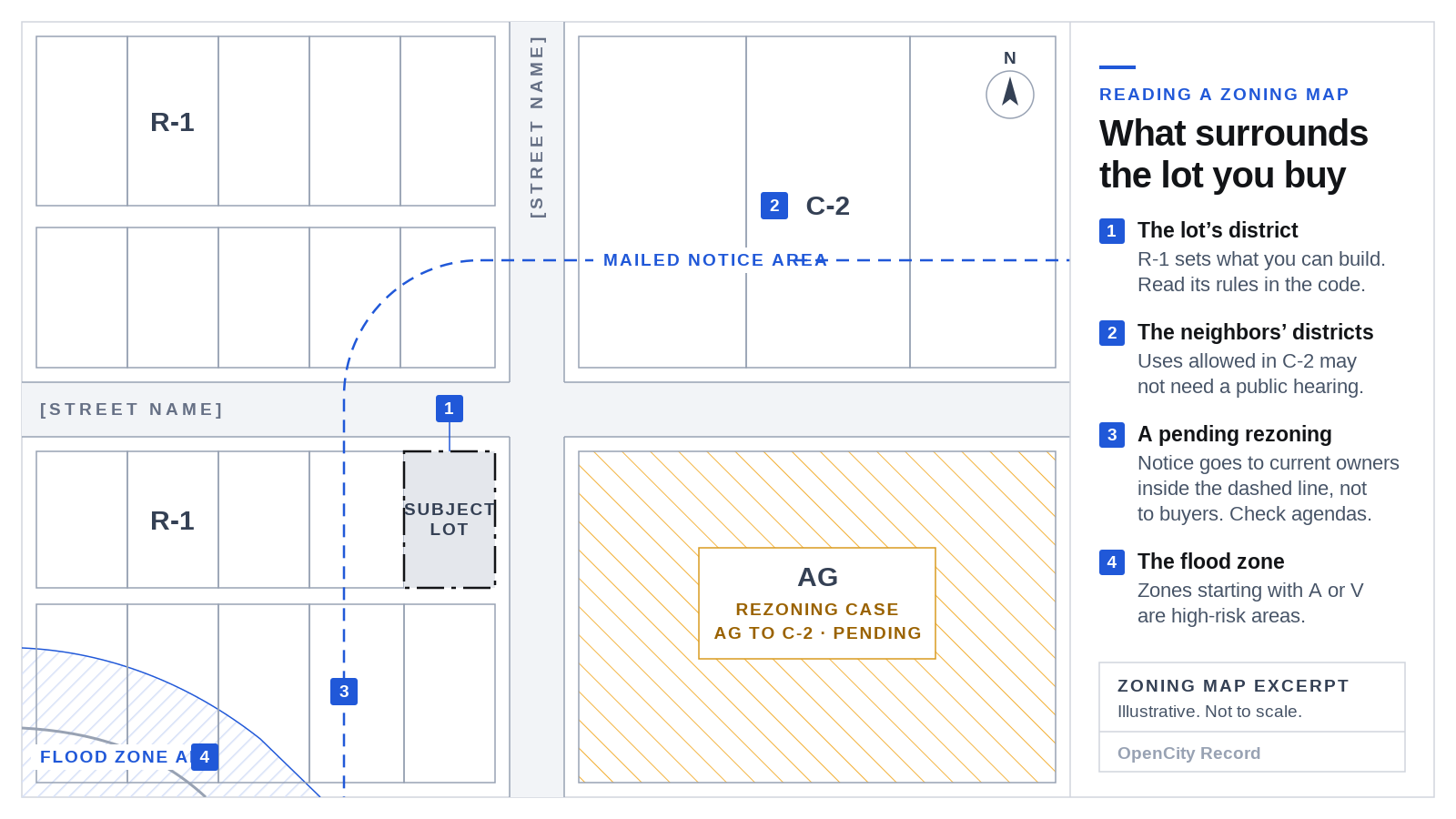
Every property sits inside decisions made down the street at city hall.
Start with the checklist
If you read one guide here, make it Things to Check Before Buying a House. It covers eleven checks, from zoning and permits to special district taxes, easements, flood zones, planned roads and annexation, and it says where to look up each one. With the parcel ID and a laptop, you can work through much of it in a few hours. In a newer subdivision, ask whether the house sits in a special taxing district. Depending on the state, it may be called a community development district, a community facilities district, a municipal utility district or a metropolitan district. Their taxes and assessments sit on top of the city, county and school taxes.
The checklist matters most in places that are growing fast. Mailed notice of a zoning change generally goes to current owners near the site, as listed in tax records, so a buyer who hasn't closed yet won't get the letter. Agendas are a better early warning.
Which guide answers your question?
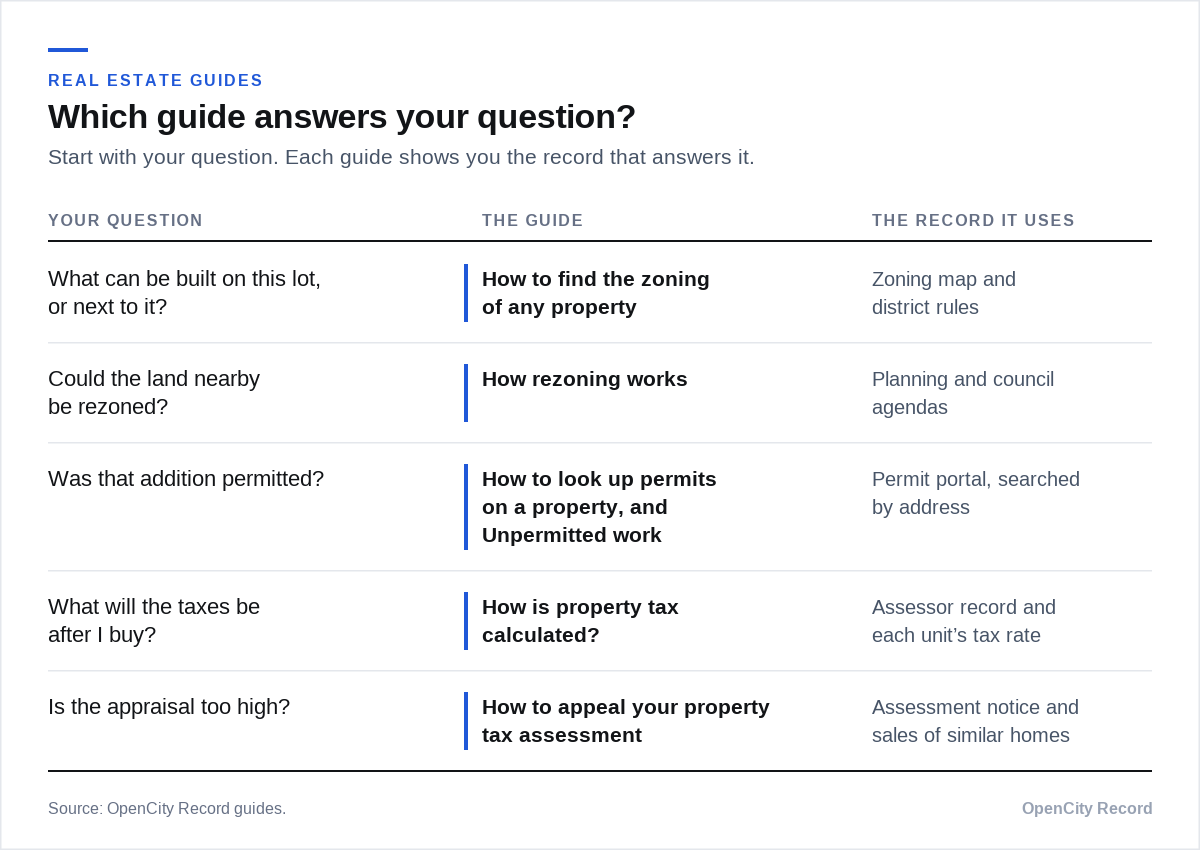
Start with the question you have; each one maps to a guide.
| Your question | The guide |
|---|---|
| What can be built on this lot, or next to it? | How to Find the Zoning of Any Property |
| Could the land nearby be rezoned? | How Rezoning Works |
| Was the garage conversion permitted? | How to Look Up Permits on a Property and Unpermitted Work |
| What will the taxes be after I buy? | How Is Property Tax Calculated? |
| Is the appraisal too high? | How to Appeal Your Property Tax Assessment |
What should agents and investors watch?
Agents use the same records, just more often. A listing next to a pending rezoning or a new special use permit raises questions a buyer will ask, and it's better to have the answer before the showing. Investors look one step further ahead, at capital improvement plans, annexation agreements and the zoning changes a council has signaled in work sessions before anything is filed.
Data center rules show how fast that can move. In the last week of October 2026 alone, San Antonio and League City, Texas each voted to require a special permit or authorization before a data center can locate in at least some zones, according to the meeting recordings. Our data center council vote tracker follows those decisions.
What does OpenCity add to the public record?
City websites post agendas and minutes, but they're hard to search and they rarely say what was argued. OpenCity indexes 207,887 public meetings in 2,356 cities across 50 states, with transcripts, votes and officials attached. That lets you search a street name across a year of planning commission meetings, read what council members said before they voted, and see whether a case passed, failed or got tabled. To try it, search recent meetings for rezoning cases.
New in your city
See what’s being built in your city
Rezonings, site plans, subdivisions and variances show up on city agendas weeks before the bulldozers do. Pick your city to see the development applications on its agendas, such as rezonings, site plans, subdivisions and variances, with the status of each. It lists the whole city; it does not search by address.
Find your cityCommon questions
What is due diligence in real estate?
It's the research you do on a property before you're locked into buying it. Inspections cover the building, while due diligence at city hall covers zoning, permits, code cases, special district taxes, easements, flood risk and anything planned nearby.
How long does due diligence take on a house?
The local government part can often be done in a few hours if you have the parcel ID. Try to finish within your contract's inspection or due diligence period, since that's often when you can still back out without losing your deposit. Check your contract.
Can I see what's being built near a property?
Yes. Rezonings and special use permits go through public hearings, and some site plans and plats do too, so they show up on planning commission and council agendas. Search the last six months and the next month for the streets around the property.
Who do I ask about zoning before buying land?
Start with the city's planning or zoning department, or the county if the land is outside city limits. Ask for the zoning district, any overlays, pending cases nearby and, for a written answer, a zoning verification letter.
Sources
- FEMA Flood Map Service Center: Search by Address · Federal Emergency Management Agency
- Florida Statutes §190.048, Sale of real estate within a district; required disclosure to purchaser · Florida Senate
- G.S. 160D-602: Notice of hearing on proposed zoning map amendments · North Carolina General Assembly
- Special Flood Hazard Area (SFHA) · Federal Emergency Management Agency
- California Civil Code §1102.6b, Notice of special tax (Mello-Roos) · California Legislative Information