Quick answer
A conditional use permit and a special use permit are usually the same tool with different names. Both let a use the zoning code allows only with approval, like a daycare, a church or a data center, go on a specific property after a public hearing, with conditions attached. State law and local habit decide the name.
Key facts
- Conditional use permit, special use permit, special permit and special exception are names for the same basic tool in many states, though a few states treat some of them as separate tools.
- The idea goes back to the 1920s Standard State Zoning Enabling Act, which let a board of adjustment hear special exceptions to the zoning ordinance.
- Who decides varies by state and city: a zoning administrator, a hearing examiner, a planning commission, a board of appeals or the elected council.
- States set different guardrails. Some make a city approve once an applicant meets the conditions, and at least one requires a supermajority board vote for most special permits.
- Conditions can get specific. In September 2026, Louisville's zoning board capped a new 24-hour child care center at 15 children.
A conditional use permit and a special use permit are usually the same tool with different names. Both let a use that the zoning code allows only with approval, like a daycare, a church or a data center, go on a specific property after a public hearing, with conditions attached. State law and local habit decide which name your city uses, and some places say "specific use permit," "special permit" or "special exception" instead.
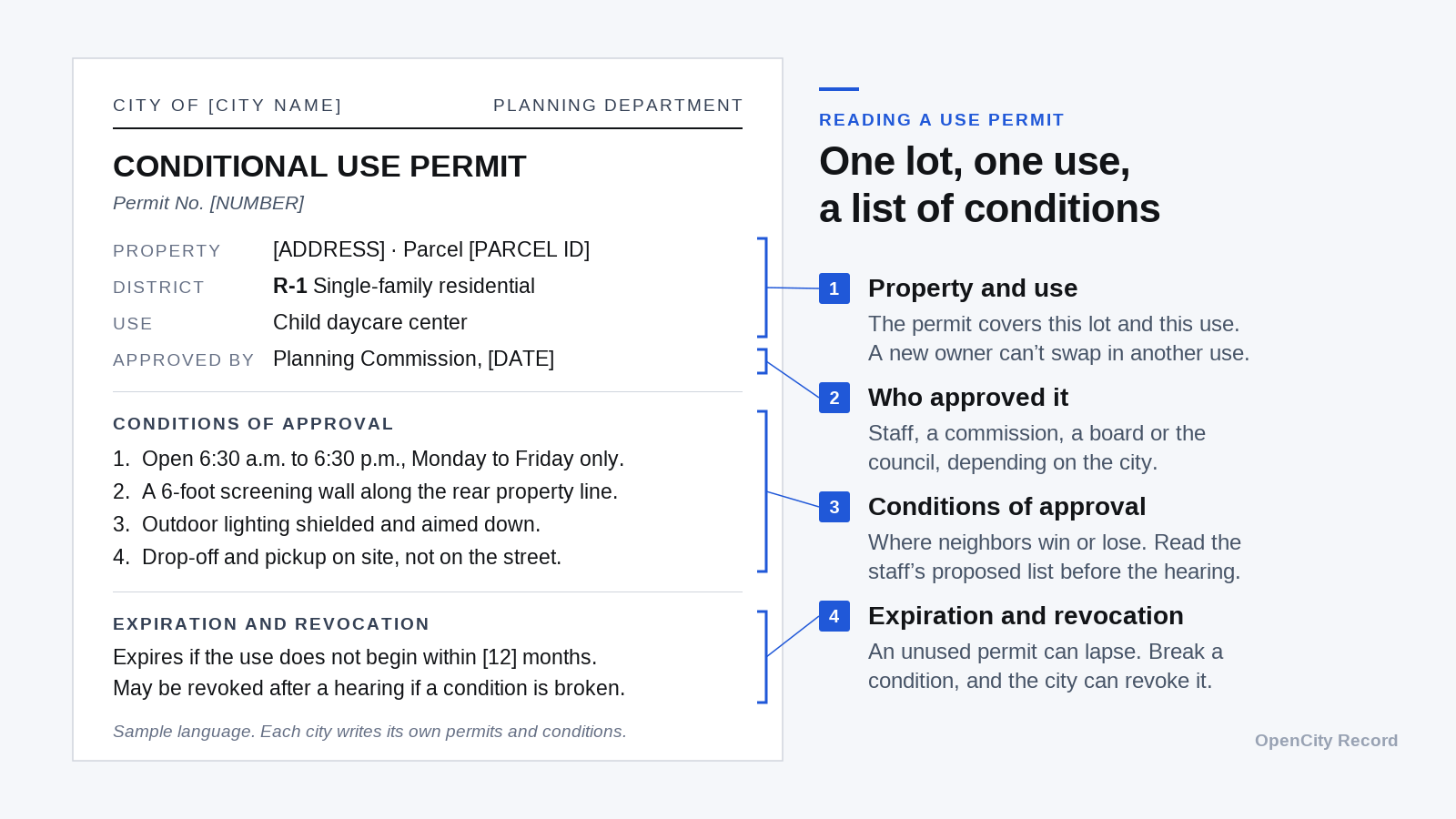
Whatever your city calls it, a conditional or special use permit pairs one property with a list of conditions.
What is a conditional use permit?
Most zoning codes sort every use into a few buckets for each district. Some uses are allowed by right, so you just need a building permit, and some are banned. A third group is allowed only after the city reviews the specific site, and that review ends in a conditional use permit.
Common examples include a church or private school in a residential zone, a drive-through in a commercial zone, a cell tower, a bar near homes or a data center in an industrial district. The city looks at how that use will work on that lot and can say yes, say no or say yes with conditions.
A conditional use permit is tied to the property and to the use described in the application, so a daycare permit doesn't let the next owner open a nightclub. Many codes also let the city revoke the permit after a hearing if the owner breaks its conditions.
Conditions can get specific. When Louisville, Kentucky's Board of Zoning Adjustment approved a conditional use permit on Sept. 28, 2026 for a 24-hour child care center in a house, it capped the center at 15 children and barred most pickups and drop-offs between 10:30 p.m. and 6 a.m.
Is a special use permit the same as a conditional use permit?
In many places, yes, and the names differ more than the tools do. The idea goes back to the Standard State Zoning Enabling Act, a model law the U.S. Department of Commerce published in the 1920s, which let a board of adjustment hear "special exceptions" to the zoning ordinance. States and cities have renamed the idea many times since.
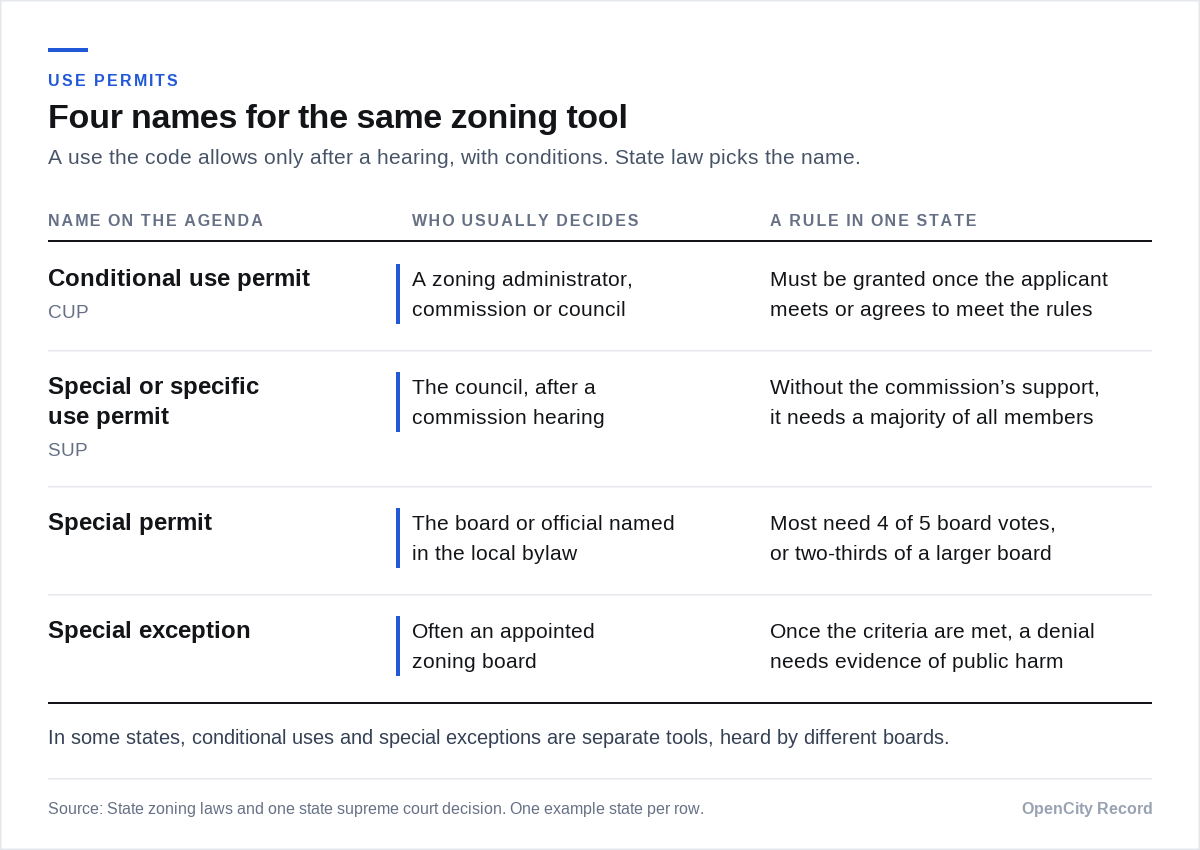
Four names, one idea: a use the code allows only after a hearing, with conditions.
A few states give two of the names different jobs and send them to different boards, as the table below shows.
How do conditional use permit rules differ by state?
Every state follows the same basic pattern. The code lists the use, the applicant shows the standards are met, and the decision maker can add conditions tied to those standards. What changes from state to state is who votes, how many votes it takes and how much room there is to say no. Here are seven common patterns, each from one state's law or courts.
| Pattern | Common name | Who decides | What the rule says |
|---|---|---|---|
| Staff can decide | Conditional use permit | A zoning administrator or board of zoning adjustment, if the local code provides for it | The local ordinance sets the criteria and the appeal route |
| The city carries the burden | Often "special exception" | Set by the local code | Once the applicant meets the code's criteria, the government must show by competent substantial evidence that the use would harm the public interest |
| A higher bar without a recommendation | Special use | City council or village board, after a hearing before a designated commission | If the hearing body doesn't recommend approval, it takes a majority of all members in office, and a city can raise that to two-thirds |
| A supermajority for most permits | Special permit | The board or official named in the local bylaw | Four votes on a five-member board, or two-thirds of a larger board, with a simple majority for some housing projects |
| A permit on the property record | Conditional use permit | Set by the local ordinance | The permit stays in effect as long as its conditions are followed, and a certified copy is recorded with the county |
| Two names, two boards | Conditional use, or special exception | The elected governing body for conditional uses; the zoning hearing board for special exceptions | Each tool goes to a different decision maker |
| Approval once standards are met | Conditional use | Set by the local ordinance | The permit must be granted once the applicant meets or agrees to meet the requirements, and conditions need substantial evidence |
Sources: state zoning laws and one state supreme court decision, one example state per row.
Two of these rules shift the burden in ways that matter on hearing night. In states with rules like these, a board can't deny a qualified applicant just because neighbors object, unless the objections rest on facts tied to the code's standards.
How is a conditional use permit different from a variance or a rezoning?
People mix these up, but each one leads to a different hearing with different rules.
| Rezoning | Variance | Conditional use permit | |
|---|---|---|---|
| What changes | The district for the whole property | One rule, like a setback | Nothing in the code; a listed use gets approved |
| Who decides | City council, after the planning commission | Board of adjustment, or council in some cities | Varies: staff, commission, board or council |
| What you prove | That the change fits the city's plan | Hardship from the land itself | That the use meets the code's standards |
| Example | Farmland to single-family homes | A garage 3 feet closer to the side line | A daycare in a residential zone |
If you need to bend a size rule, see how to get a zoning variance. If the use isn't listed in your district at all, you're likely looking at a rezoning. Our guide to variance vs. rezoning compares those two in detail.
How do you get a conditional use permit?
- Check your district's use table and confirm the use is listed as conditional, special or specific. If it isn't listed at all, a permit can't help you.
- Ask for a pre-application meeting with planning staff, and bring a rough site plan plus a description of the hours, staff, traffic and noise.
- File the application with a site plan, a written narrative and the fee.
- The city notifies nearby property owners, publishes the hearing and often posts a sign on the property.
- Staff writes a report that usually proposes conditions. Read it early, since the conditions are where most of the negotiation happens.
- Present at the hearing, which may be before a zoning administrator, a hearing examiner, a planning commission, a board or the council. In many cities, the planning commission recommends and the council decides.
- If approved, follow the conditions. Some states require the permit to be recorded with the county, so it shows up in the property's records for future buyers.
What conditions do cities attach to a conditional use permit?
Conditions turn a yes into a yes with limits, aimed at the effects neighbors worry about most.
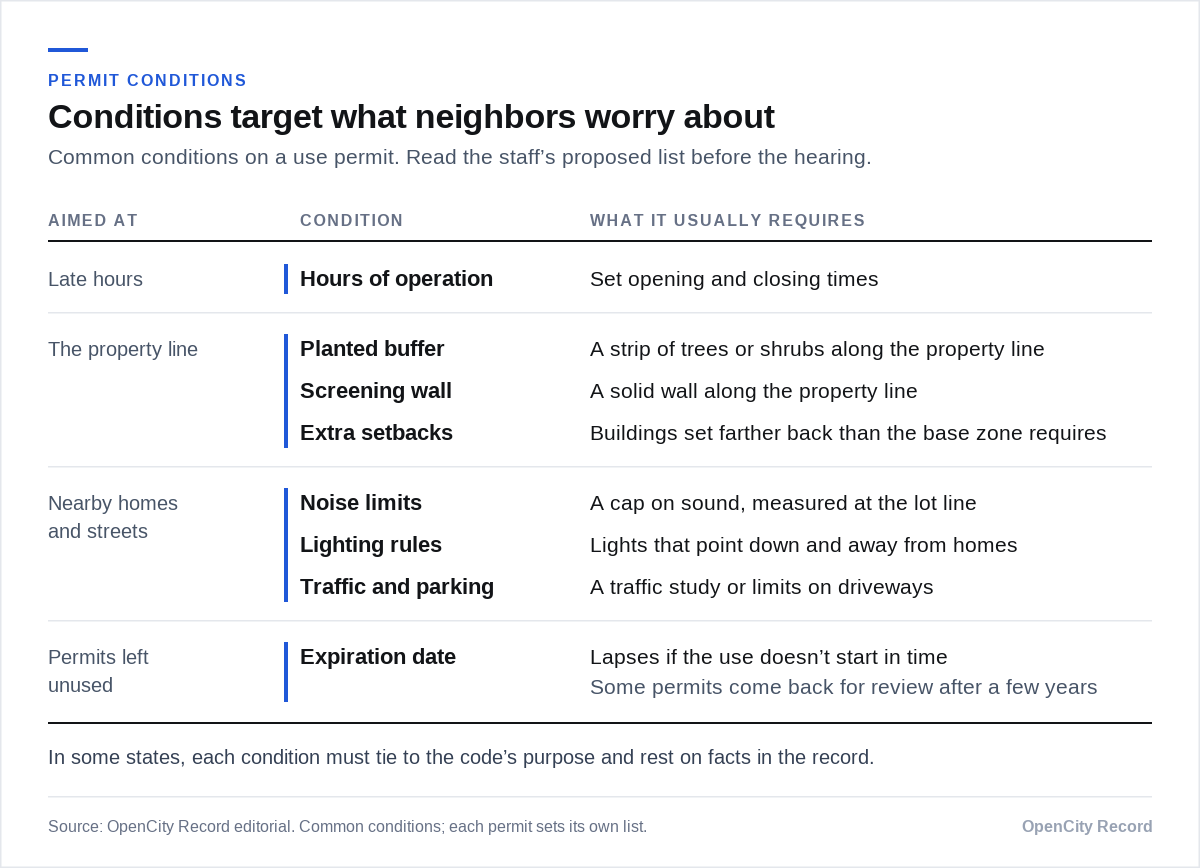
Conditions are where neighbors win or lose, so read the staff's proposed list before the hearing.
Typical conditions cover operating hours, a planted buffer or screening wall along the property line, noise limits measured at the lot line, setbacks deeper than the base zone requires, a traffic study or driveway limits, and lighting that points down and away from homes. Some permits also expire if the use doesn't start within a set time, or come back for review after a few years.
Some states limit what a city can demand, requiring each condition to relate to the purpose of the ordinance and to rest on facts in the record rather than personal preference or speculation. To see the kinds of conditions councils near you attach, search recent meetings for special use permits.
How often are special and conditional use permits approved?
No national count of approvals and denials exists. Single decisions still show where boards draw lines. On Sept. 24, 2026, DeKalb County, Georgia's Board of Commissioners voted 5-0 to deny a special land use permit for beer and wine sales at a convenience store. Staff had recommended approval. You can search recent meetings for conditional use permits to see what councils turn down.
Why are some cities requiring permits for data centers?
As data centers get bigger, some city councils are deciding whether they should need a permit instead of being allowed by right in commercial and industrial zones. A permit requirement gives the public a hearing on each project and gives the council a chance to set conditions. Two cities in OpenCity's records show how differently councils can handle it.
- On Oct. 29, 2026, San Antonio, Texas's City Council voted 9-2 to require a special use approval for data centers in a commercial district and in light-industrial districts, according to the meeting recording. A mayoral amendment adding 1,000-foot setbacks, noise limits, air monitoring and 45-day pre-filing notice failed, 5 votes to 6.
- On Aug. 5, 2026, Tucson, Arizona's mayor and council voted 6-1 for rules that send every large data center through a planned-development zoning review that ends with a council vote, so each project comes back to the council.
The two cities show the trade-off. A case-by-case vote gives neighbors a voice on each project, while standards in the code tell builders the rules up front. San Antonio's failed amendment shows a second fight, over how many conditions belong in the code itself. For more votes like these, see our data center city council votes tracker, or find your city to see whether its council has taken up the question.
From the record
Four use permit decisions from 2026
- Approved 4-0
Louisville, KY
Board of Zoning Adjustment ·
Approved a conditional use permit for a 24-hour child care center in a house, capped at 15 children, and barred pickups and drop-offs from 10:30 p.m. to 6 a.m. except in emergencies.
- Denied 5-0
DeKalb County, GA
Board of Commissioners ·
Denied a special land use permit for beer and wine sales at a convenience store, though staff had recommended approval.
- Approved 9-2
San Antonio, TX
City Council ·
Passed a data center ordinance that requires a specific use authorization in a commercial district and light-industrial districts. An amendment adding setbacks, noise limits and air monitoring failed.
From the meeting recording. The official minutes were not yet published.
- Approved 6-1
Tucson, AZ
Mayor and Council ·
Adopted rules for large data centers that send each project through a planned-development zoning review ending in a council vote.
This is general information, not legal or tax advice.
New in your city
See what’s being built in your city
Rezonings, site plans, subdivisions and variances show up on city agendas weeks before the bulldozers do. Pick your city to see the development applications on its agendas, such as rezonings, site plans, subdivisions and variances, with the status of each. It lists the whole city; it does not search by address.
Find your cityCommon questions
Is a special use permit the same as a conditional use permit?
In many places, yes. Both allow a use the zoning code lists as possible with approval, after a hearing and with conditions. The name depends on the state and the city. A few states give two of the terms different meanings and send them to different boards.
Do conditional use permit rules differ by state?
Yes, in the details. In some states, a zoning administrator or a board of zoning adjustment can decide when the local code allows it. Some states require approval once the applicant meets or agrees to meet the conditions. Others keep a permit in effect while its conditions are followed and have it recorded with the county.
Who decides a conditional use permit?
It depends on your state and city. Depending on the local code, it may be a zoning administrator, a hearing examiner, a planning commission, a board of appeals or the city council. In many cities, the planning commission holds a hearing and recommends, and the council makes the final decision.
Can a conditional use permit be taken away?
Often, yes. Many local codes let the city revoke a permit, after notice and a hearing, if the owner breaks its conditions. Some permits also expire if the use doesn't start within a set time.
How often are conditional use permits approved?
No national count exists. OpenCity's records show both approvals with conditions and outright denials, such as DeKalb County, Georgia's 5-0 denial of a special land use permit for beer and wine sales at a convenience store in September 2026.
Sources
- Land Use Update: Variances and Special Exceptions · American Bar Association
- Standard State Zoning Enabling Act and Standard City Planning Enabling Act · American Planning Association
- Government Code §65901: Board of zoning adjustment or zoning administrator · California Legislative Information
- Irvine v. Duval County Planning Commission, 495 So. 2d 167 (Fla. 1986) · Caselaw Access Project, Harvard Law School
- 65 ILCS 5/11-13-1.1: Special uses · Illinois General Assembly
- General Laws c. 40A §9: Special permits · Massachusetts Legislature
- Minnesota Statutes §462.3595: Conditional use permits · Minnesota Office of the Revisor of Statutes
- Planning Series #7: Special Exceptions, Conditional Uses and Variances · Pennsylvania Department of Community and Economic Development
- 2017 Wisconsin Act 67 · Wisconsin State Legislature
- Regulations for Large-Scale Data Centers · City of Tucson
Keep reading
- GuideVariance vs. Rezoning: Which One Do You Need?A variance bends one zoning rule for one lot. A rezoning changes the zoning itself. Learn which you need, who decides, and how neighbors can weigh in.
- GuideHow to Get a Zoning Variance: Steps, Hardship Test and VotesHow to get a zoning variance: the hardship test boards use, use vs. area variances, the application steps, vote rules and real board decisions.
- GuideHow Rezoning Works: Process, Timeline and CostsRezoning explained: each step from application to council vote, how long it takes, what cities charge, and how neighbors can weigh in or protest.
- GuideHow to Find the Zoning of Any PropertyHow to find zoning of a property: look up the address on the city zoning map, decode the district, read the rules and get a verification letter.
- GuideCan I Build an ADU? Accessory Dwelling Unit Rules ExplainedCan you build an ADU? Learn how accessory dwelling unit rules on size, parking, owner occupancy and permits work, and how to check your city's rules.
- GuideHow to Oppose a Zoning Change (or Support One)How to oppose a zoning change, or support one: read the notice, find the criteria, comment on time, organize neighbors and make arguments that persuade.