Quick answer
To oppose a zoning change, read the public notice, find the case file and the criteria the city must apply, then comment in writing and in person at the planning commission and council hearings. Tie your points to the comprehensive plan and real impacts, not to who will live there. Organize neighbors early, and ask for specific conditions.
Key facts
- Many rezonings get two public hearings: one before the planning commission, which recommends, and one before the city council or county board, which decides.
- Some states keep a protest petition rule from the 1920s model zoning law. If owners of a set share of nearby land, often 20%, object in writing, the council needs a supermajority, such as three-fourths, to approve.
- Boards weigh consistency with the comprehensive plan, compatibility with nearby land, traffic, utilities and drainage. Arguments about who might live in new housing can raise fair housing problems.
- In 2026 OpenCity records, opponents won in DeKalb County, Ga., and Greenville County, S.C., and lost in Washoe County, Nev., where commissioners approved a 940-lot subdivision 3-2.
- Conditions are a common middle ground. Phoenix approved a 2026 housing rezoning 9-0 after dropping a road extension that neighbors opposed.
If you want to know how to oppose a zoning change, start with the notice. It names the case number, the request and the hearing dates, and that's all you need to find the case file and the rules the city has to follow. Then send written comments, speak at the planning commission and the council, and give the board a reason to say no that fits its own criteria. The same steps work if you want to support a rezoning. Here's how the process works and what tends to persuade.
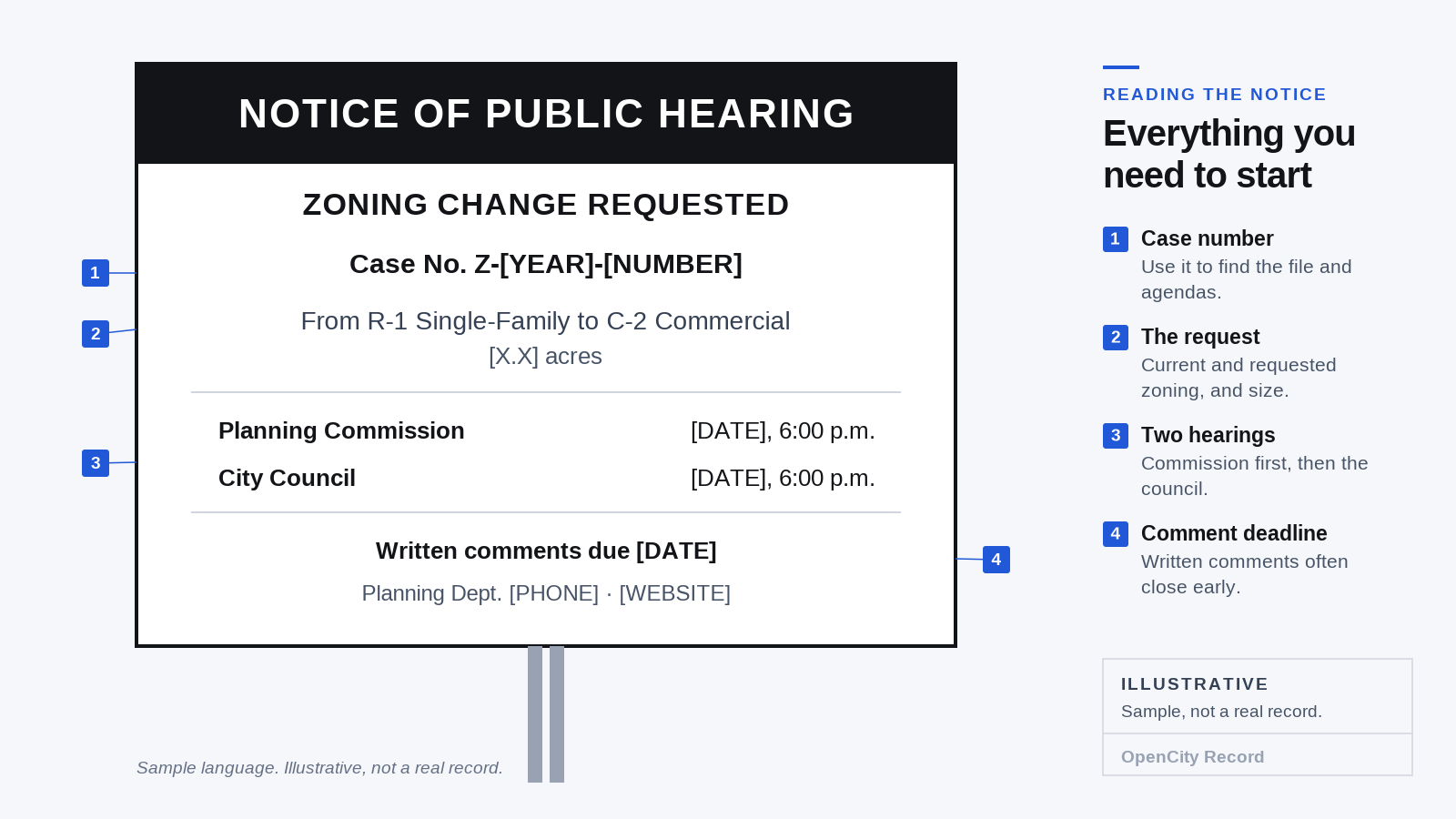
Everything you need to get started is on the notice: the case number, the request and the dates.
How does a zoning change get decided?
A rezoning changes the district on the zoning map, so it's a legislative decision made by elected officials. In many places it goes through two hearings. First, the planning commission holds a public hearing and makes a recommendation. Then the city council or county board holds its own hearing and makes the final call. Our guide to how rezoning works covers each step.
Before either hearing, planning staff writes a report. It reviews the request against the criteria in the code and usually recommends approval, approval with conditions or denial. The commission and council don't have to follow it, but it shapes the debate.
The criteria are your best tools. Most codes ask some version of these questions:
- Is the request consistent with the comprehensive plan?
- Does it fit the zoning and uses around it?
- Can roads, water, sewer, drainage and schools handle it?
- Has something changed in the area since the current zoning was set?
How do you oppose a zoning change, step by step?
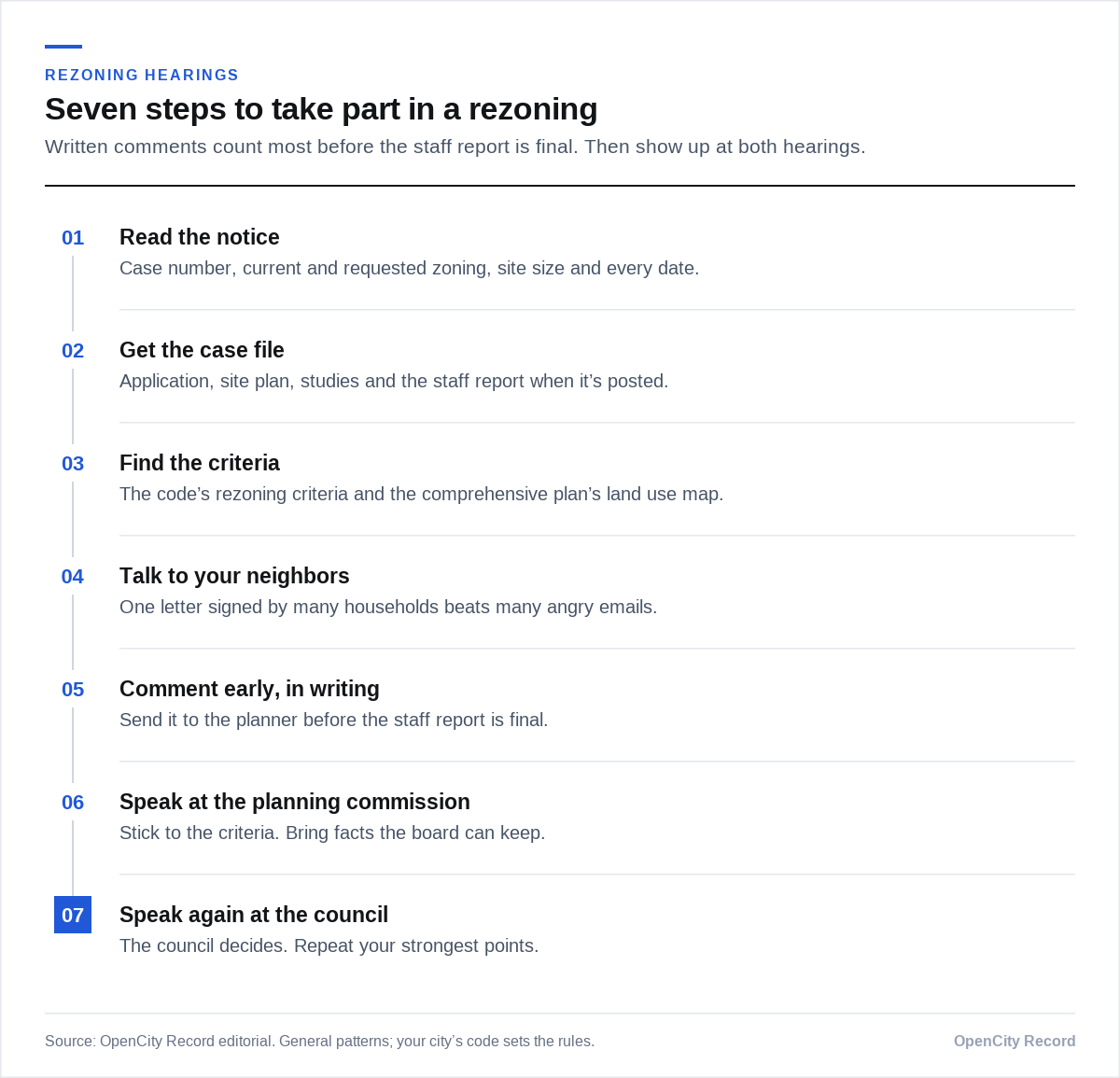
Your comments count most before the staff report is final and at each of the two hearings.
- Read the notice closely. Note the case number, the current and requested zoning, the size of the site and every date. Many cities mail notice to owners within a set distance, post a sign and publish it online.
- Get the case file. Ask the planning department for the application, site plan, traffic study and staff report. Many cities post them with the agenda. If they don't, you can ask for them through a public records request.
- Find the criteria. Look up the rezoning criteria in your code and the land use map in your comprehensive plan. Write down where the request fits and where it doesn't.
- Talk to your neighbors. One clear letter signed by 40 households carries more weight than 40 angry emails. Pick two or three speakers who will cover different points.
- Comment early, in writing. Send comments to the planner assigned to the case before the staff report is final. Keep it to a page. Use the case number in the subject line.
- Speak at the planning commission. Stay within your time limit, stick to the criteria and bring facts you can hand over. Our guide on how to speak at a council meeting has tips that work at any board.
- Speak again at the council. The council makes the final decision, and some members won't have watched the commission hearing. Repeat your strongest points and say what changed, if anything.
What actually persuades a council?
Board members hear a lot of public comment. The comments that change votes are usually specific, local and tied to the city's own rules.
Arguments that tend to work:
- The request conflicts with the comprehensive plan or a recent area plan.
- The new use doesn't fit the zoning on surrounding lots. A small rezoning that helps one owner and clashes with everything around it can also raise a legal issue called spot zoning.
- Real data on traffic, crashes, drainage or school crowding, from the city or from a professional.
- A practical fix, such as a buffer, a lower height, a cul-de-sac instead of a through street, or a smaller number of units.
Arguments that tend to backfire:
- Personal attacks on the applicant or staff.
- Claims about who might live in new homes. Comments about race, family status or disability can raise problems under the federal Fair Housing Act.
- Property value fears with no evidence behind them.
What should a written comment say?
Keep it to one page and put the case number in the subject line. Here's a simple outline you can adapt, whether you oppose the request or support it:
- Who you are. "I own the home at [your address], about 300 feet north of the site."
- Your position. "I ask the commission to deny case [number]," or "I support case [number] with the conditions below."
- Your reasons, tied to the criteria. "The comprehensive plan shows this area as low-density residential. The request would allow [number] units per acre." Use the plan's own words when you can.
- Your evidence. Photos of flooding, crash data from the city, a school's enrollment report. Attach it, and say where it came from.
- Your fallback. "If the commission recommends approval, please require a 50-foot landscaped buffer and limit building height to two stories."
- Your name and contact information.
Send it to the planner named on the notice or in the staff report, and ask that it be included in the record. Bring a printed copy to the hearing in case it didn't reach the board.
What do real rezoning fights look like?
OpenCity's records show neighbors winning, losing and settling for changes. These 2026 cases, most of them rezonings and one a large subdivision, come from different parts of the country:
- Neighbors won. DeKalb County, Georgia's commissioners voted 7-0 on June 23, 2026 to deny a rezoning from R-75 to R-60 for 12 single-family homes on smaller lots, after residents spoke against it and a commissioner pointed to the neighborhood's existing character.
- Neighbors won. Greenville County, South Carolina's council denied a change to a planned development on Feb. 17, 2026 that would have put 24 townhomes on former tennis courts. Several neighbors spoke against the plan at the meeting.
- Neighbors won. Austin's City Council voted 10-0 on March 12, 2026 to deny a mixed-use plan amendment and rezoning after testimony about displacement and environmental impacts.
- Neighbors lost. Washoe County, Nevada's commissioners voted 3-2 on March 10, 2026 to reverse their planning commission's denial and approve a 940-lot subdivision, despite residents' concerns about wildfire, traffic and water. The board did require a $1 million advance payment toward a new fire station.
- A compromise. Phoenix's City Council voted 9-0 on July 1, 2026 to approve a housing rezoning while dropping a road extension neighbors opposed, adding a cul-de-sac and a park instead.
Notice the pattern in these cases. Where neighbors won, they had a clear local reason and showed up in numbers. Where they lost, the board found ways to answer some of their concerns with conditions. Asking for specific conditions, even while you oppose a case, gives you a fallback.
What is a protest petition?
Some states still use a rule from the Standard State Zoning Enabling Act, a 1920s model law that shaped many states' zoning laws. If the owners of a set share of the land near a rezoning, often 20%, file a written protest, the council needs a supermajority to approve the change. Texas, for example, requires a three-fourths vote of the council when owners of 20% of the land within 200 feet protest. Since 2025, though, a Texas protest against a change that allows more housing needs owners of 60% of that nearby land, and it raises the vote needed only to a majority of the whole council. Other states use different shares and distances, and some have dropped the rule. Check your state's law and your city's deadline for filing, which can be days before the council hearing.
A valid petition usually needs owners' signatures that match the property records, parcel numbers and a map showing the protest area. Ask the city clerk or planning staff how they count it before you start collecting.
Should you ever support a zoning change instead?
Yes, and the case for it can be just as strong. Supporters often point to the need for housing, the jobs or services a project brings, the plan's own goals for the area or the property owner's right to use their land. Many hearings are lopsided because supporters stay home, so a few clear voices can matter. The Long Beach Planning Commission voted 4-1 on Feb. 19, 2026 to recommend a neighborhood rezoning package after many neighbors asked it to drop one site, a former Boy Scouts office lot. A motion to remove that site died for lack of a second, so the site stayed in the package, and the case moved on to the City Council.
To see how your council handles contested cases, search recent meetings for rezoning denials or find your city and read its next planning agenda.
What happens after the vote?
If the council approves, the decision is final once the ordinance passes, which can take two readings. Courts usually defer to councils on rezonings, and the deadline to sue is set by state law and is often short. A challenge usually needs a flaw in the process, such as bad notice, or a decision so arbitrary it amounts to illegal spot zoning. Talk to a land use lawyer quickly if you think that happened.
If the council denies the request, many codes bar the same application for a set time. Franklin County, N.C., for example, makes an owner wait 12 months before filing the same request again. Expect the owner to come back with changes.
This is general information, not legal advice.
New in your city
See what’s being built in your city
Rezonings, site plans, subdivisions and variances show up on city agendas weeks before the bulldozers do. Pick your city to see the development applications on its agendas, such as rezonings, site plans, subdivisions and variances, with the status of each. It lists the whole city; it does not search by address.
Find your cityCommon questions
Can neighbors stop a rezoning?
Sometimes. Neighbors can't veto a rezoning, but strong, specific objections often change votes, add conditions or lead an applicant to withdraw. In states with a protest petition rule, enough nearby owners can force a supermajority vote.
What is a protest petition?
It's a written objection signed by owners of a set share of the land near a rezoning, often 20%. In states that keep the rule, it raises the vote needed to approve, such as to three-fourths or two-thirds of the council. Check your state's law for the exact share and deadline.
What arguments work against a rezoning?
The ones tied to the city's criteria: conflict with the comprehensive plan, mismatch with nearby zoning, traffic and safety data, drainage, utilities and school capacity. Personal attacks and complaints about who might live there tend to backfire.
When should I comment on a zoning case?
As early as you can. Send written comments before the staff report is final, then speak at both the planning commission and council hearings. Comments that arrive after the deadline may not reach the board.
Can I appeal if the council approves a rezoning?
Usually only in court, and deadlines are often short. Courts generally defer to councils on rezonings unless the process was flawed or the decision was arbitrary, such as illegal spot zoning. Talk to a land use lawyer quickly.
How do I support a zoning change instead?
Use the same steps. Send a written comment, speak at both hearings and tie your support to the plan and to local needs like housing, jobs or services. Supporters often stay home, so a few voices can matter.
Sources
- Standard State Zoning Enabling Act and Standard City Planning Enabling Act · American Planning Association
- Local Government Code, Chapter 211: Municipal Zoning Authority · Texas Legislature
- Spot Zoning · Legal Information Institute, Cornell Law School
- Public Hearings · MRSC
- The Fair Housing Act · U.S. Department of Justice, Civil Rights Division
- Rezoning Process · Franklin County, North Carolina
Keep reading
- GuideHow Rezoning Works: Process, Timeline and CostsRezoning explained: each step from application to council vote, how long it takes, what cities charge, and how neighbors can weigh in or protest.
- GuideWhat Does the Planning Commission Do?What does the planning commission do? It reviews rezonings, plats and plans, holds hearings and advises the council. See its role and how to take part.
- GuideComprehensive Plans (General Plans) ExplainedA comprehensive plan, also called a general or master plan, sets a city's long-range land use vision. See what's in one, how it's made and why it matters.
- GuideHow to Find the Zoning of Any PropertyHow to find zoning of a property: look up the address on the city zoning map, decode the district, read the rules and get a verification letter.
- GuideCan I Build an ADU? Accessory Dwelling Unit Rules ExplainedCan you build an ADU? Learn how accessory dwelling unit rules on size, parking, owner occupancy and permits work, and how to check your city's rules.
- GuideConditional Use Permits vs. Special Use PermitsA conditional use permit and a special use permit are usually the same tool. Compare names and rules by state, the approval steps and real votes.