Quick answer
Rezoning changes the official zoning map so a property moves into a different district. The owner or the city applies, neighbors get notice, the planning commission holds a hearing and makes a recommendation, and the city council casts the final vote. City estimates run from about two to seven months, and filing fees run from hundreds to thousands of dollars.
Key facts
- Rezoning fees on three city fee schedules we checked in November 2026 ran from $500 plus $25 an acre to $1,515 plus $135 an acre for some single-family districts.
- City and county estimates for the whole process run from about 60 to 90 days to five to seven months.
- Protest petitions date to the 1926 Standard State Zoning Enabling Act, which let owners of 20% of nearby land force a three-fourths council vote.
- State rules still differ. A valid protest requires a three-fourths vote in some states and a two-thirds vote in others, and at least one state dropped protest petitions in 2015.
- In four rezonings in one city in 2026, the time from first planning commission hearing to final council vote ranged from 41 to 132 days, according to OpenCity records.
Rezoning changes the official zoning map so a property moves into a different district. The owner or the city applies, neighbors get notice, the planning commission holds a hearing and makes a recommendation, and the city council casts the final vote. City estimates run from about two to seven months, and filing fees run from hundreds to thousands of dollars.
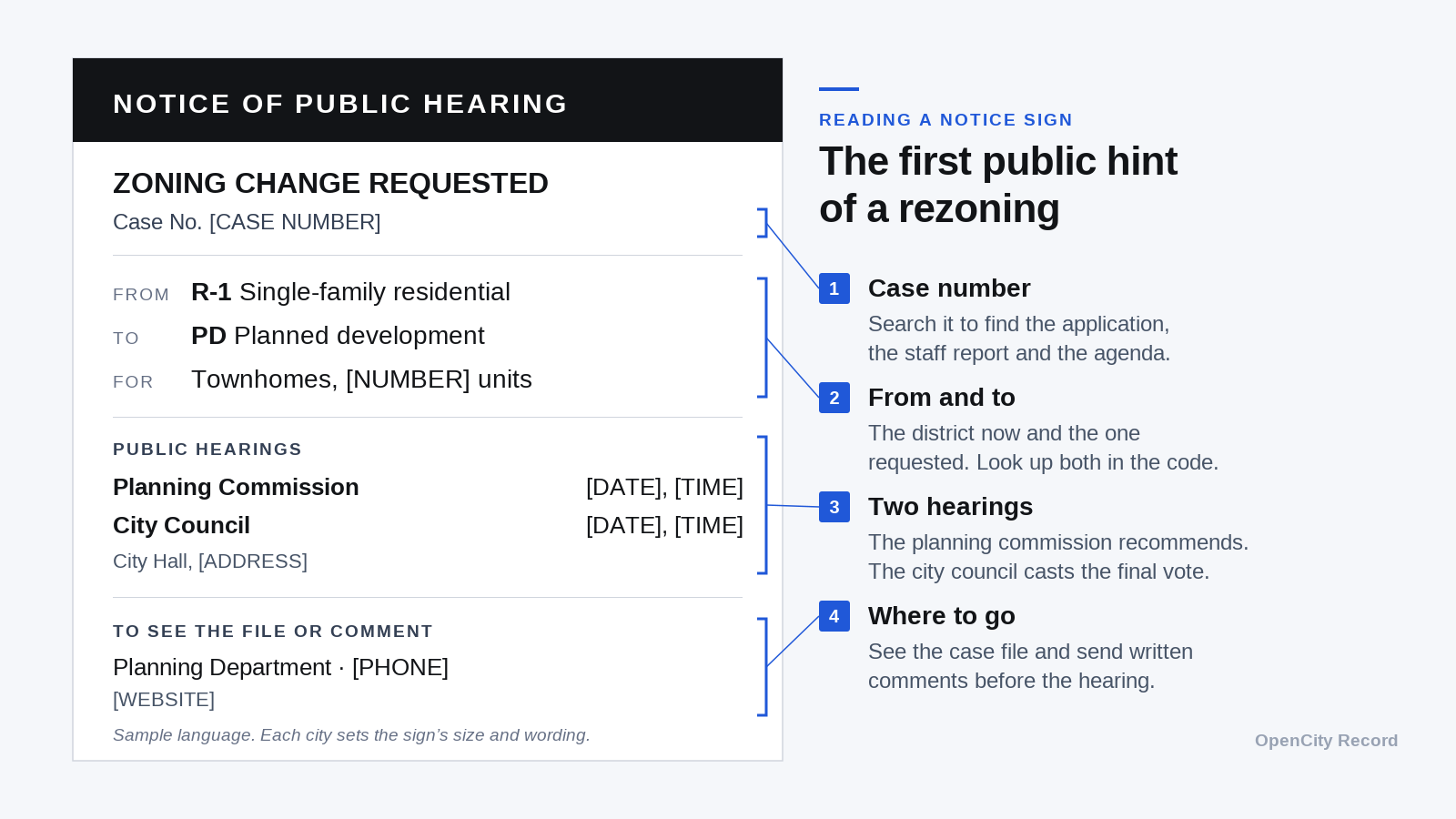
A notice sign on a vacant lot is often the first public hint that a rezoning is coming.
What is rezoning?
Every parcel in a zoned city sits in a district, such as single-family, commercial or industrial, and that district determines what can be built there. Rezoning, also called a zoning map amendment, moves land from one district to another. Because it changes the law that applies to the property, the city council makes the final decision, usually after a recommendation from the appointed planning commission.
Rezoning isn't the same as a variance, which relaxes one requirement for one lot because of a hardship and is usually decided by a board of adjustment. Our guide to variances vs. rezoning compares the two side by side. Rezoning is also different from a conditional or special use permit, which approves a specific use that the existing district already allows with conditions.
Most rezonings start with an owner or developer who wants to build something the current district doesn't allow. Cities also rezone large areas on their own initiative, often after updating their master plan. You'll hear "upzoning" for changes that allow more homes or taller buildings and "downzoning" for changes that allow less development.
How do you rezone a property?
The rezoning process looks similar across the country, though your city's code sets the exact steps, forms and deadlines.
- Meet with planning staff before you apply. Ask whether the request fits the future land use map in the city's master plan, because if it doesn't, you may need a plan amendment too, and that adds a second decision.
- File the application and pay the fee. Expect to submit a survey or legal description, an explanation of what you intend to build and, for a planned development, a concept or development plan. Larger projects may also require a traffic impact study.
- Staff reviews the request. Planners compare it with the zoning code, the master plan and comments from other city departments, then write a staff report with a recommendation.
- The city gives public notice. State law often requires a published notice before each hearing, and many states also require letters to nearby owners, from abutting lots out to 300 feet in the state laws compared below. Many cities also post a sign on the property.
- The planning commission holds a public hearing. Commissioners hear from the applicant, city staff and the public, then vote to recommend approval, approval with conditions or denial, or continue the case to a later meeting.
- The city council holds its own hearing and votes. Some councils vote twice, approving a zoning ordinance at a first reading and again at a final reading.
- Where state law allows, neighbors can file a protest petition that can require a supermajority council vote.
- Once the council adopts the ordinance, staff updates the official zoning map, and the owner moves on to site plans, plats and building permits.
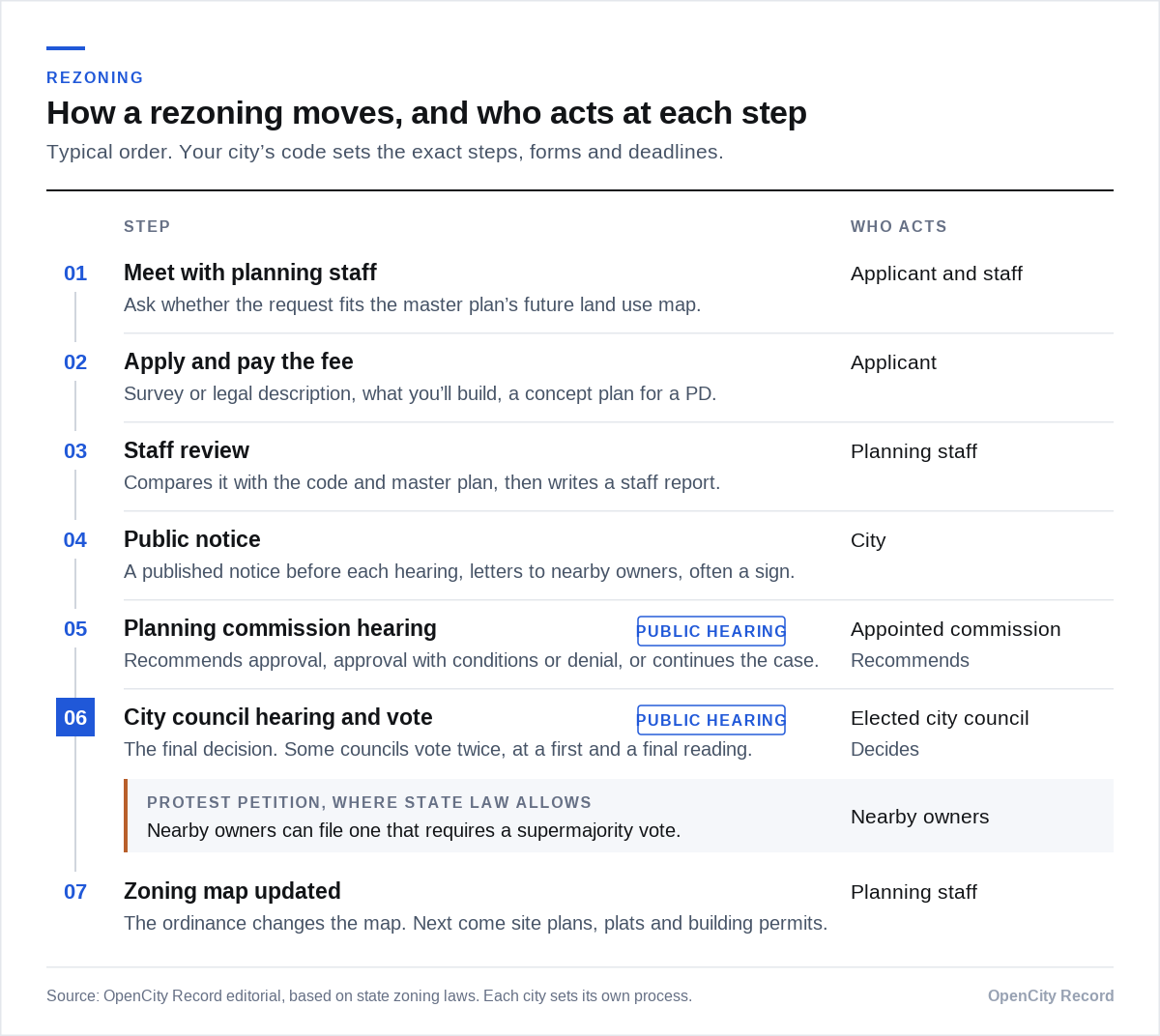
Two public hearings and one final council vote. Protest petitions can raise the bar where state law allows them.
How long does rezoning take?
Cities publish their own estimates, and they vary widely depending on staff workload, meeting calendars and whether anyone opposes the request.
| Who publishes the estimate | Typical time listed | Source |
|---|---|---|
| Franklin County, N.C. | About 60 to 90 days, with a complete application | County rezoning page |
| Phoenix | 4 to 6 months, from application to final council action | City rezoning packet, revised March 2026 |
| Tucson, Ariz. | 5 to 7 months for a standard rezoning | City rezoning process guide |
| Hagerstown, Md. | 5 to 7 months | City rezoning page |
Those estimates start at the application. OpenCity's meeting records capture the public portion, from the first planning commission hearing to the final council vote. Here's what that looked like in four rezonings in Arlington, Texas, in 2026, starting with the planning and zoning commission's Sept. 2 meeting:
| Request | First commission hearing | Commission recommended | Council final vote | Days |
|---|---|---|---|---|
| Planned development for residential estate uses plus an electric substation | Sept. 2 | Sept. 2, 8-0 | Oct. 13, 9-0 (consent agenda) | 41 |
| Planned development for limited light industrial uses | Sept. 2 | Sept. 2, 8-0 | Oct. 20, 9-0 (consent agenda) | 48 |
| Planned development for 24 single-family homes | April 29 | June 3, 5-1 | Aug. 25, 9-0 (consent agenda) | 118 |
| Planned development for nine townhomes | April 15 | June 17, 8-0 | Aug. 25, 9-0 (consent agenda) | 132 |
The two quick cases moved straight from a single commission hearing to the council, while the two slower ones were continued first. According to the meeting records, the developer of the 24 homes asked for more time after heavy neighbor opposition. The townhome case was continued twice, first so the applicant could rework the plans and address neighborhood concerns and then at the applicant's request, and it came back with nine units instead of 10. In each case the council approved a first reading, then gave final approval on its consent agenda, a single vote on routine items, as the published council minutes show. Source: OpenCity records of four rezoning cases in Arlington, Texas, April to October 2026, from planning commission meetings on April 15, April 29, June 3, June 17 and Sept. 2 and council meetings on Aug. 25, Oct. 13 and Oct. 20.
To see how long cases take where you live, find your city and follow a rezoning from its first agenda to the final vote.
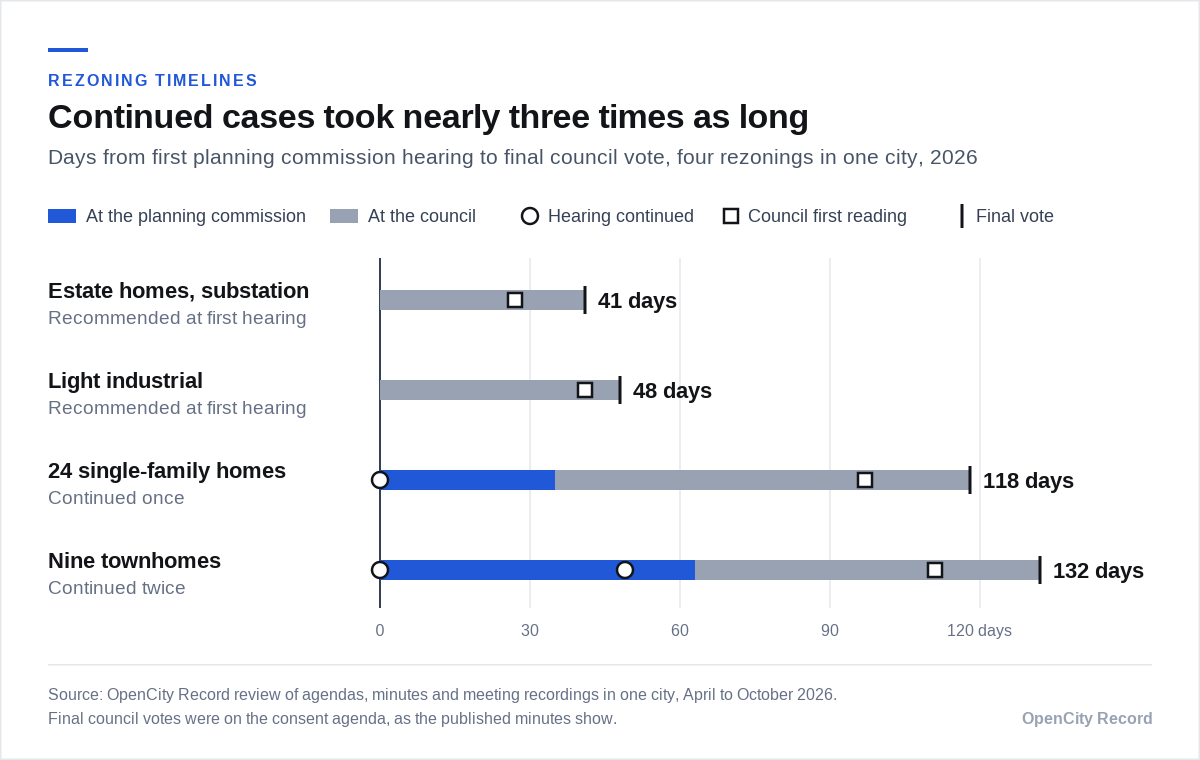
In Arlington, Texas, the two cases that drew neighborhood pushback took nearly three times as long. Source: OpenCity records of four rezoning cases, April to October 2026.
How much does it cost to rezone a property?
Many cities charge a base fee plus an amount per acre. Here's what three cities listed on their published fee schedules when we checked in November 2026:
| City | Rezoning fee | Fee for a 5-acre request |
|---|---|---|
| Bloomington, Ind. | $500 plus $25 per acre for a zoning map amendment | $625 |
| Gastonia, N.C. | $800 plus $35 per acre for a general rezoning (FY 2026) | $975 |
| Phoenix | $1,515 plus $135 per acre for rezoning to some single-family districts | $2,190 |
Fees change, and many cities charge more for planned developments or for commercial and multifamily districts. Phoenix, for example, lists a higher fee for each step up in district intensity. Check your city's current schedule before you apply.
The filing fee is often the smallest expense. A survey, a site or development plan, a traffic study, an engineer's drainage review and a land use attorney or consultant can add thousands of dollars on a contested case. Some cities also make the applicant send the neighbor notices or buy and post the sign.
How difficult is it to rezone a property?
It mostly comes down to fit. A request that matches the master plan, has staff support and doesn't add much traffic or height next to houses often passes on a single vote. A request that brings apartments or commercial buildings next to single-family homes can take months, pick up conditions along the way or fail entirely.
Two decisions from OpenCity's meeting records show how that plays out:
- Huntsville, Alabama's City Council voted 4-1 on May 28, 2026 to rezone 97 acres along a parkway from highway business to residential. The change clears the way for about 250 single-family homes as the first phase of a larger master-planned development.
- Pinal County, Arizona's Board of Supervisors voted 5-0 on Feb. 18, 2026 to deny a rezoning, a plan amendment and a planned area development overlay for an 8,122-acre solar and energy project. At the same meeting, the board approved a 3.47-acre rezoning to neighborhood commercial 5-0, with five conditions.
Can neighbors stop a rezoning?
Neighbors can speak at the planning commission hearing and again at the council hearing. How neighbors find out depends on state law and local rules. Many states require a published notice, and many also require letters to owners within a set distance.
In some states, nearby owners can also file a formal protest petition. The idea goes back to the Standard State Zoning Enabling Act, a model law the U.S. Commerce Department published in the 1920s that shaped many states' zoning laws. Under its version, owners of 20% of the land in a rezoning, or of the land next to or across the street from it, could object in writing. The change then needed a three-fourths vote of the council.
States have kept, changed or dropped that rule. Here are the common patterns for mailed notice and protests in city rezonings, from six state zoning laws we compared in November 2026:
| What state law sets | Common patterns |
|---|---|
| Who gets a mailed notice | Owners of the parcel and all abutting parcels in some states; owners, and sometimes occupants, within 300 feet in others; in others, only a published notice, with mailing left to local law |
| How early notice goes out | At least 10 to 20 days before the hearing, where the state sets a deadline |
| Who can file a protest | Owners of 20% of the land in the change, of the land within 100 to 150 feet of it, or of the frontage next to or across the street from it |
| The vote a valid protest requires | Three-fourths of the council or town board in some states; two-thirds in others |
| No protest petition | At least one state repealed its protest petition rule in 2015 |
These are state minimums. Many cities mail notices farther out or add posted signs and website notices by local ordinance, so check your state's zoning law and your city's code too.
Ask the city clerk or planning staff which rule applies before you start collecting signatures, because protest petitions have strict requirements about who can sign, when the petition is due and how the land area is measured. You can also search recent meetings for protest petitions to see how councils have handled them.
Does rezoning increase property value?
It often does, because the value of land depends heavily on what the law lets you build on it. If a lot that allowed one house can now hold four townhomes or a shop, a buyer can earn more from it and will usually pay more for it.
Research supports that. A 2019 study by urban planning researcher Yonah Freemark examined parcels that one large city upzoned in 2013 and 2015 and found that property values on those parcels rose, but it found no measurable increase in new housing construction within about five years.
The reverse is true too. Downzoning a parcel or attaching expensive conditions can lower what it's worth. Nearby homeowners sometimes worry that a rezoning next door will hurt their own property values, and whether it does depends on the project.
From the record
Three zoning changes from 2026 meeting records
- Approved 4-1
Huntsville, AL
City Council ·
Rezoned about 97 acres along Greenbrier Parkway from highway business to residential, clearing the way for about 250 homes as the first phase of a larger development.
From the meeting recording. The official minutes were not yet published.
- Denied 5-0
Pinal County, AZ
Board of Supervisors ·
Denied a rezoning of about 8,122 acres of rural land to industrial districts for a large solar and energy project, along with a plan amendment and a planned area development overlay.
The planning commission had recommended denial, 4-3.
- Approved 9-0
Arlington, TX
City Council ·
Gave final approval on the consent agenda to a planned development for nine townhomes on just under an acre, after the planning commission continued the case twice.
What happens after a rezoning is approved?
The council adopts an ordinance that changes the zoning map, and the new district regulations apply immediately or on a stated effective date. If the rezoning created a planned development, the ordinance and its development plan become the governing rules for that land, including any conditions the council added.
Approval doesn't mean construction starts right away. The owner still needs site plan approval, a subdivision plat if new lots are being created, and building permits. A rezoning that isn't built can sit unused for years, so check the ordinance for any deadlines it sets.
This is general information, not legal or tax advice.
New in your city
See what’s being built in your city
Rezonings, site plans, subdivisions and variances show up on city agendas weeks before the bulldozers do. Pick your city to see the development applications on its agendas, such as rezonings, site plans, subdivisions and variances, with the status of each. It lists the whole city; it does not search by address.
Find your cityCommon questions
How difficult is it to rezone a property?
It depends on fit. A request that matches the city's master plan and has staff support often passes without a fight. One that adds density next to single-family homes, or that neighbors organize against, can be continued, reworked or denied. Talking to planning staff before you apply is the best predictor.
How much does it cost to rezone a property?
Filing fees are set by each city. On the fee schedules we checked in November 2026, Bloomington, Ind., charged $500 plus $25 an acre, Gastonia, N.C., charged $800 plus $35 an acre, and Phoenix charged $1,515 plus $135 an acre for rezoning to some single-family districts. Surveys, site plans, traffic studies and consultants can cost more than the fee.
How long does rezoning take?
The city and county estimates we found range from about 60 to 90 days to five to seven months, and a large city lists four to six months. In four 2026 cases in one city, the public hearings alone took 41 to 132 days from start to final vote.
Does rezoning increase property value?
It can. Allowing more or more valuable uses usually raises land value, because a buyer can build more. A 2019 study of upzoning in Chicago found property values rose on affected parcels, with no measurable increase in new housing permits within five years. Downzoning can have the opposite effect.
Can neighbors stop a rezoning?
Neighbors can speak at both hearings. In states that allow protest petitions, a protest signed by enough nearby owners, often 20% of the land, raises the council vote needed to approve. Other states have dropped protest petitions.
Sources
- Standard State Zoning Enabling Act and Standard City Planning Enabling Act · American Planning Association
- Government Code Section 65091 · California Legislative Information
- Government Code Section 65854 · California Legislative Information
- A.R.S. 9-462.04: Public hearing required; protests · Arizona State Legislature
- MCL 125.3403: Zoning amendments; protest petition · Michigan Legislature
- MCL 125.3103: Notice of public hearing · Michigan Legislature
- 65 ILCS 5/11-13-14: Amendments; protests · Illinois General Assembly
- Town Law Section 265: Changes and amendments · New York State Senate
- G.S. 160D-602: Notice of hearing on proposed development regulations · North Carolina General Assembly
- Session Law 2015-160 · North Carolina General Assembly
- The Zoning Protest Petition is No More: Super-Majority Provision Repealed · UNC School of Government
- FY 2026 Planning Fees · City of Gastonia, North Carolina
- Planning and Transportation Fee Schedule · City of Bloomington, Indiana
- Rezoning and Special Permit Procedures (revised March 13, 2026) · City of Phoenix Planning and Development
- Rezoning Application and Review Process · City of Tucson
- Rezoning Process · Franklin County, North Carolina
- Rezoning · City of Hagerstown, Maryland
- Upzoning Chicago: Impacts of a Zoning Reform on Property Values and Housing Construction (Urban Affairs Review, 2019) · Oregon State Legislature (committee record copy)
- A Standard State Zoning Enabling Act (1926) · U.S. Department of Commerce, via NIST
Keep reading
- GuideVariance vs. Rezoning: Which One Do You Need?A variance bends one zoning rule for one lot. A rezoning changes the zoning itself. Learn which you need, who decides, and how neighbors can weigh in.
- GuideHow to Find the Zoning of Any PropertyHow to find zoning of a property: look up the address on the city zoning map, decode the district, read the rules and get a verification letter.
- GuideHow to Get a Zoning Variance: Steps, Hardship Test and VotesHow to get a zoning variance: the hardship test boards use, use vs. area variances, the application steps, vote rules and real board decisions.
- GuideConditional Use Permits vs. Special Use PermitsA conditional use permit and a special use permit are usually the same tool. Compare names and rules by state, the approval steps and real votes.
- GuideSetback Requirements Explained (with Diagram)Setback requirements set how close a building can sit to your property lines. See how front, side and rear setbacks are measured and what can go in them.
- GuideCan I Build an ADU? Accessory Dwelling Unit Rules ExplainedCan you build an ADU? Learn how accessory dwelling unit rules on size, parking, owner occupancy and permits work, and how to check your city's rules.