Quick answer
A certificate of occupancy, or CO, is the building department's official OK to use a building or space for a stated purpose. It's issued after the final inspection on new buildings, and often when a space changes use, like a store becoming a restaurant. Without one, the building can't legally be occupied for that use.
Key facts
- Under the International Building Code, no building may be used or occupied, and no change in its occupancy classification made, until the building official issues a certificate of occupancy.
- The certificate lists the building's use and occupancy group, construction type, occupant load and any special conditions, along with the building official's name.
- A temporary certificate lets people move in before small items are finished, and it expires on a date the building official sets.
- The building official can revoke a certificate issued in error or when the building no longer meets the code.
What is a certificate of occupancy? It's the building department's official OK to use a building, or part of one, for a stated purpose. People call it a CO. It's issued after the final inspection on a new building, and often when an existing space changes use, such as a shop becoming a restaurant. Until the certificate is issued, no one can legally move in or open for business there. It also records how the building may be used, so a later change of use usually needs a new one.
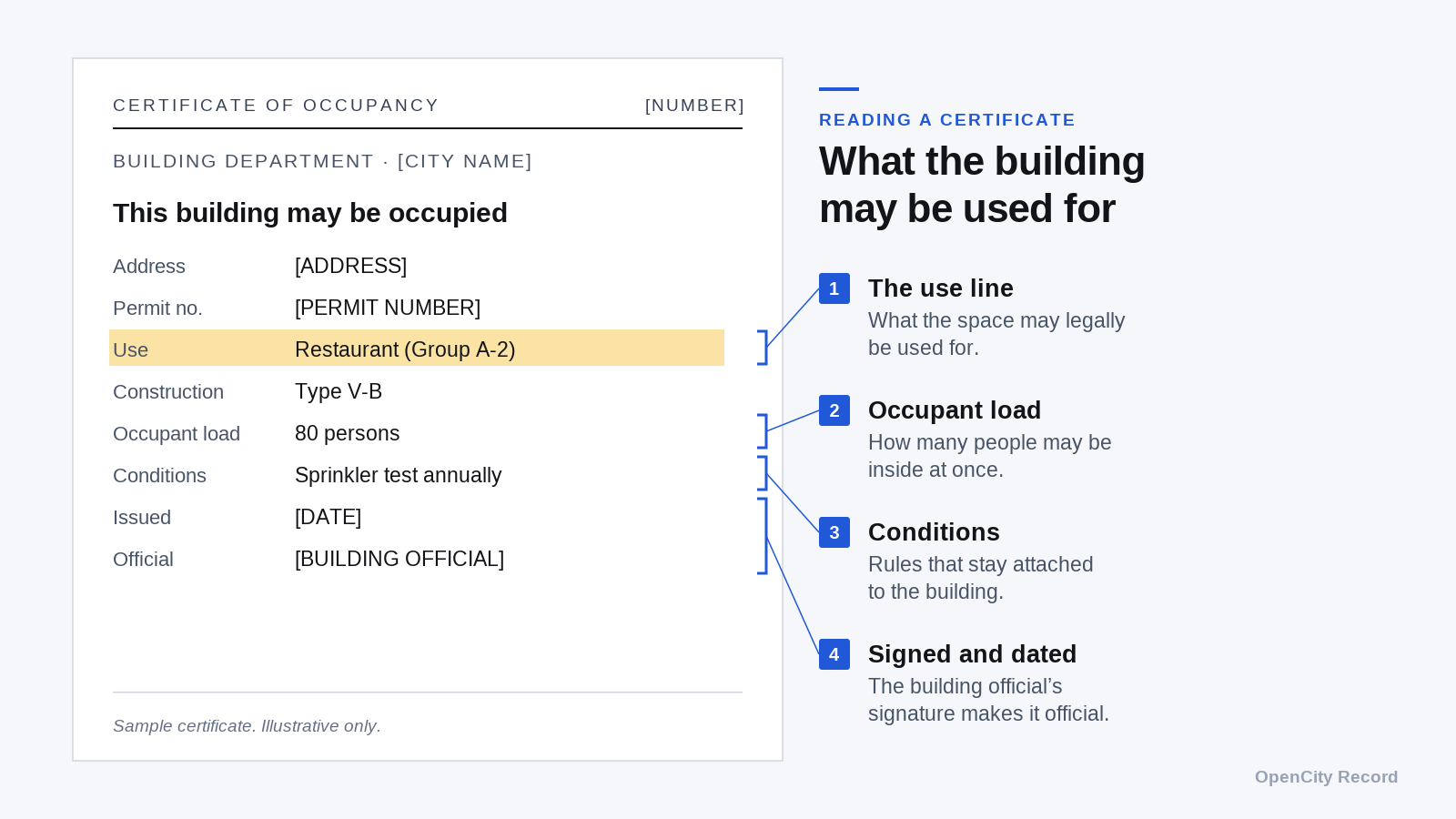 The use line is the heart of the certificate: it says what the space may be used for.
What does a certificate of occupancy say?
The International Building Code (IBC), the model code for buildings other than houses that's in use in all 50 states, lists what a certificate must include. That covers the address, the permit number, the owner, the part of the building it covers and the code edition the building was built under. It also gives the use and occupancy group, the construction type, the occupant load, whether there's a sprinkler system, any special conditions, and the building official's name.
The use and occupancy group is the key line. The IBC sorts buildings into groups, such as A for assembly, B for business, M for stores and R for homes, and each group has its own rules for exits, fire protection and accessibility. A space approved as an office (Group B) doesn't meet the rules for a restaurant with room for 80 people (Group A-2) just because the walls are the same. Under the IBC, a restaurant for fewer than 50 people is classified as Group B.
For houses, the International Residential Code has a shorter version of the same rule: a new home can't be occupied until the building official issues a certificate.
When do you need a certificate of occupancy?
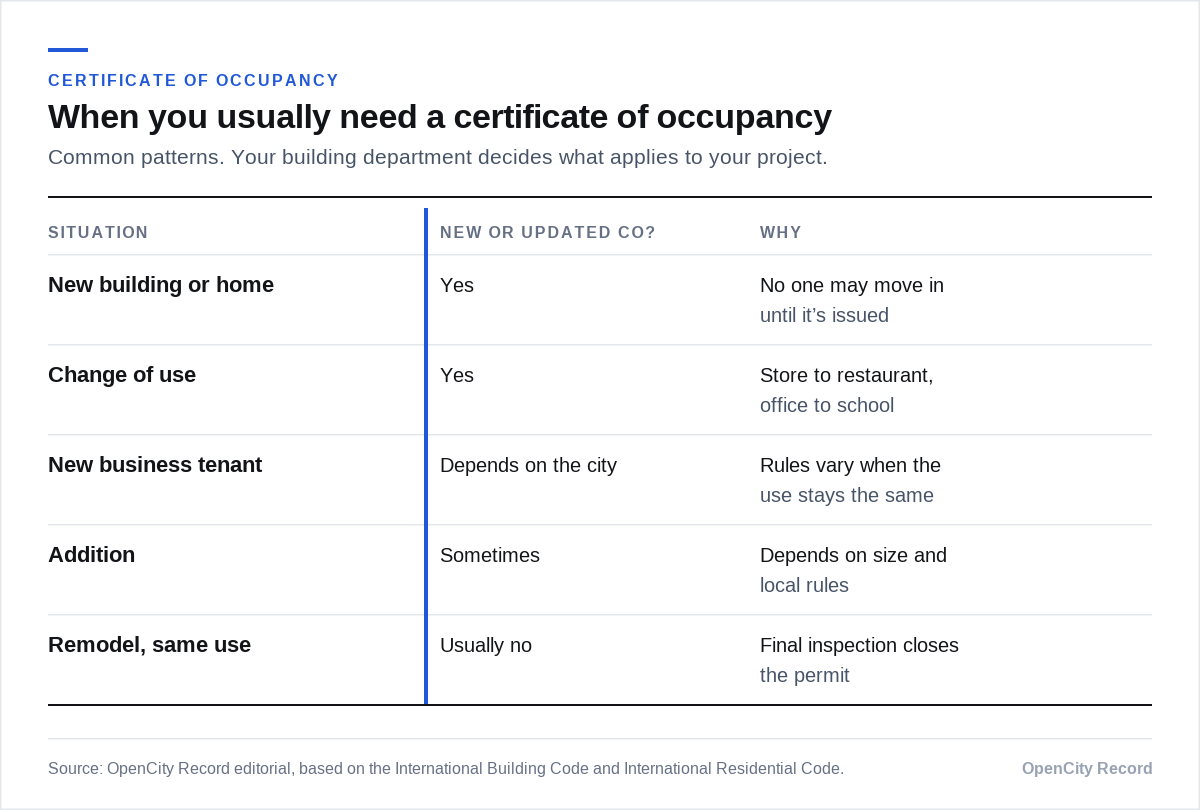 A change of use can need a new certificate even when the walls stay the same.
The IBC says a building can't be used or occupied, and its occupancy classification can't change, until the building official issues a certificate. In practice that means:
- New buildings. Every new home and commercial building gets one after the final inspections.
- Change of use. Turning a store into a restaurant, a house into an office or a warehouse into a gym usually changes the occupancy group, which needs a new certificate and may require upgrades like more exits or a sprinkler system.
- New tenants. Rules vary when a new business moves into a space used the same way. Philadelphia, for example, doesn't require a new certificate when only the tenant changes. Ask your building department.
- Additions. Ask whether your city updates the certificate after an addition.
A remodel that doesn't change the use usually ends with a final inspection that closes the permit, not a new certificate.
What is a temporary certificate of occupancy?
A temporary certificate lets people use all or part of a building before every item is done, as long as what's left doesn't affect safety. The IBC lets the building official set the time limit, and the owner has to finish the work and get the final certificate before then. In New York City, for example, a temporary certificate typically expires 90 days after it's issued, can be renewed, and costs $130.
At the Mecklenburg County, North Carolina Board of Commissioners meeting on Sept. 15, 2026, county code enforcement staff walked through how this works: after the final inspection, a temporary certificate lets occupants begin moving in, and the final certificate follows once small remaining items are fixed. In Mecklenburg County, staff also said the county won't issue the certificate or a temporary one until a code violation is fixed.
How do local governments use the certificate of occupancy?
Because it's the last approval before a building opens, councils and planning boards can tie conditions to it. A use permit may even start its review clock on the date of the certificate.
That's what happened in Clark County, Nevada. On Oct. 20, 2026, the county Planning Commission approved a use permit for a place of worship with a one-year review measured from the date the certificate of occupancy is issued, rather than from the approval date, along with a decorative block wall on one side.
Cities also write their own certificate rules. On Sept. 21, 2026, the Laredo, Texas City Council voted 8-0 to create conditional and amnesty certificates of occupancy, with a $200 fee, according to the meeting recording. To find similar votes in your area, search recent meetings for certificate of occupancy.
What if a building doesn't have a certificate of occupancy?
If a space is being used without the right certificate, the model code lets the building official prevent its use, and the owner can face penalties set by local law. The building official can also revoke a certificate that was issued in error or for a building that no longer meets the code. For a buyer, a missing or outdated certificate can mean the current use isn't legal, which is worth sorting out before you close. Ask the building department for the property's permit and certificate history, as our guide on how to look up permits on a property explains. To see how your council has handled these rules, find your city.
This is general information, not legal advice. Check your city's code and your state's law.
New in your city
See what’s being built in your city
Rezonings, site plans, subdivisions and variances show up on city agendas weeks before the bulldozers do. Pick your city to see the development applications on its agendas, such as rezonings, site plans, subdivisions and variances, with the status of each. It lists the whole city; it does not search by address.
Find your cityCommon questions
Do you need a certificate of occupancy to sell a house?
For an existing home, it depends on your city, so ask the building department before you list. For a new home, the builder needs a certificate of occupancy before anyone moves in.
What is a temporary certificate of occupancy?
It lets people use all or part of a building before every item is finished, as long as the building is safe. It expires on a date the building official sets, and the owner must finish the work and get the final certificate before then.
Does a new business need a certificate of occupancy?
It depends. A change of occupancy, like retail to restaurant, needs a new certificate under the model code and may trigger building upgrades. For a new tenant with the same use, rules vary. Philadelphia, for example, doesn't require a new certificate when only the tenant changes. Ask your building department.
How long does it take to get a certificate of occupancy?
It's issued after the final inspections pass. The real timeline is the construction and inspections that come first, so ask your building department what sign-offs it needs before it issues the certificate.
Can a certificate of occupancy be revoked?
Yes. The building official can revoke one that was issued in error, based on wrong information, or for a building that no longer meets the code, such as one with unsafe conditions or an unapproved use.
Sources
- 2024 International Building Code, Chapter 1: Scope and Administration · International Code Council
- 2024 International Residential Code, Chapter 1: Scope and Administration · International Code Council
- Temporary Certificate of Occupancy · NYC Department of Buildings
- 2024 International Building Code, Chapter 3: Occupancy Classification and Use · International Code Council
- Get a Certificate of Occupancy · City of Philadelphia
- Mecklenburg County Board of Commissioners, Sept. 15, 2026 · OpenCity Record
Keep reading
- GuideHow to Get a Building Permit, Step by StepHow to get a building permit: check the rules, prepare plans, apply, get through plan review, pass inspections and close it, with a document checklist.
- GuideUnpermitted Work: Risks, Buying a House With It and How to Legalize ItWhat unpermitted work can cost you in a sale, an appraisal or a code case, what buyers should check, and how to legalize it with an after-the-fact permit.
- GuideConditional Use Permits vs. Special Use PermitsA conditional use permit and a special use permit are usually the same tool. Compare names and rules by state, the approval steps and real votes.
- GuideHow to Look Up Permits on a PropertyHow to look up permits on a property: search the right city or county portal by address, read each status and request older records that aren't online.
- GuideDo I Need a Building Permit? A Project-by-Project GuideDo I need a permit for a fence, shed, deck, roof or water heater? See the usual rule for 13 home projects, the 2024 IRC limits and how to check your city.
- GuideDo I Need a Permit for a Deck?Many decks need a permit. See the four tests a deck must pass to skip one under the model code, what inspectors check and how setbacks still apply.