Quick answer
R1 zoning is a residential district that usually allows one detached house per lot, sometimes on the largest lots in the city. It sets a minimum lot size, setbacks and a height limit, and it lists a few other uses, like home businesses or churches, that may need a permit. The exact rules come from your city's code.
Key facts
- R-1 is a label, not a national standard. Each city's code sets its own lot size, setbacks, height limit and use list for its R-1 district.
- Some codes treat R-1 as the least intense residential district, with higher numbers such as R-2 and R-3 allowing more homes per acre.
- Some places use other names for the same idea, such as RS2 or R-75, where the number is often tied to lot size.
- Some states, such as Oregon and Washington, now require many cities to allow accessory dwelling units or more housing types on single-family lots, so check your state's law.
- In 2026, Denver's council turned down a single-family lot split on a 5-6 vote, while a Milwaukee committee backed rezoning single-family land for senior apartments 5-0.
R1 zoning, often written R-1, is a residential zoning district that usually allows one detached house on each lot. In some cities it's the most restrictive residential district, with the biggest minimum lot size and the fewest allowed uses. The district also sets building rules, like how far a house must sit from the street and how tall it can be. Every city writes its own R-1 rules, so the details on your street come from your local code, not from the label.
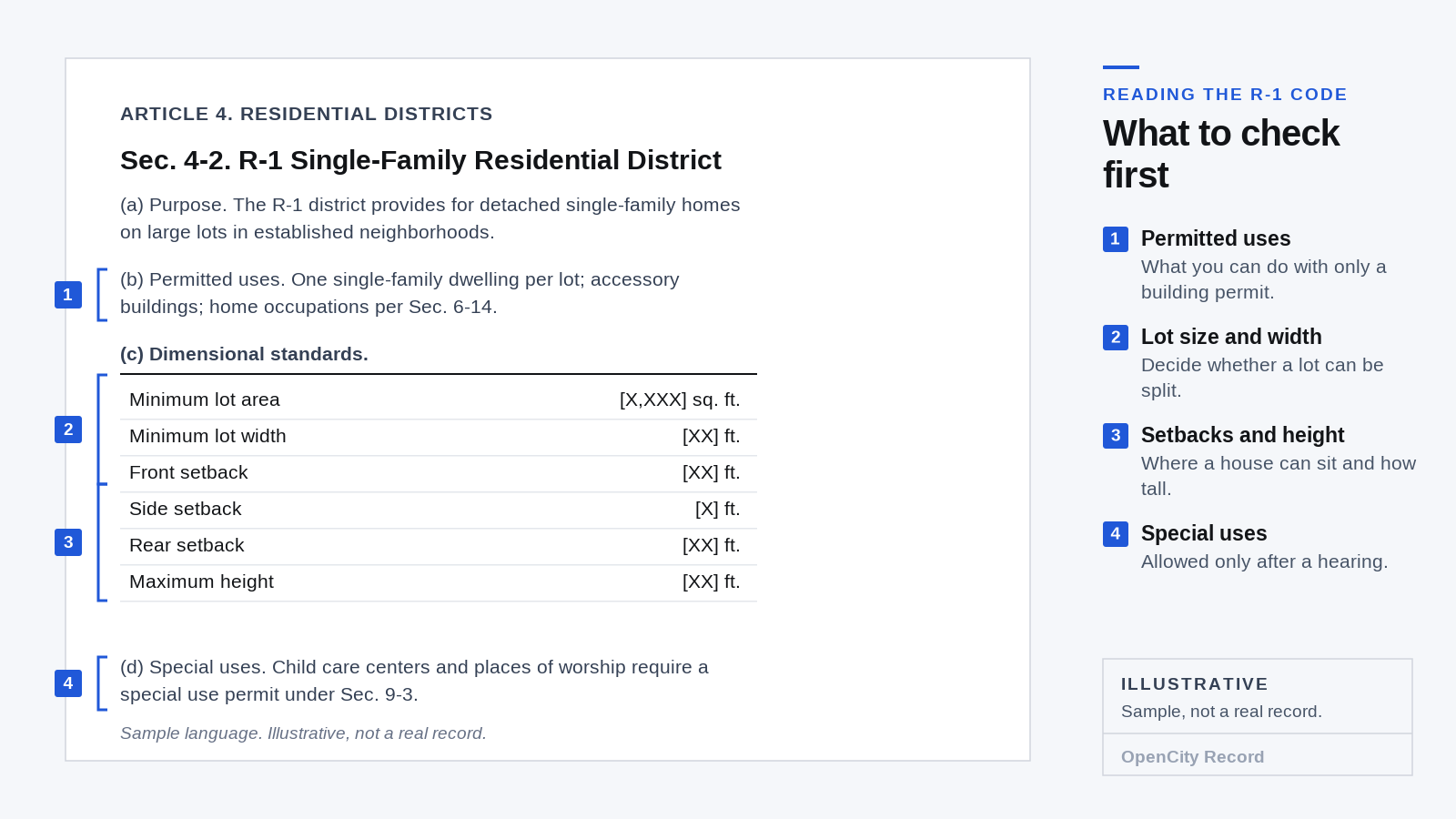
The R-1 page in your city's code answers most questions about what you can build on your lot.
What does R1 zoning mean?
The R stands for residential and the 1 usually marks the lowest intensity in the city's series of residential districts. If your city also has R-2 and R-3, those usually allow more homes per acre, such as duplexes, townhomes or apartments. Our guide to zoning classifications explains how those letters and numbers work.
Not every city uses the R-1 name. Milwaukee calls a single-family district RS2, and DeKalb County, Ga., uses names like R-75 and R-60, where a smaller number allows smaller lots. In March 2026, DeKalb County's commissioners voted to rezone two lots from R-75 to R-60 for a 29-unit cottage home development. Whatever the name, the district section of the code tells you what the label means.
What can you build in an R-1 district?
Most R-1 districts sort uses into three groups. The exact list is in your code's permitted use table, but this is the usual pattern.
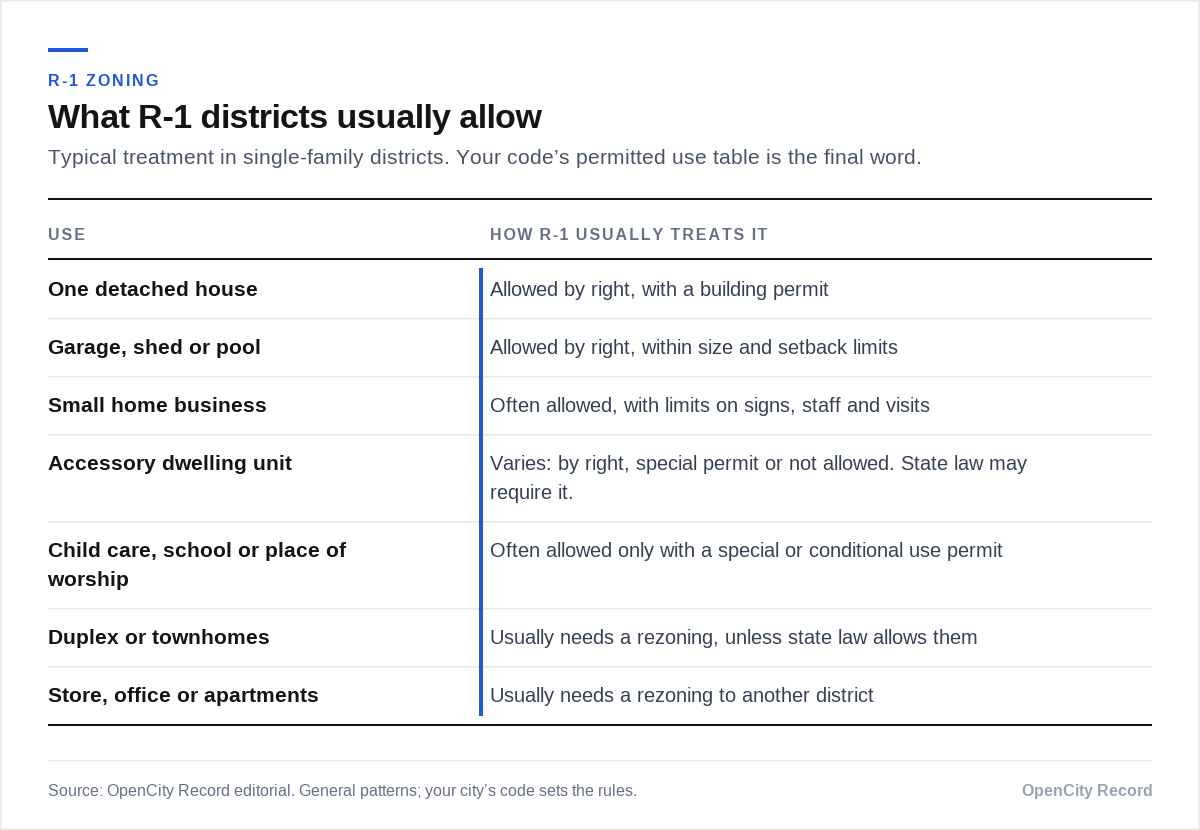
The same use can land in a different column in your city, so check your code's use table.
Allowed uses are things you can do with only a building permit. That's usually a single-family house, a detached garage or shed within size limits and a small home business.
Uses that need a hearing are things the code allows only after a review. In some cities that list includes accessory dwelling units, child care, schools and places of worship. A planning commission or council can add conditions before it says yes.
Then there's everything else. A store, an office building or an apartment complex usually needs a rezoning to a different district, which is a much bigger process. Our guide to how rezoning works covers it.
What standards does R-1 set?
Every R-1 district has a set of numbers that control the size and placement of a house. Look for these in your district's section of the code:
- Minimum lot size and lot width, which decide whether a lot can be split.
- Front, side and rear setback requirements, which set how close a building can sit to each property line.
- Maximum height, in feet or stories.
- Maximum lot coverage, the share of the lot that buildings or paving can cover.
- Parking, such as two spaces per house.
These numbers vary a lot. A rural-edge R-1 district may require lots of an acre or more, while an older inner-city R-1 district may allow much smaller lots. That's why you can't compare two cities by their labels.
Is R-1 zoning changing?
In many places, yes. Single-family zoning has become one of the most debated topics in local government. Supporters say it protects neighborhood character, keeps traffic and noise down and gives buyers a clear idea of what will be built next door. Critics say it limits the supply of homes, raises prices and keeps people out of neighborhoods near jobs and schools.
Some states have stepped in. Oregon and Washington, for example, require many of their cities to allow accessory dwelling units on single-family lots, and both also require many cities to allow duplexes or other small multi-unit homes on residential lots. Other states leave it to each city. Check your state's law and your city's latest code, since rules adopted in the last few years may not show up in older summaries.
At the local level, the fight is usually case by case, and it can go either way:
- Denver's City Council rejected a lot-split rezoning on Feb. 17, 2026. A homeowner wanted to split a 9,000-square-foot lot to build a second house. The rezoning failed 5-6 after city planners recommended denial.
- A Milwaukee council committee voted 5-0 on May 5, 2026 to recommend rezoning RS2 single-family land to RM3 multi-family for about 100 senior apartments next to a church.
- The Las Vegas Planning Commission voted 6-0 on Aug. 11, 2026 to recommend rezoning a 0.59-acre R-1 lot to professional office.
- The Fredericksburg, Texas, City Council denied a request on Aug. 18, 2026 to rezone three R1 single-family lots to neighborhood commercial. The vote was 3-1, with one member abstaining, and it followed the planning commission's recommendation to deny, according to the published minutes.
How do you change R-1 zoning on a property?
You have three paths, from smallest to largest:
- Ask for a variance if one rule, like a setback, doesn't fit your lot.
- Ask for a special or conditional use permit if your code lists the use as possible with approval.
- Ask for a rezoning if you want a use the district doesn't allow at all.
Each path has a public hearing. To see how your city handles these cases, search recent meetings for single-family rezoning or find your city and read its latest planning commission agenda.
This is general information, not legal advice.
New in your city
See what’s being built in your city
Rezonings, site plans, subdivisions and variances show up on city agendas weeks before the bulldozers do. Pick your city to see the development applications on its agendas, such as rezonings, site plans, subdivisions and variances, with the status of each. It lists the whole city; it does not search by address.
Find your cityCommon questions
What does R1 zoning mean?
R1, or R-1, is usually a single-family residential district. In most codes it allows one detached house per lot and sets a minimum lot size, setbacks and a height limit. Your city's code defines the exact rules.
Can I build a duplex on R1 land?
Usually not by right. Most R-1 districts allow one home per lot, and a duplex needs a rezoning or a different district. Some states now require cities to allow more housing types on single-family lots, so check your state's law and your city's latest code.
Can I run a business from home in R1 zoning?
Often yes, as a home occupation with limits on signs, employees, customer visits and noise. Some cities need a permit for it. Read the home occupation section of your code before you start.
What is the difference between R1 and R2 zoning?
In many codes R-2 allows more homes than R-1, such as two-family homes or smaller lots. The difference varies by city, so compare the two district sections side by side in your code.
Can I build an ADU on an R1 lot?
It depends on your city and state. Some cities allow one accessory dwelling unit by right, others need a special permit, and some don't allow them. Some states, such as Oregon and Washington, now require many cities to allow at least one ADU on single-family lots in their urban areas.
Sources
- Zoning · Legal Information Institute, Cornell Law School
- Village of Euclid v. Ambler Realty Co., 272 U.S. 365 (1926) · Legal Information Institute, Cornell Law School
- Development Regulations and Zoning · MRSC
- Accessory Dwelling Units · MRSC
- National Zoning Atlas · National Zoning Atlas
- ORS 197A.420 and 197A.425: Duplexes, middle housing and accessory dwelling units · Oregon State Legislature
- RCW 36.70A.635: Middle housing · Washington State Legislature
- RCW 36.70A.681: Accessory dwelling units · Washington State Legislature
Keep reading
- GuideZoning Classifications Explained: What R-1, C-2 and M-1 MeanZoning classifications explained: what codes like R-1, C-2 and M-1 mean, why district names differ from city to city and how to read your zoning map.
- GuideSetback Requirements Explained (with Diagram)Setback requirements set how close a building can sit to your property lines. See how front, side and rear setbacks are measured and what can go in them.
- GuideCan I Build an ADU? Accessory Dwelling Unit Rules ExplainedCan you build an ADU? Learn how accessory dwelling unit rules on size, parking, owner occupancy and permits work, and how to check your city's rules.
- GuideHow Rezoning Works: Process, Timeline and CostsRezoning explained: each step from application to council vote, how long it takes, what cities charge, and how neighbors can weigh in or protest.
- GuideHow to Find the Zoning of Any PropertyHow to find zoning of a property: look up the address on the city zoning map, decode the district, read the rules and get a verification letter.
- GuideConditional Use Permits vs. Special Use PermitsA conditional use permit and a special use permit are usually the same tool. Compare names and rules by state, the approval steps and real votes.